
Environment – Supreme Court Flags Illegal Sand Mining Threat to Chambal Wildlife
Environment – The Supreme Court has raised serious concerns over ongoing illegal sand extraction in the National Chambal Gharial Sanctuary, describing the situation as an environmental crisis that could undermine long-standing conservation efforts.
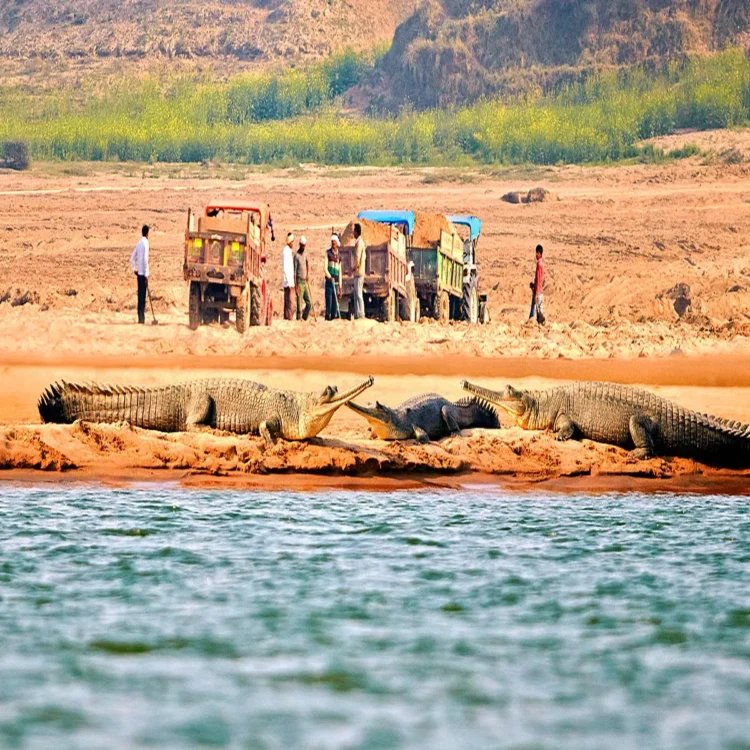
The court’s observation came during proceedings on Friday, where it examined the scale and impact of unchecked mining activities in the riverbed. The judges emphasized that such practices are not only unlawful but also deeply harmful to fragile aquatic ecosystems that depend on undisturbed river conditions.
Court Expresses Concern Over Conservation Risks
A Bench comprising Justices Vikram Nath and Sandeep Mehta sharply criticized the governments of Rajasthan, Madhya Pradesh, and Uttar Pradesh for their inability to effectively control illegal mining operations. The sanctuary, which spans across these three states, has been witnessing persistent violations despite existing regulations.
The court noted that the unchecked removal of sand from riverbeds disrupts natural habitats, alters water flow, and threatens species that rely on specific ecological conditions. Among the most affected is the gharial, an endangered crocodilian species whose survival depends heavily on clean and stable river environments.
Justice Mehta, while delivering the order, pointed out that the situation has escalated to a level where it endangers the very conservation initiatives that state authorities are duty-bound to protect and promote.
Directions for Surveillance and Monitoring
In an effort to curb these activities, the court has ordered the installation of high-resolution CCTV cameras equipped with Wi-Fi connectivity along routes commonly used for illegal mining transportation. These surveillance systems are expected to provide real-time monitoring of suspicious movements.
The responsibility for overseeing these live feeds has been assigned to senior district-level officials, including the Superintendent of Police or Senior Superintendent of Police, along with the Divisional Forest Officer. The court has made it clear that continuous monitoring must be ensured through designated personnel.
This move is aimed at strengthening enforcement mechanisms and preventing offenders from operating unnoticed in remote or poorly monitored areas.
Strict Action Against Violators
The Bench has also directed authorities to take immediate legal action whenever illegal mining is detected. This includes seizing vehicles and machinery involved in the activity and initiating prosecution against those responsible.
The court stressed that enforcement agencies must act promptly and decisively, leaving no room for delays or administrative lapses. It underscored that accountability at all levels is essential to tackle the issue effectively.
Case Initiated After Media Reports
The matter is being heard as part of a suo motu case initiated by the court after it took note of media reports highlighting the growing threat posed by illegal sand mining. The case, focused on the impact of such activities on endangered aquatic species, reflects the judiciary’s proactive approach in addressing environmental concerns.
The next hearing in the case has been scheduled for May 11, during which the court is expected to review the progress made in implementing its directions.
Ecological Importance of Chambal Sanctuary
The National Chambal Gharial Sanctuary, covering an area of approximately 5,400 square kilometers, is one of India’s most important protected river ecosystems. It stretches across Rajasthan, Madhya Pradesh, and Uttar Pradesh along the Chambal River.
The sanctuary serves as a critical habitat for several endangered species, including the gharial, the red-crowned roof turtle, and the Ganges river dolphin. These species depend on clean water, minimal human disturbance, and stable riverbanks for survival.
Environmental experts have long warned that continued illegal mining could lead to irreversible damage, not only affecting wildlife but also disrupting the broader ecological balance of the region.
Need for Coordinated Efforts
The court’s intervention highlights the urgent need for coordinated action among state authorities, enforcement agencies, and environmental bodies. Without strict monitoring and sustained enforcement, experts believe that conservation efforts could face significant setbacks.
By mandating surveillance and accountability, the judiciary has signaled that environmental protection must remain a priority, especially in ecologically sensitive zones like the Chambal sanctuary.