
Ethanol Blending – Supreme Court Reviews Centre’s Stand on Petrol Mixing Policy
Ethanol Blending – The Union government informed the Supreme Court on Tuesday that its plan to achieve 20% ethanol blending in petrol remains under evaluation, adding that a clearer assessment of the programme’s overall impact is expected by next year.
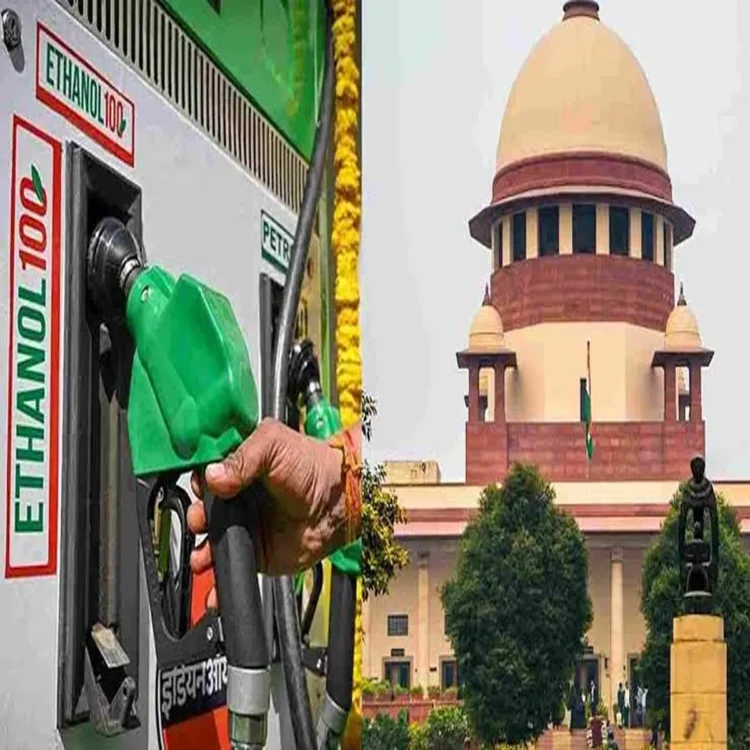
Supreme Court Grants Interim Relief
The matter came before the Supreme Court after a challenge filed by Bharat Petroleum Corporation Limited (BPCL) against a Karnataka High Court order. The High Court had directed Oil Marketing Companies (OMCs) to reconsider the allocation and increased distribution of ethanol for the 2025-26 supply cycle. While hearing the appeal, the apex court ordered that the existing situation should remain unchanged until further proceedings.
A Bench comprising Justices M.M. Sundresh and Sheel Nagu issued notices to dedicated ethanol manufacturing units that had earlier secured favourable directions from the Karnataka High Court. The Supreme Court instructed all parties to maintain the status quo until the next date of hearing, providing temporary relief to the OMCs.
Centre Warns Against Policy Disruption
Representing BPCL, Attorney General R. Venkataramani argued that implementing the High Court’s directions at this stage could interfere with the Centre’s nationwide ethanol blending strategy. He submitted that the government’s ethanol programme is still evolving and that its long-term outcomes cannot yet be fully measured.
According to the Centre, altering ethanol allocations for one producer could have wider consequences for the national distribution framework. Officials maintained that the policy is being implemented across the country with broader energy and fuel objectives in mind, making consistency in allocation an important consideration.
Dispute Over Ethanol Procurement
The legal dispute began after VINP Distilleries and Sugars, a Dedicated Ethanol Plant (DEP), approached the Karnataka High Court. The company had entered into a long-term agreement to exclusively supply ethanol to BPCL, Hindustan Petroleum Corporation Limited (HPCL), and Indian Oil Corporation Limited (IOCL).
However, in 2025, the OMCs expanded ethanol procurement by permitting purchases from non-dedicated ethanol producers as well. Following the revised procurement process and fresh tenders, VINP received an allocation of only 1.44 crore litres despite submitting a bid for 9.26 crore litres. The company challenged the allocation, arguing that it was inconsistent with the existing contractual arrangement.
Government Raises Concern Over Wider Litigation
The Centre informed the Supreme Court that the allocation process for the 2025 ethanol supply season had already been completed by October 2025. It cautioned that increasing the allocation for a single supplier could prompt similar claims from other ethanol producers seeking equal treatment.
Government representatives further argued that such a development could trigger multiple legal disputes, creating uncertainty in the implementation of the national ethanol blending programme. The Centre urged the court to consider the broader implications for fuel policy and procurement before any modification to the existing allocation framework is made.
The Supreme Court will continue hearing the matter at a later date, with the interim order remaining in force until then.