
Elections – Yogi Adityanath Targets Rivals at Bengal Campaign Rally
Elections – Uttar Pradesh Chief Minister Yogi Adityanath on Saturday addressed a large public gathering in Mathabhanga, located in the Cooch Behar district of West Bengal, as election campaigning gained momentum ahead of the upcoming Assembly polls. During his speech, he strongly criticised the ruling Trinamool Congress (TMC), along with the Congress and Left parties, while also presenting the governance record of the Bharatiya Janata Party (BJP) at both the Centre and in Uttar Pradesh.
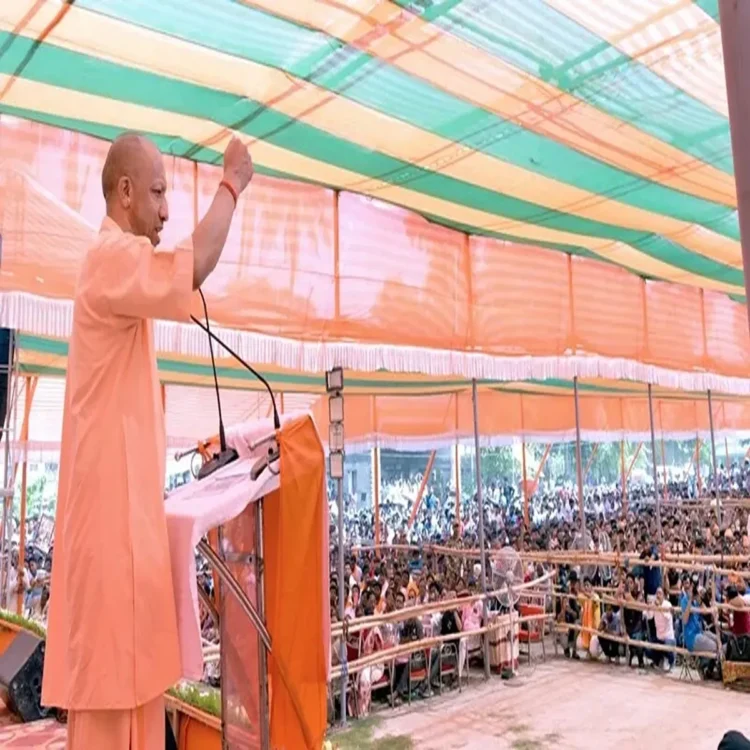
Focus on Law and Order Comparisons
Drawing a contrast between Uttar Pradesh and West Bengal, Adityanath highlighted what he described as a significant improvement in law and order under the BJP-led administration in his state. He remarked that Uttar Pradesh had previously faced similar challenges but had seen a turnaround in recent years. According to him, incidents such as riots and curfews have declined, creating a more stable environment under what he called a “double-engine government,” referring to BJP governments at both state and central levels.
Allegations on Governance in West Bengal
The Uttar Pradesh Chief Minister raised concerns about the situation in West Bengal, accusing the state government of failing to maintain internal security. He alleged that illegal infiltration from Bangladesh remained a serious issue and claimed that residents were living under fear. He also pointed to economic concerns, stating that thousands of factories had shut down over the past decade and a half, affecting employment and industrial growth.
In addition, Adityanath accused elements associated with the ruling party of misusing public funds, though these claims remain part of the ongoing political contest between parties ahead of the elections.
Religious Expression and Cultural Concerns
Adityanath also addressed issues related to religious expression, alleging restrictions in West Bengal. He claimed that certain slogans and religious practices faced opposition in the state and suggested that tensions often arise around major festivals. These remarks formed part of his broader criticism of the current administration’s approach to governance and social harmony.
Highlighting Measures in Uttar Pradesh
During his address, the Chief Minister emphasised actions taken by his government against organised crime in Uttar Pradesh. He stated that properties linked to criminal networks had been confiscated and repurposed for public welfare, including housing for economically weaker sections. According to him, such measures were aimed at strengthening governance and ensuring that benefits reach those in need.
He further noted that welfare schemes had played a role in improving living conditions, citing the construction of housing units for millions of beneficiaries as an example of targeted development efforts.
Reference to Bengal’s Historical Legacy
While criticising the present situation, Adityanath also acknowledged West Bengal’s historical and cultural importance. He referred to the contributions of prominent figures such as Swami Vivekananda, Bankim Chandra Chattopadhyay, and Netaji Subhas Chandra Bose, noting the state’s role in India’s intellectual and freedom movements. He also mentioned that Bengal had once been a major contributor to the country’s economic progress.
Criticism of Opposition in Parliament
The Chief Minister also spoke about recent developments in Parliament, alleging that opposition parties had obstructed legislative proceedings. He suggested that such actions had delayed measures intended to benefit large sections of the population, framing it as part of a broader political disagreement between the ruling party and its opponents.
Elections Seen as Crucial Turning Point
Describing the upcoming polls as a decisive moment, Adityanath urged voters to participate actively and make informed choices. He called for an end to political violence and emphasised the importance of stable governance.
The West Bengal Assembly elections are scheduled to be held in two phases on April 23 and April 29, with counting of votes set for May 4. The contest follows the 2021 elections, where the TMC secured a decisive victory with 213 seats, while the BJP emerged as the principal opposition with 77 seats. Congress and Left parties did not win any seats in that election, setting the stage for a competitive political battle this time.