
Ganesh Festival – Maharashtra Seeks to Continue Conditional Immersion of Large PoP Idols
Ganesh Festival – The Maharashtra government has defended its policy on the immersion of large plaster of Paris Ganesh idols, stating that the current arrangement should continue until a practical recycling system is fully developed. The state informed the Bombay High Court that existing relaxations are necessary for the upcoming Ganesh festival while authorities continue to improve waste management and environmentally responsible disposal methods.
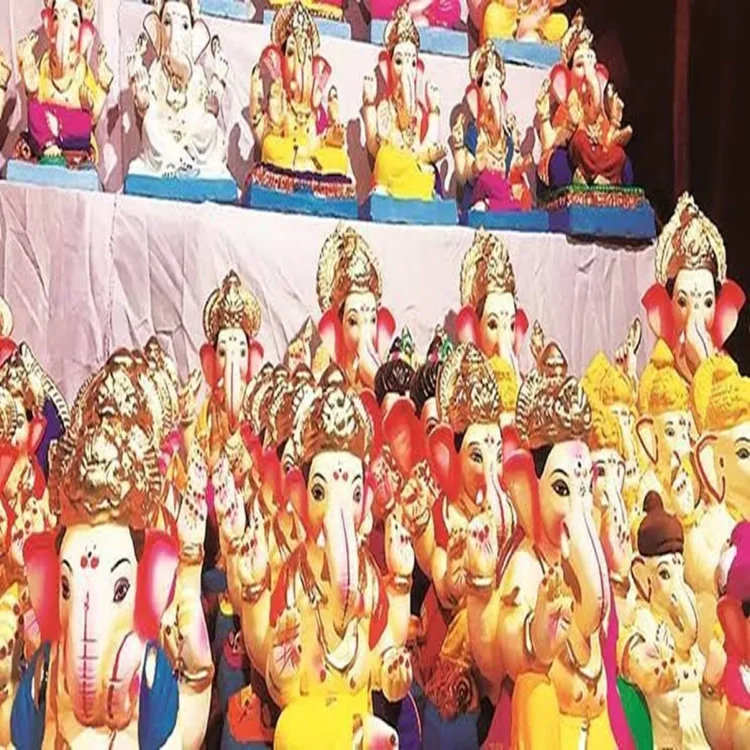
State Explains Existing Immersion Policy
During proceedings before the Bombay High Court, the Maharashtra government opposed a public interest litigation seeking a complete prohibition on immersing plaster of Paris (PoP) Ganesh idols taller than six feet in natural water bodies. The state argued that the Central Pollution Control Board’s 2020 guidelines are advisory in nature and do not impose a mandatory nationwide ban. If the court agrees with the government’s submissions, large public Ganesh idols will continue to be immersed in rivers, lakes, and coastal waters during this year’s celebrations under conditions outlined in the state’s 2025 guidelines.
Conditions Attached to Large Idol Immersion
The guidelines issued by the Maharashtra government on August 1, 2025, permit the immersion of PoP Ganesh idols exceeding six feet only in areas where dedicated artificial immersion facilities are unavailable. Organisers must obtain prior approval from the relevant authorities before carrying out the immersion.
The guidelines also require strict environmental safeguards. Officials must ensure that PoP residue is collected after immersion, disposed of using scientific methods, and that the affected water body is cleaned thoroughly. According to the government, these measures are intended to reduce environmental impact while allowing traditional festival practices to continue.
Government Highlights Long-Term Environmental Plans
In an affidavit submitted to the court, Environment Department Joint Secretary Ramesh Mahale stated that Maharashtra is working on a long-term strategy focused on recycling and reusing plaster of Paris. The government said it is simultaneously promoting eco-friendly celebrations through awareness campaigns and improved waste management initiatives.
The affidavit noted that civic authorities across the state have already created alternative immersion facilities for Ganesh idols measuring up to six feet. Officials are also collecting PoP waste after immersion and studying sustainable recycling solutions. The government maintained that its objective is to strike a balance between protecting the environment and respecting long-standing cultural traditions associated with Ganeshotsav.
Petition Questions Implementation of Pollution Guidelines
The public interest litigation argues that the implementation of the CPCB’s 2020 guidelines has been inadequate and that permitting large PoP idols to be immersed in natural water bodies continues to contribute to water pollution.
Appearing for the petitioners, senior advocate Mihir Desai submitted that the revised state policy is not practical and urged the court to prohibit the immersion of PoP idols taller than six feet. These larger idols are commonly installed by Sarvajanik Ganesh mandals during the annual festival.
In response, the Maharashtra government referred to an affidavit filed by the Central Pollution Control Board on June 7, 2025. According to the state, the CPCB clarified that its 2020 guidelines regulate the process of immersion but do not prohibit the manufacture or use of plaster of Paris idols. Based on this clarification, the government argued that the PIL lacks legal merit.
Court to Continue Hearing the Matter
The Maharashtra government also informed the court that Ganeshotsav holds significant cultural importance and remains one of the state’s most celebrated public festivals. At the same time, officials reiterated their commitment to encouraging environmentally responsible practices and increasing public participation in the use of eco-friendly idols.
According to the government, awareness campaigns over recent years have contributed to a gradual reduction in the use of PoP idols, reflecting growing public acceptance of sustainable alternatives. After considering submissions from both parties, the Bombay High Court scheduled the matter for further hearing on Thursday, July 16, when detailed arguments will continue.