
Irrigation – Political row intensifies over Kaleshwaram project claims
Irrigation – The political debate around the Kaleshwaram Lift Irrigation Project has intensified, with leaders from the Bharat Rashtra Samithi (BRS) strongly rejecting recent criticism from the Union government. The controversy has brought renewed focus on the project’s cost, design, and long-term benefits.
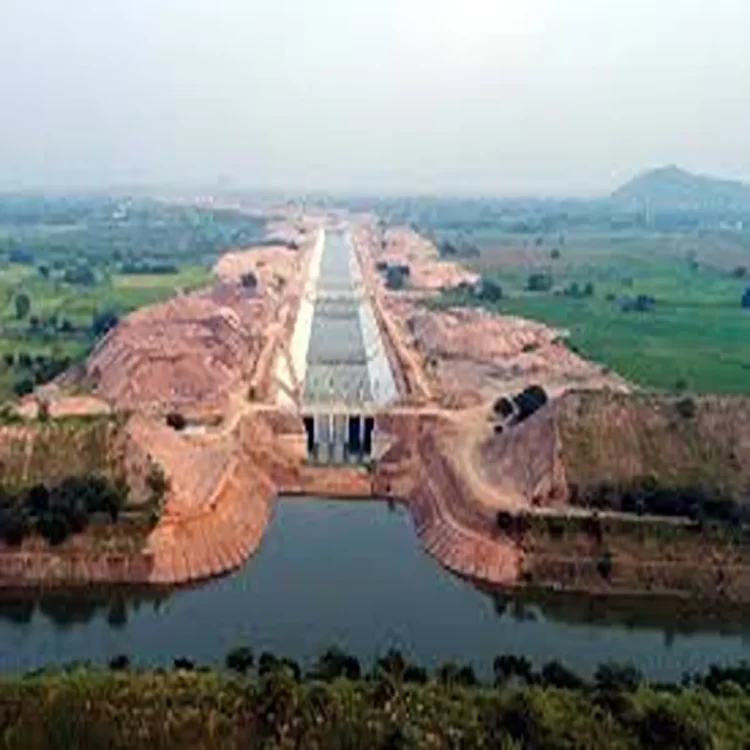
BRS defends project as key to Telangana’s growth
BRS leader Ravula Sridhar Reddy dismissed allegations made by Union Jal Shakti Minister CR Patil, stating that criticism would not alter what he described as the project’s proven impact. He maintained that the Kaleshwaram project has played a crucial role in improving irrigation capacity and supporting power generation across Telangana.
Reddy described the initiative as a transformative development, often referred to by the party as the “lifeline” of the state. According to him, the project has significantly strengthened agricultural output and ensured water availability for decades to come. He also pointed out that Telangana, since its formation, has emerged as a strong example in irrigation and energy management.
Centre raises concerns over cost and design
The Union government, however, has raised serious questions regarding the project’s execution. Speaking in the Rajya Sabha, Minister CR Patil alleged that more than ₹1 lakh crore of public funds had been wasted due to poor planning and structural shortcomings.
He specifically referred to reported issues at the Medigadda, Annaram, and Sundilla barrages, suggesting that these failures highlighted deeper flaws in the project’s design. The remarks came in response to a demand by BRS MP KR Suresh Reddy, who had urged the Centre to grant national project status to Kaleshwaram.
Claims of long-term benefits and approvals
Rejecting the Centre’s criticism, BRS leaders reiterated that the project had received all required approvals from central agencies, including the Central Water Commission, in earlier stages. They argued that the same institutions had previously acknowledged the project’s scale and importance.
Party leaders also highlighted the project’s contribution to expanding cultivable land in Telangana. According to their claims, the irrigated area has grown substantially over the past decade, benefiting farmers and improving rural livelihoods.
Ravula Sridhar Reddy further stated that the project, as the world’s largest multi-stage lift irrigation system, is designed to ensure water security for at least the next century. He also accused certain political and business interests of spreading negative narratives about Telangana for their own benefit.
Political exchanges extend beyond irrigation issue
The debate over the irrigation project has also spilled into broader political exchanges. Telangana Chief Minister A Revanth Reddy used the opportunity to challenge opposition leaders, inviting them to visit the state and assess the implementation of welfare schemes introduced by his government.
While addressing a public event related to the United Democratic Front (UDF) manifesto for the upcoming Kerala Assembly elections, he criticised both Kerala Chief Minister Pinarayi Vijayan and Prime Minister Narendra Modi. He alleged administrative failures and corruption, drawing comparisons between their governance styles.
Revanth Reddy also expressed confidence in the UDF’s prospects in Kerala, stating that a new phase of governance could emerge if the alliance comes to power. He added that he would personally demonstrate how welfare guarantees have been implemented in Telangana if leaders from Kerala visit the state.
Ongoing debate reflects larger political divide
The Kaleshwaram project remains a central issue in Telangana’s political discourse, reflecting a wider divide between the state government and the Centre. While one side emphasises its developmental impact, the other continues to question its financial and structural soundness.
As the debate continues, the project is likely to remain under scrutiny, both for its engineering scale and its political significance in shaping narratives around governance and public spending.