
AI – Modi Calls for Democratic and Ethical Future of Technology
AI – Prime Minister Narendra Modi on Thursday urged the global community to ensure that artificial intelligence remains accessible to all, unveiling India’s “MANAV Vision” as a framework to guide the technology’s growth with ethics, accountability and inclusion at its core.
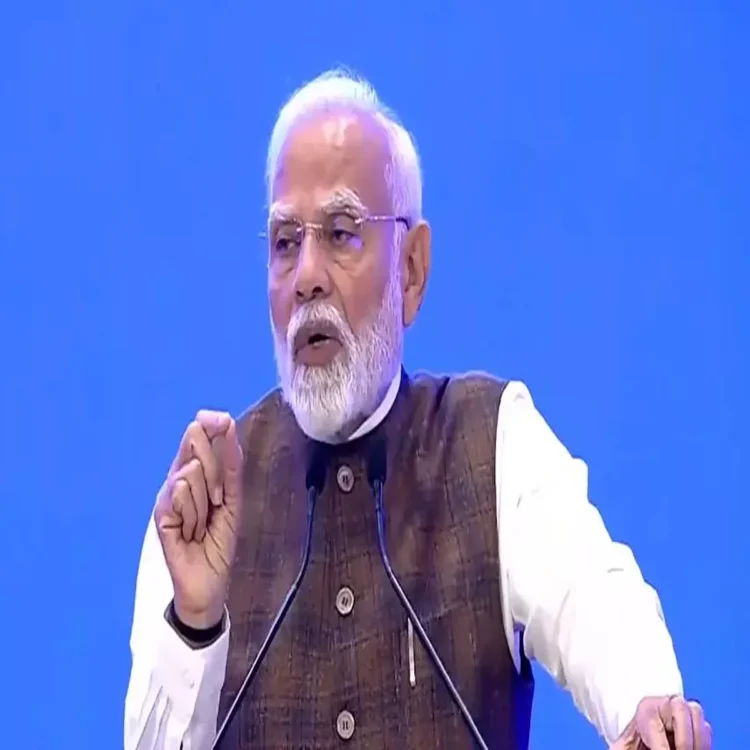
Speaking at the India AI Impact Summit in New Delhi, the Prime Minister described artificial intelligence as a defining force of the current century. He said India is not merely participating in the technological transformation but actively shaping its direction. Addressing an audience of international leaders, policymakers and industry executives, he stressed that the future of AI would depend on how responsibly nations choose to develop and deploy it.
India’s MANAV Vision for Responsible AI
At the summit, Modi introduced the MANAV Vision, outlining a structured approach to artificial intelligence governance. The term “MANAV,” meaning human, reflects what he described as a human-centric path for innovation.
He explained that the framework rests on five pillars. The first, moral and ethical systems, underscores that AI must operate within clear ethical boundaries. The second, accountable governance, calls for transparent regulations and effective oversight. National sovereignty, the third pillar, emphasizes that individuals and nations should retain rights over their data. The fourth principle, accessibility and inclusion, advocates for AI that benefits many rather than concentrating power in a few hands. Finally, validity and legitimacy highlight the importance of lawful, verifiable systems.
According to the Prime Minister, this model aims to ensure that artificial intelligence advances human welfare and contributes positively to global development, particularly in emerging economies.
A Tool for Global Good
Modi positioned AI as a shared global resource rather than a competitive asset confined within borders. He said innovation must flourish in an open environment, yet remain guided by strong human oversight. Without such balance, he cautioned, rapid advances could drift away from human priorities.
He argued that technology should be judged by its contribution to people’s well-being and happiness. In that context, democratising artificial intelligence becomes essential to prevent individuals from being reduced to mere data sources. Instead, AI should function as a means of empowerment, especially for nations in the Global South seeking equitable technological access.
India’s Growing Role in the AI Landscape
The Prime Minister noted that India possesses both the capacity to build advanced AI systems and the agility to adopt them across sectors. He suggested that the pressing question is not what artificial intelligence may achieve decades from now, but how it can be harnessed effectively today.
Highlighting public interest in the summit’s exhibition, Modi observed strong enthusiasm among young innovators and startups. He remarked that while skepticism often accompanies new technologies, the younger generation has shown a readiness to engage with AI in unprecedented ways.
Safeguards Against Misuse
While advocating expansion, Modi acknowledged potential risks linked to artificial intelligence. He warned that deepfakes and fabricated digital content could destabilize open societies if left unchecked. Such challenges, he said, reinforce the need for regulatory mechanisms that evolve alongside innovation.
He described artificial intelligence as a transformative power capable of reshaping development trajectories, much like pivotal inventions of previous centuries. However, he maintained that outcomes would depend on deliberate choices made by governments, institutions and developers.
Global Leaders Gather in New Delhi
The summit drew participation from several world leaders, including French President Emmanuel Macron, Brazilian President Luiz Inacio Lula da Silva, Sri Lankan President Anura Kumara Disanayaka, Bhutan’s Prime Minister Tshering Tobgay, Mauritian Prime Minister Navinchandra Ramgoolam, Croatian Prime Minister Andrej Plenkovic, Serbian President Aleksandar Vucic, Seychelles Vice President Sebastien Pillay, Estonian President Alar Karis, and Finnish Prime Minister Petteri Orpo.
Their presence underscored the international attention surrounding AI governance and collaboration. As discussions concluded, India’s message was clear: artificial intelligence must evolve within a framework that prioritizes transparency, inclusivity and shared progress.