
Weather – Advanced Coastal Observatory Boosts Forecast Accuracy in Vizag
Weather – A new atmospheric research facility has been established in Visakhapatnam to strengthen weather observation and improve forecasting systems along India’s eastern coastline.
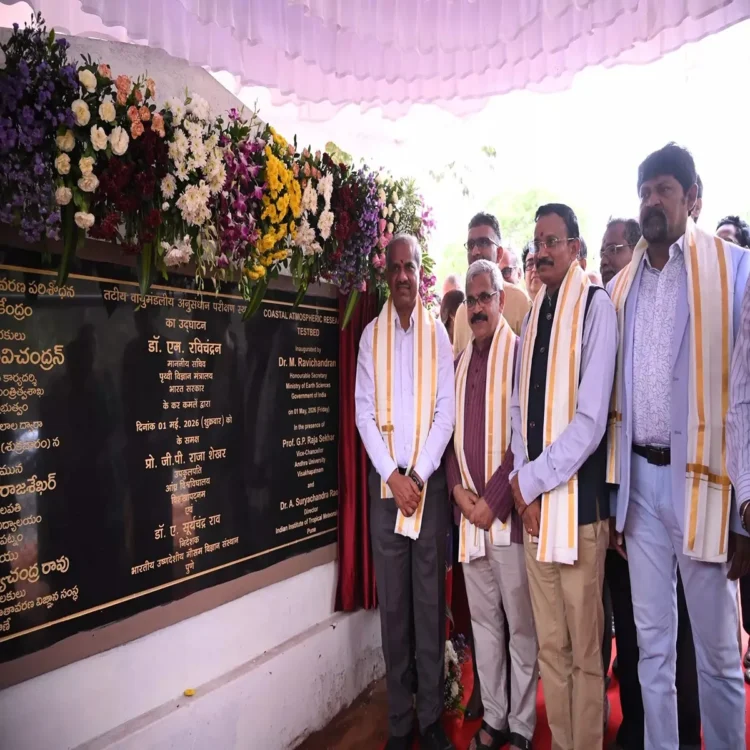
The Indian Institute of Tropical Meteorology (IITM) has launched a Coastal Atmospheric Research Testbed (C-ART) at Andhra University, marking a significant development in regional climate research. The open-field observatory was inaugurated by M Ravichandran, Secretary of the Ministry of Earth Sciences, in the presence of university and institute officials. The initiative is part of the Mission Mausam programme, which focuses on enhancing observational infrastructure and refining forecasting capabilities across the country.
Facility Designed for Continuous Atmospheric Monitoring
The newly established testbed has been set up as an advanced outdoor observatory equipped with modern scientific instruments. Andhra University has allocated space within its campus to support long-term collaborative research efforts. The facility is expected to operate continuously, gathering detailed data on atmospheric conditions.
A combination of instruments has been installed to monitor key weather parameters such as rainfall, temperature, wind speed, and humidity. Specialized devices like disdrometers will measure raindrop size and distribution, while automated weather stations will record routine meteorological data. Additionally, an eddy covariance tower has been installed to analyze exchanges of heat, moisture, and gases between the land surface and the atmosphere.
Data Integration to Strengthen Forecast Models
Scientists involved in the project highlighted that the data collected at the site will be processed and integrated into national weather prediction systems. This continuous flow of high-resolution information is expected to improve the accuracy of forecasts, particularly for coastal regions that experience rapidly changing weather conditions.
Plans are already underway to expand the facility in its next phase. Additional equipment, including wind lidars and Doppler weather radars, will be introduced. These instruments will provide deeper insights into wind movement, cloud structure, and atmospheric composition, further enhancing research capabilities.
Supporting Research on Extreme Weather Patterns
Officials emphasized that the testbed will play a crucial role in studying rainfall variability, cloud formation, and interactions between land and sea. Such research is especially important for improving early warning systems related to cyclones and other extreme weather events that frequently impact the eastern coast.
The Bay of Bengal region is known for its cyclonic activity, but the intensity and behavior of storms often vary along the coastline. By collecting detailed local data, researchers aim to better understand these variations and improve regional climate predictions.
Strategic Importance of Visakhapatnam Location
Experts noted that Visakhapatnam offers an ideal setting for such a research facility due to its coastal geography and exposure to monsoon systems and cyclonic activity. The location allows scientists to observe weather patterns influenced by both land and sea conditions.
According to academic experts at Andhra University, the observatory will help address existing gaps in weather modeling. High-resolution observations will contribute to a better understanding of cloud microphysics, rainfall distribution, and land-sea interactions. Researchers also expect the data to support studies on sea-level changes and their impact on coastal environments.
Collaboration Expected to Strengthen Scientific Research
The establishment of the C-ART facility is also seen as a boost for academic and scientific collaboration. University officials expressed confidence that the observatory will enhance research opportunities for students and faculty, while also contributing to national-level scientific initiatives.
With its advanced instrumentation and strategic location, the testbed is expected to evolve into a key platform for atmospheric research in India. By improving observational capabilities and supporting detailed studies, the facility aims to contribute to more reliable weather forecasts and better preparedness for climate-related challenges.