
Transit – Namo Bharat Corridor Proposed for Extension to Rajasthan’s Behror
Transit -The Central Government has moved a step closer to extending the Namo Bharat Regional Rapid Transit System (RRTS) corridor beyond Bawal to Behror in Rajasthan, following key approvals within the government. The proposal, which has already received clearance from the Public Investment Board (PIB), has now been forwarded to the Ministry of Finance for financial approval. If sanctioned, the extension is expected to strengthen regional connectivity and support industrial growth across southern Haryana and adjoining parts of Rajasthan.
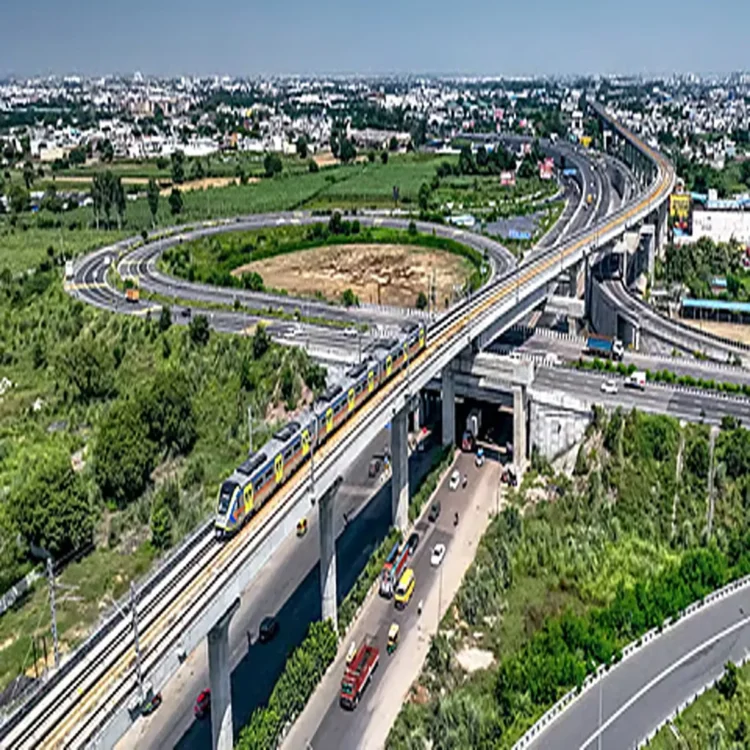
Extension Plan Includes New Stations and Higher Investment
The proposed expansion will add nearly 36 kilometers to the existing Sarai Kale Khan-Gurugram-Bawal corridor, including approximately 11 kilometers in Haryana and 25 kilometers in Rajasthan. Four additional stations are planned between Bawal and Behror, with the journey across the extended stretch expected to take around 24 minutes. The additional work is estimated to require an investment of about Rs 8,000 crore, increasing the total projected cost of the corridor to nearly Rs 43,000 crore.
Proposal Advances After Technical and Financial Review
An official memorandum issued by the Ministry of Housing and Urban Affairs on July 9 confirmed that the proposal had been updated after incorporating observations from the Department of Expenditure and other concerned ministries. The revised submission was prepared using a supplementary Detailed Project Report (DPR) submitted by the National Capital Region Transport Corporation (NCRTC) in May. Following PIB approval, the proposal was forwarded to the Finance Ministry for the next stage of financial clearance.
Corridor Restored Toward Original Alignment
Earlier this year, the Centre approved the Delhi-Bawal section after previous revisions had shortened the planned route to Dharuhera. The Haryana government had already endorsed the Delhi-Bawal alignment last year before sending it to the Union Government for consideration.
Union Minister of State and Gurugram Member of Parliament Rao Inderjit Singh stated that the latest progress reflects continuous efforts to restore the corridor closer to its original alignment. According to him, the matter was also reviewed during a meeting of the National Capital Region Planning Board (NCRPB), where the decision to extend the line to Behror was taken in view of increasing economic activity across the region.
Industrial Growth Drives Expansion Decision
The minister said the government considered several upcoming industrial and logistics developments before supporting the proposal. These include the planned logistics hub at Nangal Chaudhary, expansion of IMT Bawal, and continued development of the Khushkhera-Bhiwadi-Neemrana Investment Region.
He added that thousands of employees working in the Shahjahanpur-Neemrana-Behror industrial belt are expected to benefit from improved transportation facilities. Better connectivity is also likely to reduce travel time while supporting economic activity across Haryana and Rajasthan.
Long-Term Vision for Regional Rapid Transit
The Gurugram-Alwar corridor was initially planned as the Delhi-Gurugram-Shahjahanpur-Neemrana-Behror-Alwar route when NCRTC identified three priority Namo Bharat corridors in 2019. The other priority corridors include Delhi-Ghaziabad-Meerut and Delhi-Sonipat-Panipat.
Among these, the Delhi-Ghaziabad-Meerut corridor is already operational. Meanwhile, the Delhi-Sonipat-Panipat project has received approval from the Haryana government and is awaiting final clearance from the Centre. NCRTC has also completed preliminary drone and soil surveys for a proposed extension toward Karnal.
Future Demand Expected to Be Highest on This Route
Over the years, the Gurugram-Alwar corridor underwent several alignment revisions, with the proposed endpoint successively reduced from Behror to Dharuhera and later to Bawal. The latest proposal seeks to restore the corridor toward its earlier planned terminus.
According to projections prepared by the National Capital Region Planning Board, this corridor is expected to attract the highest daily passenger volume among the three priority RRTS routes by 2041. Estimates suggest daily ridership could reach approximately 1.51 million passengers, exceeding projected demand on both the Meerut and Panipat corridors.
Rao Inderjit Singh also noted that residents, industry bodies, and social organizations from Haryana and Rajasthan have consistently supported the extension to Behror. He said the project would improve mobility for commuters while contributing to industrial expansion and economic development across South Haryana and neighboring districts of Rajasthan.