
Politics – Amit Shah Criticises Opposition Over Women’s Reservation Debate
Politics – Union Home Minister Amit Shah launched a sharp critique of opposition parties on Friday, accusing them of resisting key reforms related to women’s reservation and electoral restructuring. Speaking during a Lok Sabha debate on three proposed bills, Shah argued that certain parties are not only opposing the reservation of seats for women in Parliament and state Assemblies but are also reluctant to support an increase in representation for Scheduled Castes (SC) and Scheduled Tribes (ST).
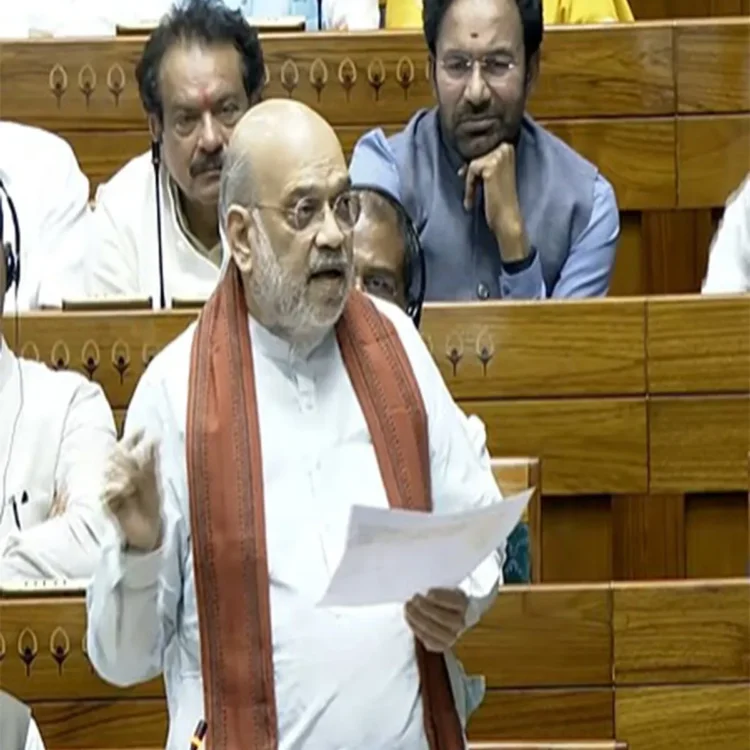
Debate Over Women’s Reservation and Delimitation
Addressing lawmakers, Shah defended the government’s legislative push, which includes amendments to the women’s reservation framework and the formation of a new delimitation commission. He alleged that past governments, particularly those led by the Congress, had stalled delimitation exercises during their tenure and continue to show resistance today.
He emphasised that delimitation is a constitutional requirement designed to adjust the number of parliamentary seats based on population changes. According to Shah, this process also ensures that SC and ST communities receive representation proportional to their population growth. He argued that opposition to delimitation effectively translates into opposition to increasing seats for these communities.
Census and Caste Enumeration Clarified
Responding to criticism from opposition leaders, Shah dismissed claims that the government was using the women’s reservation amendment as a means to delay caste-based data collection. He clarified that the Union Cabinet had already taken a decision in 2025 to include caste enumeration as part of the upcoming national census.
He stated that the government remains committed to ensuring transparency in demographic data and that linking reservation implementation with delimitation after the census is a structured and necessary step.
Offer to Expand Lok Sabha Seats
In a significant political statement, Shah said the government is open to introducing an official amendment that would increase the number of Lok Sabha seats by 50 percent across all states. However, he made this offer conditional on opposition support for the women’s reservation bill.
He warned that without adequate backing in Parliament, the proposed legislation could fail. At the same time, he noted that citizens, particularly women, are closely observing which political groups support or obstruct the reform.
Addressing Representation Imbalance
Highlighting disparities in voter representation, Shah pointed out that some constituencies currently have electorates approaching 40 to 45 lakh voters, while others have as few as 6 lakh. He argued that such imbalances undermine the principle of equal representation and must be corrected through delimitation.
The proposed exercise aims to redistribute constituencies more evenly, ensuring that elected representatives serve comparable population sizes. Shah maintained that this would strengthen democratic fairness and governance.
Southern States and Seat Share Concerns
Addressing concerns about regional representation, particularly from southern states, Shah cited current data to reassure lawmakers. He noted that the five southern states collectively hold 129 Lok Sabha seats, accounting for 23.76 percent of the total.
With a proposed 50 percent increase in seats, their combined strength would rise to 195 out of 816 seats, slightly increasing their share to 23.87 percent. Shah urged political leaders to avoid framing the issue in terms of regional divisions such as north versus south or east versus west.
Historical Context of Seat Freeze
Shah also referred to the historical decision to freeze the number of parliamentary seats, which dates back to 1971 during the tenure of former Prime Minister Indira Gandhi. He suggested that this freeze has contributed to current imbalances and needs to be revisited in light of changing population dynamics.
Concluding his remarks, Shah reiterated that the proposed reforms are intended to modernise India’s electoral system, improve representation, and ensure fairness across regions and communities.