
NEET Exam – Supreme Court Reviews Centre’s Proposal on Computer-Based Entrance Test
NEET Exam – The Supreme Court on Thursday reviewed the ongoing discussion over proposed changes to the NEET (UG) examination system after the Central government informed the court that shifting the medical entrance test from the traditional pen-and-paper format to a computer-based examination is currently being examined by all concerned authorities.
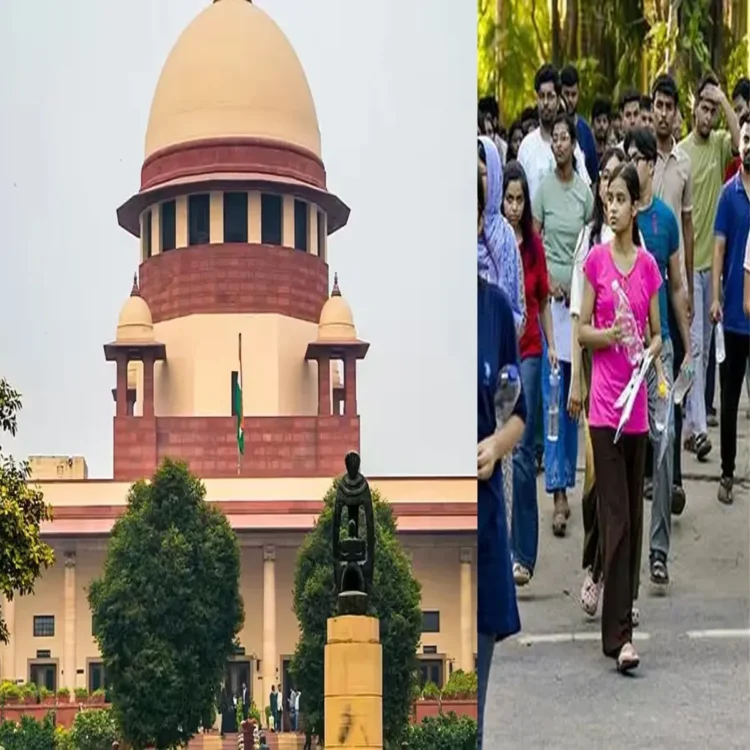
The matter came up before a bench comprising Justices PS Narasimha and Alok Aradhe. During the hearing, the court directed all petitioners, including the Federation of All India Medical Association (FAIMA), to submit their responses to the Centre’s affidavit. The bench fixed August 19 as the next date of hearing and stated that suggestions and replies from all parties would be taken into consideration before proceeding further.
Petitioners Seek Clarity on Examination Transition
Representing FAIMA, advocate Tanvi Dubey told the court that if the authorities are planning to introduce a computer-based format for NEET (UG), students should receive clarity without delay. She argued that aspirants are currently preparing according to the existing pen-and-paper pattern, and any uncertainty regarding the examination format could affect their preparation strategy. The bench acknowledged the concern and assured that every submission would be examined before any decision is considered.
Centre Says Multiple Models Are Being Evaluated
According to the affidavit submitted before the Supreme Court, the government is actively evaluating the possibility of conducting NEET (UG) through a computer-based system. The proposal includes examining both a single-stage online examination and a two-stage model similar to the Joint Entrance Examination (JEE Main and JEE Advanced). The Centre stated that consultations involving all stakeholders are underway before any final policy decision is taken.
Nandan Nilekani-Led Panel to Guide Final Decision
The Union government informed the court that no final decision has been reached so far. It said the recommendations of the High-Powered Task Force headed by Nandan Nilekani will play an important role in shaping the future examination framework. The task force consists of experts from technology, academia, intelligence, space, and public administration, enabling a comprehensive review of issues such as digital infrastructure, examination security, fairness, accessibility, and academic standards before any transition is implemented.
Government Highlights Measures to Strengthen Examination Process
The affidavit also outlined several reforms introduced after concerns over examination security. According to the Centre, the conduct of NEET has undergone extensive review to reduce the possibility of paper leaks and address weaknesses in the examination process. The government stated that these steps are intended to improve transparency, strengthen institutional systems, and ensure greater confidence in national-level entrance examinations.
The Centre further referred to legislative changes aimed at preventing examination-related offences. It informed the court that Parliament has strengthened legal provisions through the Public Examinations (Prevention of Unfair Means) Amendment Act, 2026, which builds upon the 2024 legislation that criminalised offences including question paper leaks, impersonation, tampering with computer systems, and other forms of examination fraud.
Pleas Seek Structural Reforms in NTA
Apart from the issue of examination mode, one of the petitions before the Supreme Court seeks restructuring or replacement of the National Testing Agency (NTA). The plea argues for establishing a stronger and more autonomous institution to conduct NEET (UG) and other major entrance examinations, with the objective of improving accountability and ensuring better administrative oversight.
Senior advocate Pijush Kanti Roy and advocate Satyam Singh Rajput appeared on behalf of RJD MP Sudhakar Singh, who has also sought reforms in the functioning of the NTA.
Background of the Ongoing Case
The current proceedings stem from the Supreme Court’s May 29 order directing the Union government to explain how future NEET examinations would be conducted while ensuring institutional learning and stronger regulatory mechanisms. The issue gained further attention after the National Testing Agency cancelled the NEET (UG) examination held on May 3 following allegations of a question paper leak. A fresh examination was conducted on June 21.
The alleged paper leak remains under investigation by the Central Bureau of Investigation (CBI). Earlier, following similar allegations related to the 2024 examination, the Supreme Court had declined to cancel the test but issued several directions aimed at strengthening safeguards against examination malpractice and establishing standards for deciding when public examinations should be cancelled.