
Diplomacy – Russia Suggests India Could Help Ease Iran-US Tensions
Diplomacy – India may soon find itself playing a larger diplomatic role in West Asia after Russia indicated that New Delhi could help encourage long-term dialogue between Iran and the United States amid rising regional tensions.
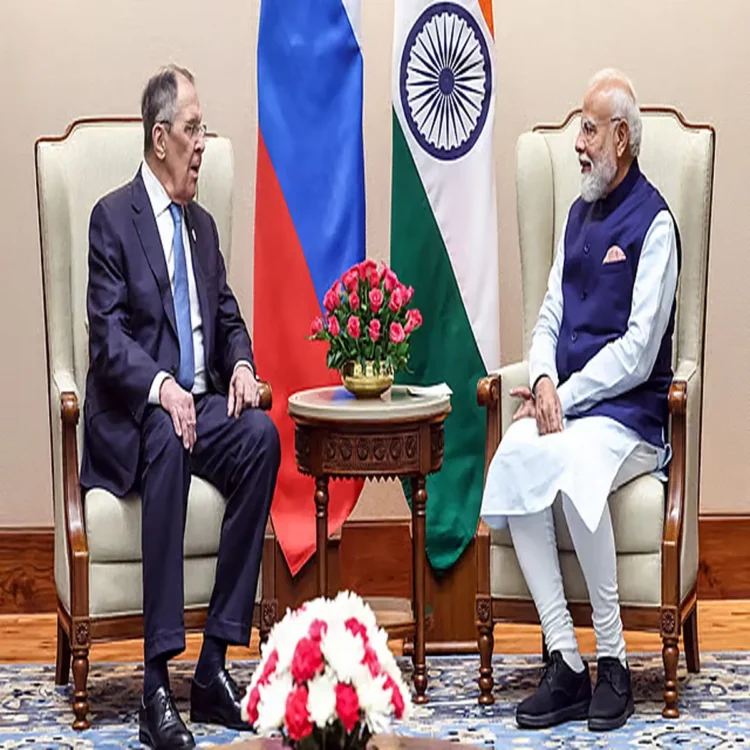
Russian Foreign Minister Sergey Lavrov made the remarks on Friday following a meeting of BRICS foreign ministers. Speaking during a media interaction, Lavrov said India’s diplomatic reputation and international credibility make it a suitable country to support broader peace efforts involving Iran and its neighbouring Arab nations.
Russia Highlights India’s Diplomatic Experience
According to Lavrov, Pakistan has been assisting in creating immediate communication channels between Washington and Tehran to address urgent concerns. However, he suggested that India could contribute more strategically in the long run by helping maintain regional stability and reducing hostility in the region.
He noted that India’s long-standing diplomatic engagement across global conflicts gives it the experience required to facilitate discussions between countries facing tensions in West Asia.
Lavrov’s comments came while Prime Minister Narendra Modi was visiting the United Arab Emirates during his ongoing five-country foreign tour.
Concerns Grow Over Regional Instability
The Russian minister’s remarks also arrived at a time when international attention remains focused on tensions involving Iran, along with uncertainty surrounding sanctions connected to Russian and Iranian oil exports.
Lavrov pointed out that India, currently holding the BRICS presidency and being one of the world’s major energy consumers, has direct economic and strategic interests tied to stability in the Gulf region. He said India could use its position to encourage communication between Iran and countries such as the United Arab Emirates to prevent further escalation.
He stressed that regional dialogue remains necessary to avoid conflict and maintain economic balance, particularly in energy markets that are closely linked to developments in West Asia.
Russia Accuses Other Nations of Escalating Hostility
During the briefing, Lavrov also alleged that some countries were attempting to worsen relations between Iran and Arab nations by encouraging mistrust and confrontation.
He claimed Russia was pursuing the opposite approach by supporting diplomatic engagement aimed at reducing tensions and preventing wider instability. Lavrov further argued that understanding the underlying causes of conflicts was important before seeking solutions.
Russia has repeatedly called for diplomatic negotiations instead of military escalation in the region, especially as geopolitical competition continues to intensify.
India’s Long Record in Peace Initiatives
India has historically played a visible role in international peacekeeping and mediation efforts since gaining independence. Over the decades, New Delhi has participated in several diplomatic initiatives focused on reducing conflict and promoting negotiations.
One of India’s early diplomatic achievements came during the Korean conflict in the 1950s, when it helped develop proposals related to prisoner-of-war exchanges. India also chaired the International Commission for Supervision and Control in Vietnam during a politically sensitive period in Southeast Asia.
In Europe, India contributed to discussions surrounding Austria’s neutrality agreement in 1955, which eventually led to the withdrawal of Soviet troops from the country.
Modern Foreign Policy Focuses on Dialogue
India has also been involved in diplomatic efforts connected to the Suez Canal crisis, the Congo conflict, and the Iran-Iraq war. More recently, New Delhi used its G20 presidency to draw attention to the economic and humanitarian consequences of ongoing global conflicts, including the Russia-Ukraine war.
Indian foreign policy in recent years has increasingly focused on consensus-building, strategic partnerships, and peaceful engagement. Officials have frequently described the country’s international approach through the principle of “the world is one family,” reflecting its emphasis on cooperation and balanced diplomacy.
Russia’s latest remarks are likely to add further attention to India’s growing position in international negotiations and its expanding role in global geopolitical discussions.