
Commemoration – Delhi Marks Centenary of Sardar Teja Singh Samundri’s Martyrdom with Kirtan
Commemoration –Lieutenant-Governor Taranjit Singh Sandhu joined devotees at a special religious gathering held in Delhi to pay tribute to the enduring legacy of Sardar Teja Singh Samundri on the 100th anniversary of his martyrdom. The Vishesh Kirtan Darbar was organised at Gurdwara Sri Guru Singh Sabha in Janakpuri, where members of the Sikh community, religious leaders, and dignitaries gathered to honour one of the prominent figures of the Sikh reform movement. Delhi Education Minister Ashish Sood was also present during the commemorative event.
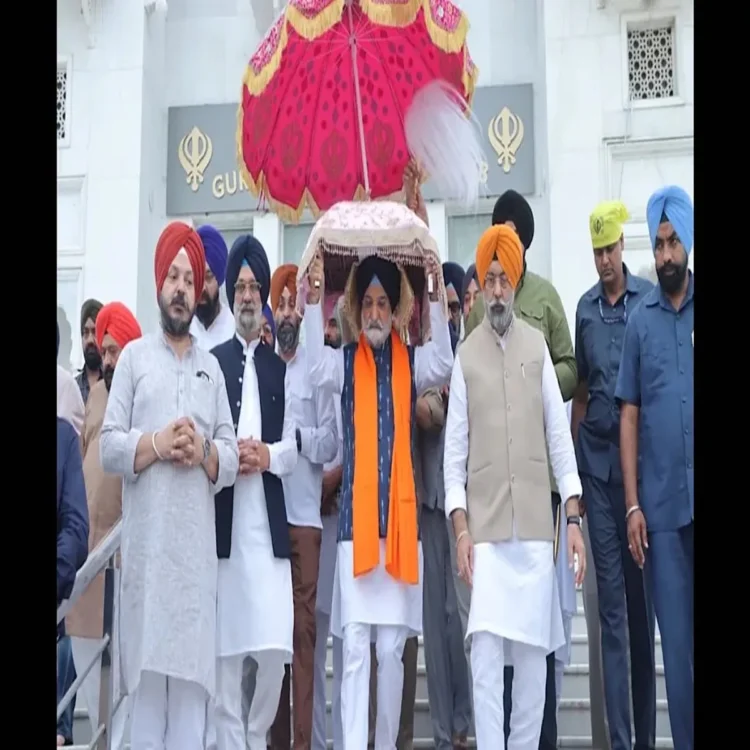
Devotional gathering marks historic occasion
The programme began with soulful Gurbani Kirtan performed by Bhai Surjeet Singh Ji, Hazoori Raagi, and Bhai Jaskaran Singh Ji of Patiala. The congregation participated in prayers and the Ardaas, creating a solemn atmosphere dedicated to remembering the sacrifices made by Sardar Teja Singh Samundri. The event focused on preserving the values of courage, faith, and public service that continue to inspire generations within the Sikh community.
Lieutenant-Governor reflects on Samundri’s sacrifice
Addressing the gathering, Lieutenant-Governor Taranjit Singh Sandhu spoke about the historical importance of Sardar Teja Singh Samundri’s life and sacrifice. He recalled that Samundri died in Lahore Jail in 1926 under circumstances that were described as mysterious by Master Tara Singh. Sandhu noted that renowned Sikh scholar Bhai Vir Singh had referred to Samundri as a supreme and sacred martyr, while Master Tara Singh remembered him as an ideal Sikh whose entire life reflected unwavering commitment and sacrifice.
Firm stand during imprisonment remembered
Highlighting Samundri’s steadfast character, Sandhu said that among the 53 Sikh leaders who were arrested and imprisoned in Lahore, only 11 chose not to seek release by offering an apology to the authorities. Sardar Teja Singh Samundri was one of those who refused to compromise his principles. According to the Lieutenant-Governor, this decision became a lasting symbol of his dedication to justice and the Sikh cause during a challenging period in history.
Sandhu also pointed out that the Teja Singh Samundri Hall located within the Darbar Sahib complex holds special significance. He said it remains the only building in the complex named after an ordinary Sikh, reflecting the deep respect and honour that the Sikh Panth continues to extend to his memory.
Role in Sikh reform and freedom movements highlighted
During his address, the Lieutenant-Governor underlined Samundri’s active contribution to both the Sikh reform movement and India’s freedom struggle. He said Samundri was among the earliest volunteers to offer arrest during the Shaheedi Morchas held between 1914 and 1920. His commitment to religious and community service was further recognised in 1923 when members of the Sangat selected him to lead the Kar Seva at Darbar Sahib.
Sandhu observed that these contributions made Samundri an important figure whose work extended beyond political activism and reflected his dedication to preserving Sikh religious institutions and community values.
Story of communal harmony recalled
The Lieutenant-Governor also narrated an incident connected with the Guru Ka Bagh Morcha to illustrate the spirit of unity that existed during that period. Referring to scholar Professor Ruchi Ram Sahni, Sandhu said Sahni had once questioned Samundri about why he believed the movement had succeeded.
In response, Samundri reportedly highlighted the spontaneous assistance provided by members of the Hindu community in Amritsar, who arranged essential supplies and mats for those participating in the agitation. Sandhu said the episode demonstrated the strong sense of cooperation and mutual respect that existed between Hindu and Sikh communities during the movement, serving as an example of social harmony alongside the struggle for justice.