
SpaceExploration – NASA Accelerates Plans for Permanent Lunar South Pole Base
SpaceExploration – NASA has revealed a detailed strategy aimed at establishing a long-term human presence near the Moon’s South Pole, marking a major step in the agency’s broader vision for future missions beyond Earth. The announcement included new partnerships, upcoming lunar missions, and advanced technologies designed to support astronauts during extended stays on the Moon and future journeys toward Mars.
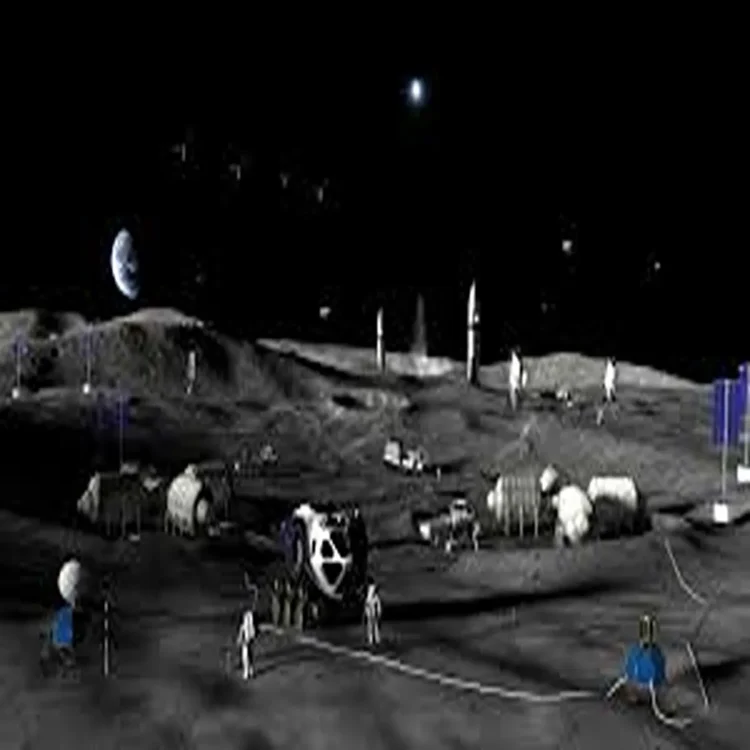
NASA Outlines Long-Term Vision for Lunar Expansion
Speaking at NASA Headquarters in Washington, NASA Administrator Jared Isaacman described the Moon initiative as a defining moment in modern space exploration. He said the project is intended to help scientists and astronauts gain practical experience in surviving and operating in one of the harshest environments known to humanity.
According to Isaacman, every mission planned under the program — whether robotic or crewed — will contribute to developing systems needed for sustainable lunar operations. He added that the agency views the effort as an important foundation for future Mars exploration.
NASA officials said the lunar South Pole was selected because scientists believe the region may contain significant water ice deposits. These resources could eventually support drinking water supplies, oxygen production, and even fuel generation for spacecraft.
Three Early Missions Planned Before End of 2026
NASA confirmed that three major lunar missions are currently scheduled before the close of 2026 as part of the early development phase of the Moon Base initiative.
The first mission, known as Moon Base I, will use Blue Origin’s Blue Moon Mark 1 Endurance lander. The spacecraft is expected to deliver scientific equipment to the Shackleton Connecting Ridge area near the lunar South Pole, where researchers hope to gather important geological and environmental data.
Moon Base II will involve Astrobotic’s Griffin lander, which is expected to transport more than 1,100 pounds of cargo to the Moon. Among the equipment onboard will be Astrolab’s FLIP rover, a vehicle designed to test transportation and mobility systems that could later assist astronauts during lunar surface operations.
Meanwhile, Moon Base III will carry scientific payloads aboard Intuitive Machines’ Nova-C Trinity lander. One of the main objectives of the mission will be the Lunar Vertex investigation, which aims to study unusual swirl-like formations visible on the Moon’s surface.
New Lunar Vehicles to Support Artemis Astronauts
NASA also announced major financial agreements with private aerospace companies to develop advanced lunar transportation systems for future Artemis missions.
Astrolab received a contract valued at $219 million to continue work on its lunar terrain vehicle technology. At the same time, Lunar Outpost secured a separate $220 million agreement to build another generation of lunar mobility systems.
Astrolab’s vehicle is based on its FLEX platform and is designed to transport astronauts, scientific tools, and supplies across difficult lunar terrain. Lunar Outpost’s Pegasus rover, meanwhile, is being developed with multiple operating modes, allowing it to function autonomously, through remote control, or with direct human operation.
NASA officials stated that these vehicles are expected to significantly increase the distance astronauts can travel compared to the Apollo-era missions.
Drone Missions to Search for Water Ice
In another important development, NASA introduced a separate mission called MoonFall, which will deploy four robotic drones capable of hopping across the lunar surface. The drones are expected to examine potential landing locations and investigate regions that may contain frozen water beneath the surface.
Firefly Aerospace has been selected to build the spacecraft that will carry the drones into lunar orbit before deployment.
Program leaders emphasized that the Moon Base initiative will rely heavily on partnerships with commercial aerospace companies rather than depending solely on traditional government-led development models. NASA believes this approach will allow the program to evolve more efficiently through repeated testing, smaller missions, and continuous technological improvements.
Officials said the overall objective is to gradually build a broad operational network on the Moon that could eventually support continuous human activity for years to come.