
DefenceMinister – Rajnath Singh Pays Tribute to Ho Chi Minh in Hanoi
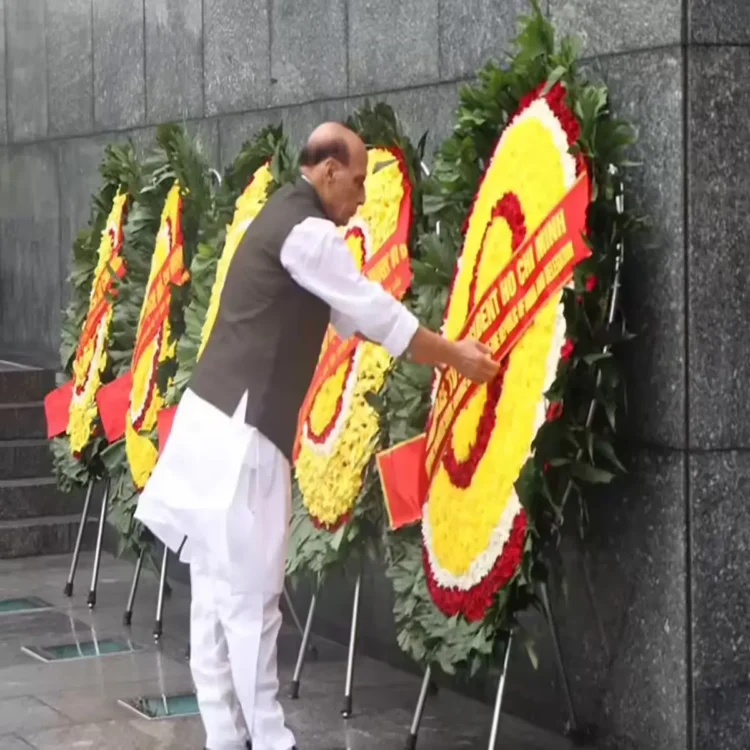
DefenceMinister – Defence Minister Rajnath Singh on Tuesday honoured Vietnam’s founding leader Ho Chi Minh during a visit to the Ho Chi Minh Mausoleum in Hanoi, marking the late revolutionary leader’s 136th birth anniversary. The tribute came as Singh continued his official tour aimed at strengthening India’s strategic ties with Vietnam and South Korea.
India and Vietnam Mark Strategic Partnership Milestone
Singh reached Hanoi on Monday for a two-day visit that coincides with a decade of the Comprehensive Strategic Partnership between India and Vietnam. Relations between the two countries received another boost earlier this month when the partnership framework was elevated during Vietnamese President To Lam’s state visit to India.
Sharing details of the tribute on social media platform X, Singh said Ho Chi Minh’s leadership and dedication to national freedom continued to inspire people across generations. He also highlighted the long-standing friendship between India and Vietnam, describing it as a relationship built on mutual trust, shared principles, and respect for sovereignty.
The Indian minister’s visit is expected to focus heavily on regional security cooperation, defence manufacturing, and maritime coordination in the Indo-Pacific region, an area that has gained growing strategic importance in recent years.
Address to Indian Community Highlights India’s Growing Confidence
During an interaction with members of the Indian community in Hanoi, Singh spoke about India’s evolving global position and the country’s increasing role in technology and security matters.
Referring to Operation Sindoor, he described it as an example of India’s emergence as a determined and capable nation prepared to protect its interests. Singh reiterated that India remains committed to its long-standing no first use nuclear policy, but stressed that the country would firmly respond to any threat or hostile action.
He also underlined the government’s focus on strengthening India’s technological capabilities, particularly in semiconductor manufacturing. According to Singh, the sector represents not only industrial progress but also India’s larger ambition to build a modern and self-reliant economy.
Push for Investment and Global Partnerships
The Defence Minister invited international investors and strategic partners to participate in India’s growth journey. He noted that India’s expanding influence on the global stage has improved confidence among citizens and strengthened the country’s reputation internationally.
Officials believe deeper cooperation in advanced technology, manufacturing, and defence production could become a major pillar of India’s future engagement with Southeast Asian countries.
India and Vietnam have steadily expanded collaboration across several sectors in recent years, including naval exchanges, defence training, energy cooperation, and trade. Analysts view the growing partnership as an important element of broader Indo-Pacific stability.
South Korea Visit to Focus on Defence Cooperation
After concluding his Vietnam visit, Singh is scheduled to travel to South Korea from May 19 to 21 for a series of high-level meetings focused on bilateral defence cooperation.
Ahead of the trip, Singh stated that discussions would centre on expanding military collaboration, increasing defence industrial partnerships, and strengthening maritime security initiatives.
According to India’s Ministry of Defence, Singh will hold bilateral talks with South Korean Minister of National Defence Ahn Gyu-back. The two sides are expected to review ongoing defence engagements and identify new areas for strategic cooperation.
The Indian minister is also set to meet Lee Yong-cheol, head of South Korea’s Defence Acquisition Program Administration. In addition, he will chair the India-Korea business roundtable, where discussions are likely to cover defence manufacturing, investment opportunities, and technology partnerships.
India has been actively pursuing stronger security and economic ties with major Asian nations as part of its broader regional engagement strategy. The visits to Vietnam and South Korea are being viewed as part of New Delhi’s continued efforts to deepen strategic cooperation across the Indo-Pacific region