
ForeignPolicy – Congress Leaders Back India’s Measured Stand on West Asia Conflict
ForeignPolicy – India’s approach to the escalating tensions involving the United States, Israel, and Iran has drawn varied reactions, with some senior opposition figures expressing support for the government’s restrained stance.
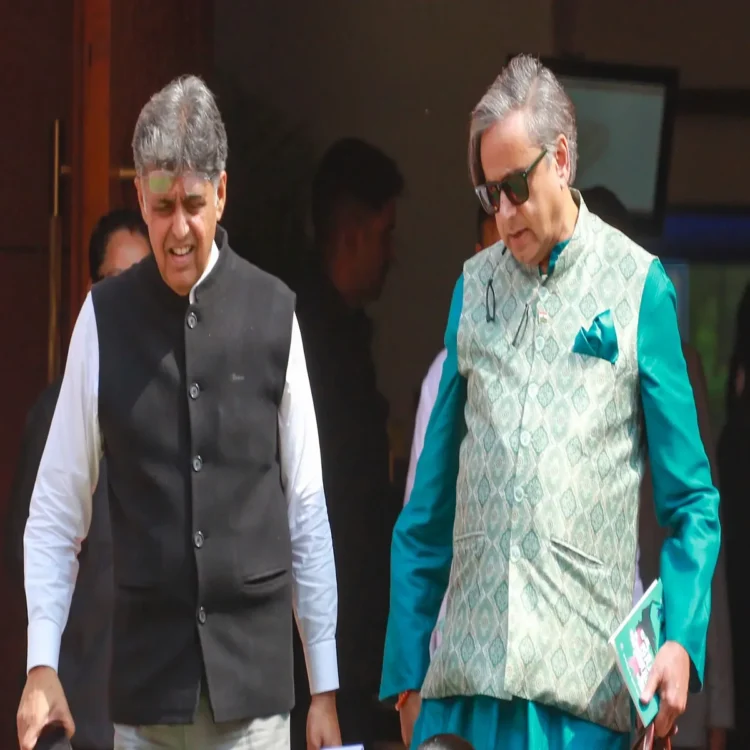
Congress MPs Shashi Tharoor and Manish Tewari on Thursday publicly endorsed the Centre’s careful handling of the evolving situation in West Asia, even as their party’s top leadership questioned the broader direction of India’s foreign policy.
Leaders highlight need for caution amid complex conflict
Speaking to reporters, Tharoor underlined the importance of maintaining a balanced and cautious approach in a volatile region. He pointed out that India has significant interests tied to developments in the Gulf, particularly in the energy sector, which relies heavily on imports such as LPG and LNG.
He also noted the presence of millions of Indian nationals living and working in the region, whose safety remains a key concern. In addition, he referred to India’s economic ties with countries like the United Arab Emirates and Saudi Arabia, including trade partnerships, investments, and ongoing cooperation in security matters.
According to Tharoor, any escalation in the conflict could disrupt these critical relationships. He stressed that stability in West Asia is vital for India’s economic and strategic interests and expressed hope that New Delhi would encourage all parties involved to work toward a swift resolution.
Strategic autonomy cited as guiding principle
Echoing similar views, Chandigarh MP Manish Tewari said India’s response reflects its long-standing policy of strategic autonomy. He observed that the current situation in West Asia involves multiple overlapping conflicts, rather than a single isolated confrontation.
Tewari added that India has historically played a limited role in the region’s geopolitical tensions and should therefore avoid taking sides. He argued that maintaining a measured distance allows the country to safeguard its interests while navigating a complex international landscape.
In his view, a cautious and calculated response aligns with India’s broader foreign policy framework, which prioritizes flexibility and independent decision-making in global affairs.
Party leadership questions government’s silence
Despite these supportive remarks, the Congress party’s senior leadership has taken a sharply critical position on the government’s handling of recent developments. Leaders including Sonia Gandhi, Mallikarjun Kharge, and Rahul Gandhi have raised concerns over what they describe as a lack of clear response to key घटनाओं related to the conflict.
They questioned why India had not issued a stronger statement following the reported assassination of Iran’s former supreme leader Ayatollah Ali Khamenei. The leadership argued that remaining silent on such an incident could be perceived as a departure from India’s traditional diplomatic stance.
Sonia Gandhi, in particular, described the absence of a clear प्रतिक्रिया as troubling, suggesting it could reflect inconsistencies in the country’s foreign policy approach.
Debate over diplomatic response continues
Responding to calls for a stronger reaction, Tharoor clarified that while outright condemnation may not have been necessary, a formal expression of condolences would have been appropriate. He noted that India has previously extended such gestures in similar situations, including after the death of Iranian President Ebrahim Raisi in a helicopter crash.
Tharoor acknowledged that Foreign Secretary Vikram Misri had signed the condolence register, describing it as a positive step. However, he suggested that a more visible public expression of sympathy could have reinforced diplomatic goodwill.
The differing views within the Congress party reflect a broader debate over how India should position itself in an increasingly complex global environment. While some leaders emphasize caution and strategic balance, others are calling for clearer articulation of India’s stance on key international developments.