
Democracy, Institutions, and Dissent: Rahul Gandhi’s Perspective from Berlin
Democracy, Institutions, and Dissent: Rahul Gandhi’s recent visit to Germany has drawn significant attention in political and academic circles, especially after his address at the Hertie School in Berlin. During this interaction, the senior Congress leader presented a detailed critique of the current political environment in India, focusing on institutions, democratic values, and the balance of power. His remarks were framed not as an attack on a single political party, but as a broader concern about the direction in which Indian democracy is moving.
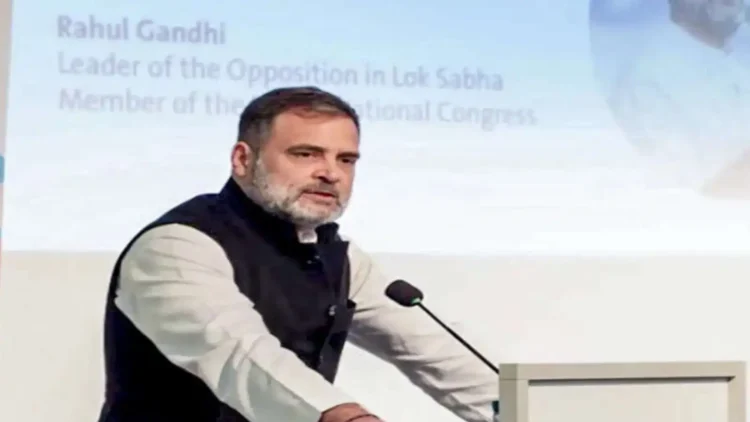
Rahul Gandhi is on a five-day Germany visit, where he interacted with students, scholars, and members of the Indian diaspora. Speaking at an academic forum allowed him to articulate his views in a reflective and analytical manner, placing India’s internal political challenges within a global democratic context.
Allegations of Institutional Capture
While addressing the audience, Rahul Gandhi alleged that India’s institutional framework is being systematically weakened. He claimed that key democratic institutions are no longer functioning independently and are instead being used as instruments to consolidate political power. According to him, this trend represents a serious challenge to democratic accountability and transparency.
He specifically referred to investigative agencies, stating that bodies responsible for maintaining law and order are being selectively used. In his view, this selective use has created an atmosphere of fear, particularly among political opponents and independent voices. Gandhi argued that when institutions lose their neutrality, democracy itself becomes vulnerable.
Use of Investigative Agencies in Politics
Gandhi highlighted the Enforcement Directorate and the Central Bureau of Investigation, alleging that these agencies have been turned into political tools. He pointed out that, in his assessment, cases are disproportionately filed against Opposition leaders, while members of the ruling establishment remain largely unaffected. This imbalance, he suggested, sends a strong message to anyone considering support for Opposition parties.
He also spoke about the business environment, claiming that entrepreneurs are discouraged from financially supporting parties like the Congress. According to him, such pressure creates an uneven political playing field and weakens pluralism, which is essential for a healthy democracy.
Vision of Resistance and Democratic Safeguards
In response to these challenges, Gandhi stated that the Congress intends to build a structured and peaceful system of resistance. This, he explained, would focus on protecting constitutional values and restoring institutional independence. He emphasized that the struggle is not merely electoral, but ideological and systemic in nature.
According to Gandhi, the objective is to defend the spirit of the Constitution and ensure that democratic checks and balances are preserved. He stressed that institutions should serve the people, not any single political interest.
INDIA Alliance and Ideological Differences
When asked about internal differences within the INDIA alliance, Gandhi acknowledged that alliance partners sometimes contest elections against each other. However, he clarified that they remain united on core ideological issues. He said the alliance stands collectively against the ideology of the Rashtriya Swayamsevak Sangh, while allowing room for tactical competition at the regional level.
He further accused the ruling party, the Bharatiya Janata Party, of promoting ideas that threaten constitutional equality. In his view, proposals that undermine equality among states, languages, and religions go against the foundational principles of India.
India as a Conversation, Not a Command
One of the most notable aspects of Gandhi’s speech was his description of India as a complex and diverse society. He argued that millions of citizens do not align with the vision promoted by the central government and the RSS. According to him, India’s strength lies in dialogue, diversity, and decentralization rather than centralized authority.
Gandhi posed a fundamental question to the audience: should a nation as diverse as India be governed by the decisions of a single individual, or through continuous dialogue among its many regions and cultures? He advocated for a model where India functions as an ongoing conversation between states, languages, and communities.
Global Discussion of Indian democracy on the stage
By raising these issues in Germany, Gandhi aimed to internationalize the discussion around democratic norms and institutional integrity. His remarks were positioned as part of a broader global debate on democracy, authoritarian tendencies, and the role of institutions in safeguarding freedom.
While reactions to his statements have been mixed, his Berlin address has undeniably added a new dimension to conversations about India’s political future, both at home and abroad.