
Safety – Supreme Court Calls for Encroachment-Free Walking Space on Roads Nationwide
Safety –Pedestrian rights and safe public infrastructure remain central to India’s urban development agenda – The Supreme Court has directed the Central Government to ensure that every road across the country provides clearly marked and encroachment-free space for pedestrians, reinforcing the importance of safe walking facilities as part of citizens’ constitutional rights.
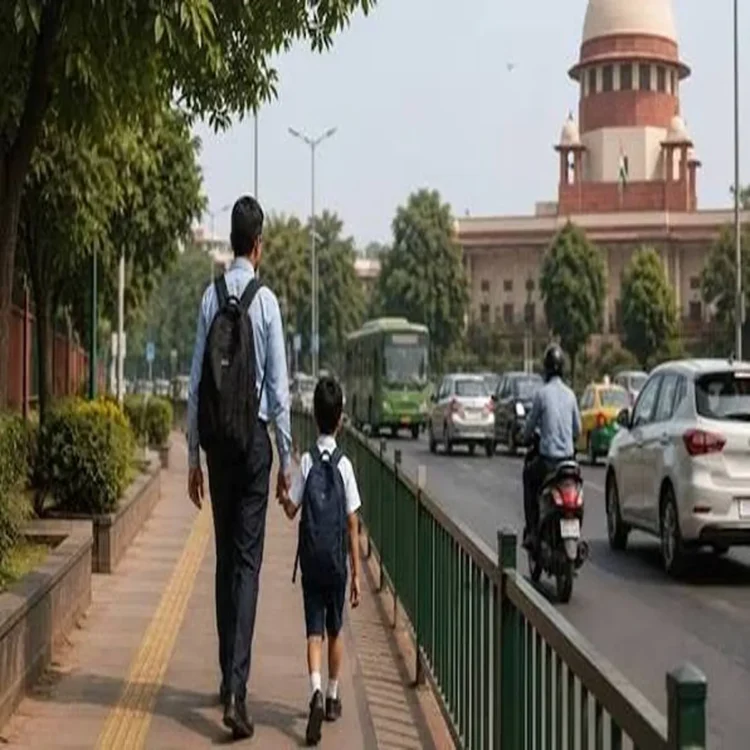
Court Directs Immediate Action on Pedestrian Spaces
During a hearing on Monday, a Bench comprising Justices P. S. Narasimha and Alok Aradhe instructed the Centre to issue directions to the concerned authorities for identifying and protecting designated pedestrian areas on all roads. Representing the Union Government, Additional Solicitor General K. M. Nataraj was asked to communicate the court’s instructions to the relevant departments.
The Bench observed that creating safe walking zones does not necessarily require large infrastructure projects or heavy financial investment. Instead, authorities should immediately demarcate pedestrian space using practical methods, including temporary barriers or ropes where required, and ensure that these areas remain free from illegal occupation. The matter has been scheduled for further consideration after two weeks.
Centre Granted Two Weeks to Issue Instructions
The Supreme Court allowed the Central Government two weeks to circulate necessary directions to the responsible agencies. The judges emphasized that pedestrians should feel secure while using roads and must have confidence that the space reserved for them will remain protected from vehicle movement and unauthorized encroachments.
According to the court, safe access to roads is not merely a matter of convenience but an essential public responsibility that directly affects the daily lives of citizens across urban and rural areas.
Fundamental Right to Walk Reaffirmed
The latest directions follow the Supreme Court’s judgment delivered on July 19, in which it declared that the right to walk on properly demarcated footpaths forms an essential part of the fundamental freedoms guaranteed under the Constitution of India. The Bench held that this right deserves priority over the movement of motor vehicles whenever pedestrian safety is involved.
The judgment stated that the constitutional guarantee of freedom of movement, along with the protections provided under Article 21 and other related provisions, naturally includes access to safe and clearly identified footpaths. The court also stressed that the existence of roads creates a corresponding obligation on public authorities to provide and maintain pedestrian infrastructure.
Case Originated From Fatal Road Accident
The observations emerged while the Supreme Court was deciding an appeal connected to a motor accident compensation dispute. The case involved the tragic death of a five-year-old child who was struck by a tanker while walking to school with his father.
Following the accident, the child’s father sought compensation of Rs 25 lakh before the Motor Accidents Claims Tribunal. However, the tribunal awarded Rs 7.82 lakh with six percent interest. Appeals from both sides later resulted in the High Court reducing the compensation to Rs 4.70 lakh. Dissatisfied with the outcome, the father approached the Supreme Court.
After examining the matter, the apex court set aside the High Court’s decision and enhanced the compensation to Rs 11,44,628, directing that the amount be paid within two months.
Authorities Must Protect Footpaths
The Bench made it clear that responsibility for creating and safeguarding pedestrian infrastructure rests with urban development bodies, municipal corporations, municipalities, and panchayats. These agencies have a continuing duty to identify, construct, maintain, and protect footpaths so that walking remains safe and accessible for everyone.
The judges observed that pedestrian infrastructure is an essential public service and should receive sustained administrative attention.
Recommendation for Independent Regulatory Body
The Supreme Court also highlighted the need for establishing a dedicated regulatory authority focused on pedestrian infrastructure and road safety. According to the Bench, such an institution would help preserve technical expertise, maintain reliable data, and make informed decisions based on accumulated experience.
The court noted that an independent regulator functioning with transparency and accountability would strengthen long-term planning while remaining free from undue governmental or commercial influence.
Citizens Can Seek Legal Remedies
The judgment further clarified that if authorities fail to protect the right to walk on designated footpaths, affected citizens may pursue constitutional and legal remedies, including claims for restitution and compensation. The court stated that these rights exist independently of the remedies available under the Motor Vehicles Act, 1988, ensuring broader legal protection for pedestrians.