
Politics – Women’s Reservation Bill Fails in Lok Sabha After Heated Debate
Politics – The proposed constitutional amendment seeking to reserve one-third of seats for women in Parliament failed to pass in the Lok Sabha, triggering strong political responses and renewed debate over women’s representation.
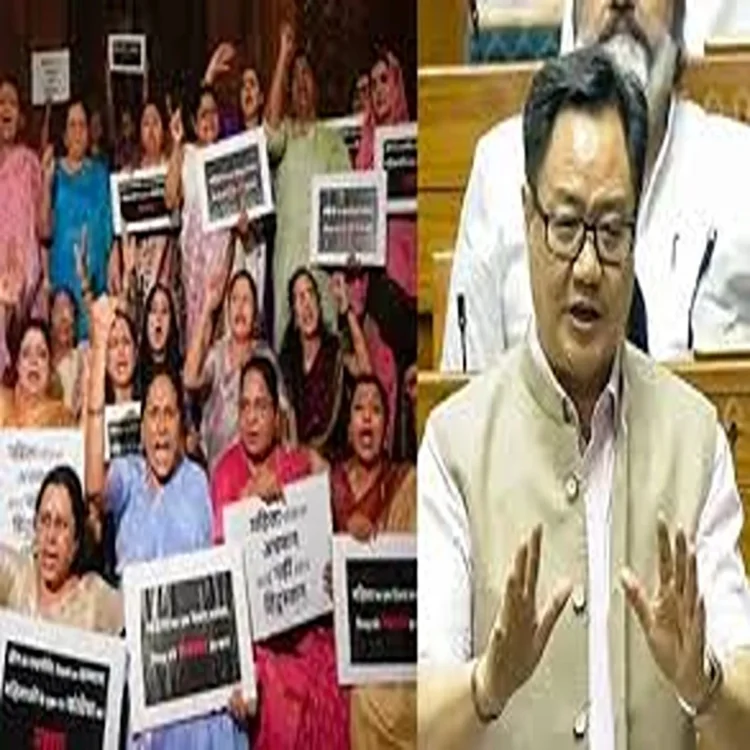
The Constitution (131st Amendment) Bill, 2026, which aimed to introduce 33 per cent reservation for women in Parliament and state assemblies, did not secure the required two-thirds majority during voting in the Lok Sabha. Despite receiving 278 votes in favour and 211 against, the numbers fell short of the constitutional threshold, resulting in the Bill’s defeat.
Government Expresses Disappointment Over Outcome
Union Parliamentary Affairs Minister Kiren Rijiju described the development as a matter of concern, stating that the failure of the Bill should not be seen as a political loss for the ruling government but as a setback for the country. He expressed regret that the legislation, which was intended to enhance women’s participation in governance, could not be passed.
According to him, the inability to secure sufficient support from Opposition parties prevented the Bill from becoming law. He emphasized that the initiative was aimed at empowering women with greater decision-making roles in legislative bodies.
Sharp Political Divide Between Ruling and Opposition Blocs
The voting outcome has intensified the political divide between the ruling National Democratic Alliance (NDA) and the Opposition INDIA bloc. While the government maintained that it made sincere efforts to build consensus, it accused Opposition parties of failing to support a measure intended for women’s advancement.
Rijiju also criticised the reaction of certain Opposition leaders, suggesting that celebrating the Bill’s defeat was inappropriate given its significance for women’s representation. He argued that such responses reflected a lack of commitment toward gender equality in politics.
Linked Delimitation Proposals Put on Hold
Following the Bill’s rejection, the Centre decided not to move forward with two related delimitation proposals that were part of a broader legislative package. Officials indicated that these proposals could be revisited independently at a later stage, separate from the reservation measure.
The Bill had also included provisions to increase the total number of seats in legislative bodies, which would have required subsequent delimitation exercises to ensure fair representation.
Government Highlights Broader Achievements
While acknowledging the setback, the Minister described the recently concluded Budget Session of Parliament as productive. He pointed to progress made in addressing key national challenges, including internal security concerns.
Rijiju stated that efforts to curb Left-wing extremism have reached an advanced stage, with significant improvements reported in affected regions. He also noted that the overall situation in Jammu and Kashmir has stabilised, and peace has largely been restored across much of the Northeast, apart from isolated issues.
Continued Commitment to Women’s Empowerment
Despite the Bill’s failure, the government reiterated its commitment to promoting women’s empowerment through policy initiatives. Rijiju stated that the administration would continue working toward improving opportunities and representation for women across sectors.
He also clarified that the government adhered to democratic procedures during the voting process and could not compel Opposition members to support the legislation. According to him, multiple attempts were made to engage with Opposition leaders, including outreach efforts through meetings and discussions.
Opposition Engagement Remains a Concern
The Minister further alleged that some Opposition leaders did not actively participate in discussions, despite being invited for consultations. He claimed that while other parties attended meetings, key Opposition figures chose to communicate through written correspondence instead of engaging directly.
This lack of participation, he suggested, contributed to the failure to build the consensus required for passing a constitutional amendment.
A Setback With Long-Term Implications
The defeat of the Women’s Reservation Bill marks a significant moment in India’s legislative history, highlighting ongoing challenges in achieving political consensus on gender representation. While the issue remains unresolved, it is expected to continue shaping political discourse in the coming months.