
OppositionAlliance – DMK’s Absence Deepens Questions Over INDIA Bloc’s Future
OppositionAlliance – A fresh political controversy has emerged after the Dravida Munnetra Kazhagam (DMK) decided not to attend the INDIA bloc meeting scheduled in New Delhi on June 8. The decision has triggered strong reactions across the political spectrum, with the Bharatiya Janata Party (BJP) claiming that the opposition alliance has suffered a major setback and is losing relevance.
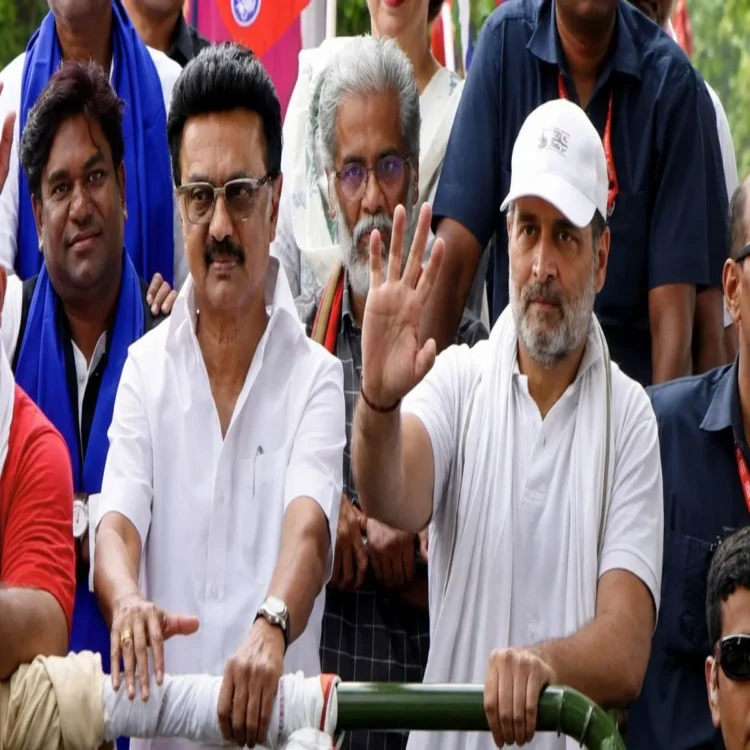
BJP Targets Opposition Coalition
Responding to the DMK’s announcement, BJP national spokesperson Shehzad Poonawalla said the opposition grouping had effectively ceased to function as a united front. He argued that recent Assembly election outcomes in states such as Tamil Nadu, Kerala, and West Bengal exposed deep divisions among alliance partners and weakened the coalition’s political standing.
According to Poonawalla, the alliance now exists more as a formal arrangement than as a functioning political partnership. He maintained that predictions about the bloc’s fragmentation following the state election results had proven accurate.
DMK Explains Its Stand
The DMK defended its decision to stay away from the upcoming gathering, stating that it was acting in line with the sentiments of its party workers. The party said its cadre felt disappointed and betrayed by recent political developments involving the Congress.
The disagreement stems from changing political equations in Tamil Nadu. The DMK has remained critical of the Congress after the national party aligned itself with the Tamilaga Vettri Kazhagam (TVK), which emerged victorious in the state Assembly elections. Party leaders believe the move has damaged trust between the two long-time allies.
Questions Raised Over Alliance Unity
The BJP used the development to question the overall cohesion of the INDIA bloc. Poonawalla pointed to political contests involving opposition parties in several states, arguing that many alliance partners continue to compete against one another locally while presenting a united image at the national level.
He cited examples from states including West Bengal, Punjab, Karnataka, Delhi, Uttarakhand, and Madhya Pradesh, suggesting that the alliance lacks a consistent political framework across regions.
Criticism of Congress Leadership
The BJP spokesperson also accused the Congress of failing to maintain confidence among regional partners. Referring to the DMK’s decision, he claimed that several opposition parties were increasingly uncomfortable with Congress-led coordination efforts.
Poonawalla further argued that ideological and electoral differences among alliance members have remained unresolved. He highlighted the political rivalry between Congress and Left parties in Kerala, while noting that both groups have worked together on national opposition platforms.
Samajwadi Party Mentioned in Debate
During his remarks, Poonawalla also referred to the Samajwadi Party’s reported plans for the next Uttar Pradesh Assembly election. He claimed that the party intends to contest all 403 seats independently, a move he said reflects the broader weakening of opposition cooperation.
While opposition parties have not collectively responded to the BJP’s criticism, the latest disagreement has renewed debate over the future direction of the INDIA bloc and its ability to maintain unity ahead of upcoming political challenges.
Political Significance of the Development
The DMK’s absence from the June 8 meeting is being viewed as a significant moment for the opposition coalition. Political observers note that the strength of any alliance depends heavily on coordination among its major regional partners. Whether the current differences can be resolved remains uncertain, but the episode has clearly intensified scrutiny of the bloc’s internal relationships and long-term strategy.