
NationalSong – Vande Mataram Added to Red Fort Independence Day Ceremony for First Time
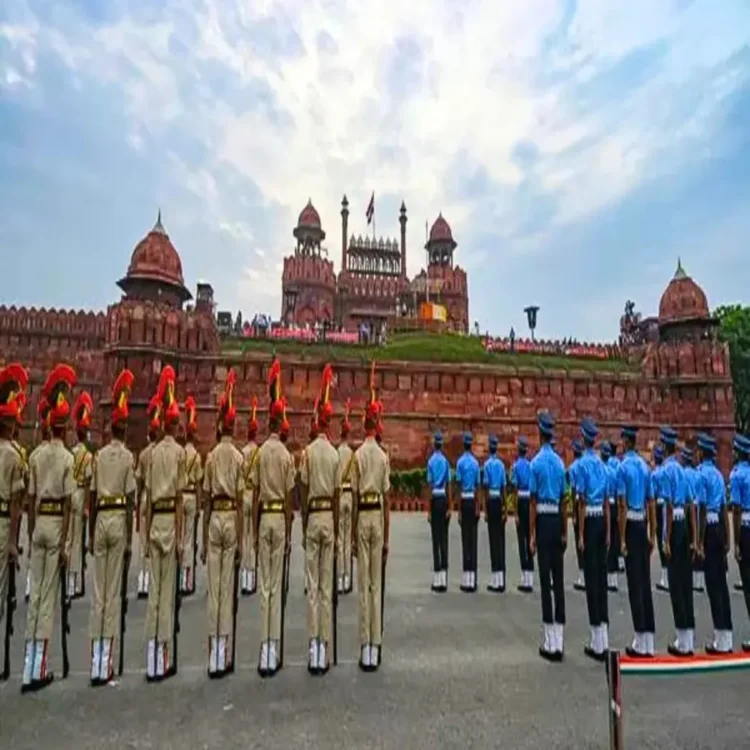
NationalSong – The Independence Day celebrations at Delhi’s Red Fort will include a significant change this year, with Vande Mataram scheduled as an official part of the August 15 programme for the first time. According to a Defence Ministry official, the national song will be performed immediately before the national anthem at the conclusion of the Prime Minister’s address. Until now, the formal ceremony traditionally ended with Jana Gana Mana, while patriotic songs were presented earlier in the morning before the Prime Minister arrived at the venue.
Parliament Clears Bill Expanding Legal Protection
The decision follows closely after Parliament approved the Prevention of Insults to National Honour (Amendment) Bill, 2026. The legislation extends legal safeguards previously available only to the national anthem under the 1971 law to Vande Mataram as well. The Bill was introduced in the Rajya Sabha on July 24 and has now been passed by both Houses of Parliament. It is currently awaiting the President’s assent before becoming law.
Under the proposed amendment, deliberately disrupting the singing of the national song or intentionally preventing its performance could attract a prison term of up to three years, a monetary penalty, or both. Individuals convicted of the offence for a second time would face a minimum jail sentence of one year.
Ceremony Details Yet to Be Released
The complete schedule for this year’s Independence Day programme at Red Fort has not yet been made public. In previous editions of the event, National Cadet Corps (NCC) cadets concluded the ceremony by singing the national anthem after the Prime Minister’s speech. An NCC choir also performed patriotic songs earlier in the morning before the official proceedings began.
Officials have not confirmed whether the Red Fort ceremony will feature only the two commonly accepted stanzas of Vande Mataram or whether a longer version of the composition will be presented.
Government Recalls India’s First Independence Day
During the parliamentary discussion on the amendment Bill, Minister of State for Home Nityanand Rai referred to a historical event from August 15, 1947. He stated that Sardar Vallabhbhai Patel had requested noted vocalist Pandit Omkarnath Thakur to perform the complete Vande Mataram on All India Radio at 6:30 am, marking the beginning of India’s first Independence Day celebrations.
The minister’s reference has drawn attention because the government has not yet clarified the version of the song that will be used during this year’s official ceremony.
Historical Debate Over the Song Continues
The inclusion of Vande Mataram comes amid renewed discussion surrounding the song during its 150th anniversary year. While launching commemorative events last year, Prime Minister Narendra Modi said that important sections of the original composition had been removed in 1937 and argued that the decision contributed to political divisions before Independence.
The Congress party rejected that interpretation, maintaining that Nobel laureate Rabindranath Tagore had recommended using only the opening two stanzas for national purposes. Party leaders argued that it would be incorrect to associate Tagore’s advice with divisive political motives.
Historical records show that the Congress Working Committee, meeting in Calcutta between October 26 and November 1, 1937, adopted a resolution limiting national use of the song to its opening two stanzas. The later verses, which contain references to Hindu deities such as Durga and Lakshmi, were not included.
Constitutional Position Remains Unchanged
Tagore, in a letter to Jawaharlal Nehru dated October 26, 1937, observed that while the complete poem might be viewed as objectionable by some sections of the Muslim community, the opening two stanzas could be accepted without creating such concerns. Around the same period, the Congress Working Committee also formed a committee that included Jawaharlal Nehru, Subhas Chandra Bose, Maulana Abul Kalam Azad and Acharya Narendra Dev to identify other patriotic songs in simple Hindustani.
The issue also resurfaced in Parliament earlier this year when Union Home Minister Amit Shah criticised the 1937 decision, describing it as the beginning of a policy of appeasement. Congress MP Jairam Ramesh responded by referring to correspondence between Rajendra Prasad and Vallabhbhai Patel, arguing that the historical decision had followed careful deliberation.
Meanwhile, the legal position regarding citizens’ participation remains unchanged. In its 1986 judgment in the Bijoe Emmanuel case, the Supreme Court ruled that no individual can be compelled to sing either the national anthem or the national song. The court held that standing respectfully in silence does not constitute disrespect.