
Elections – Child Labour and Low Wages Shadow Murshidabad Beedi Industry
Elections – As election campaigns intensify ahead of the West Bengal assembly polls, political debates in Murshidabad are dominated by issues such as infiltration and voter identity. Yet, away from public rallies, daily life in the district’s vast beedi-producing belt tells a different story—one shaped by low wages, child involvement in work, and deep economic dependence on contractors.
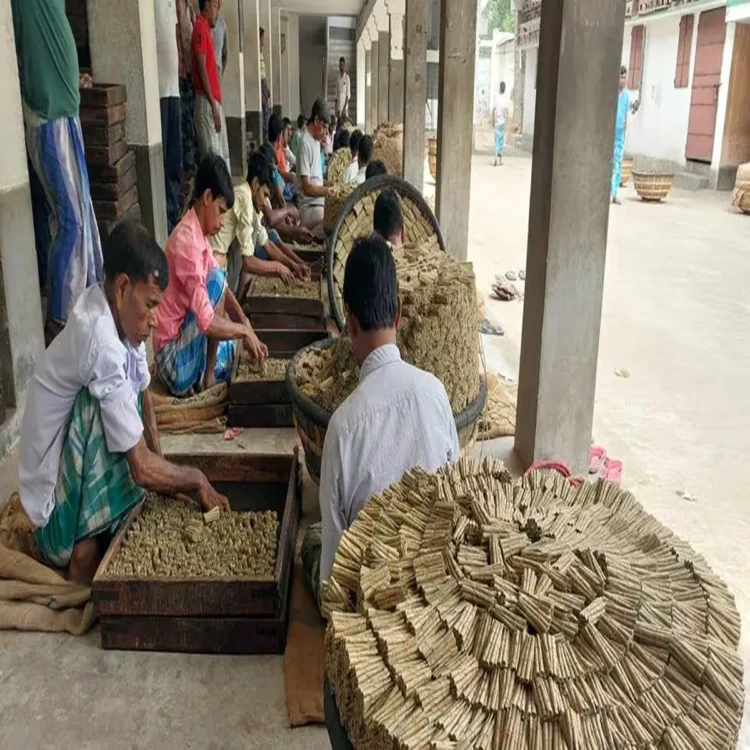
Children Quietly Supporting Household Livelihoods
In Suti, a young girl sits on the floor of her modest home, carefully rolling tobacco into tendu leaves before heading to school. Officially, she is not considered a worker. In reality, her contribution is essential for the family to meet strict daily production targets. Across Murshidabad, similar scenes unfold in thousands of homes where children assist their parents either before or after school hours.
Families are often required to produce up to 1,000 beedis a day to secure full payment. Falling short can lead to reduced wages, making every extra pair of hands crucial. For many households, children’s involvement is seen as a necessity rather than a choice.
Backbone of the Local Economy
Murshidabad accounts for a significant share of India’s beedi production, with nearly a quarter of the country’s workers based in the district. The industry supports around 2.5 million people, making it the primary source of income in areas like Suti, Jangipur, Lalgola, and Dhuliyan.
In these regions, homes double as small-scale production units. Women spend long hours rolling beedis in poorly lit spaces, surrounded by tobacco dust. While they shoulder most of the workload, their earnings remain limited, typically ranging between Rs 160 and Rs 190 per 1,000 beedis.
Education and Health Take a Back Seat
The economic pressure on families often affects children’s education. Many drop out after primary school, particularly girls, who begin assisting their mothers full-time. Teachers in the region note that regular attendance becomes difficult as children take on increasing responsibilities at home.
Health concerns are also widespread. Medical professionals report frequent cases of respiratory issues, chronic cough, and back pain among workers. Prolonged exposure to tobacco dust affects both adults and children, raising long-term health risks in the community.
Contractors Hold Significant Control
The beedi trade in Murshidabad operates through a network of local contractors, often referred to as “munshis.” These individuals play a central role in determining wages, approving production, and providing advances during festivals or emergencies.
Workers say this system leaves them vulnerable. A contractor can decide whether a family continues to receive work or not. As a result, many feel compelled to maintain good relations, even if it means accepting low wages or difficult conditions.
Political Influence and Worker Concerns
Several workers allege that contractors also influence political choices during elections. While such claims are difficult to verify publicly, many residents believe that economic dependence can indirectly shape voting behavior.
Political parties, however, offer differing perspectives. Leaders from the ruling party highlight welfare schemes such as financial assistance, food distribution, and healthcare coverage. Opposition parties argue that systemic issues in the beedi sector remain unaddressed, pointing to low wages and lack of social security.
Protests Highlight Wage Issues
In 2025, thousands of workers, many of them women, staged protests demanding higher wages. After several days of demonstrations, payment rates were increased modestly. Despite this, workers say earnings remain insufficient to support large families.
Many also lack access to benefits such as provident funds or formal healthcare support, as home-based work often falls outside standard labor regulations.
Real Issues Beyond Election Rhetoric
As polling day approaches, campaign speeches continue to focus on broader political narratives. However, in the narrow lanes of Murshidabad’s beedi-producing areas, daily concerns revolve around income stability, health challenges, and access to education.
For many families, survival depends less on electoral outcomes and more on the steady availability of work. The upcoming elections may shape governance, but for workers here, immediate challenges remain rooted in their everyday struggle for livelihood.