
Delhi Metro – Passenger Numbers Dip After Temporary Station Closures During Protests
Delhi Metro – Average weekday passenger traffic on the Delhi Metro recorded a moderate decline after temporary station closures were enforced in parts of central Delhi during student demonstrations, according to official data released by the Delhi Metro Rail Corporation (DMRC).
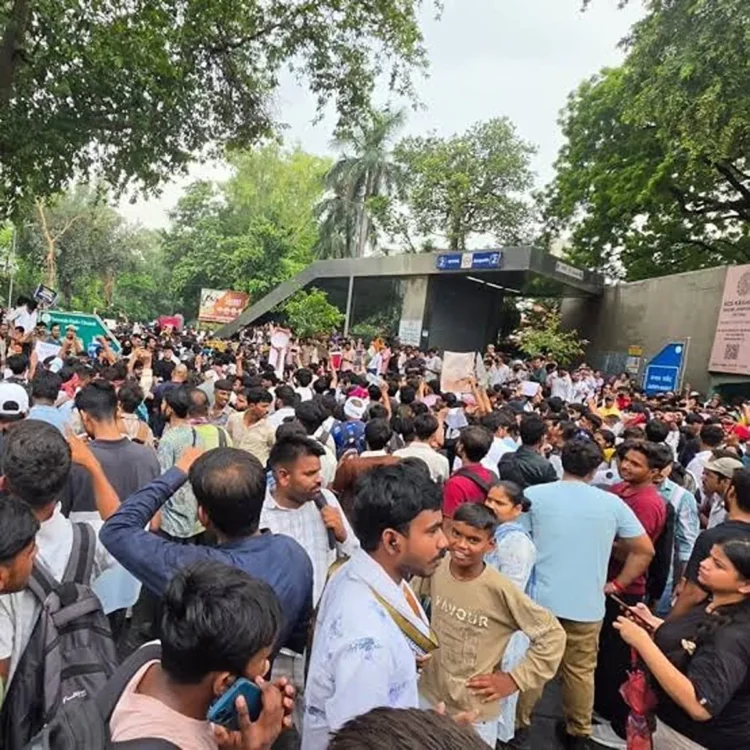
The Delhi Metro Rail Corporation (DMRC) has reported a slight reduction in weekday ridership during the period from July 20 to July 24, following temporary restrictions at several Metro stations in central Delhi. The measures were introduced on the instructions of the Delhi Police as student-led protests took place in the city. While passenger numbers fell compared to the first half of July, the transport authority stated that the overall impact on its network remained limited.
Ridership Declined by Around Four Percent
Official figures show that the average number of weekday passenger journeys decreased from nearly 6.6 million between July 1 and July 19 to approximately 6.3 million during July 20-24. This represents a drop of about 267,000 daily journeys, or roughly 4.1 percent. According to the DMRC, such a variation is relatively small when viewed against the scale of the entire Metro network, which serves millions of commuters every working day.
The corporation also noted that similar fluctuations are commonly observed during weekends, public holidays, school vacations, and other periods when regular travel patterns change. Officials indicated that temporary changes in commuter movement are not unusual and should be considered within the broader context of seasonal travel trends.
Comparison With Previous Months
Data released by the DMRC also provides a comparison with ridership levels from recent months. The average weekday passenger count stood at 6,856,803 in June 2026. During July 2025, the corresponding figure was 6,740,968, while June 2025 recorded an average of 6,677,710 weekday journeys.
These numbers suggest that daily passenger volumes continue to remain consistently high despite short-term variations caused by operational restrictions or changes in commuter activity. The Metro system continues to be one of the busiest public transport networks in the country, carrying millions of passengers across Delhi and the National Capital Region.
Station Restrictions During Demonstrations
Between July 20 and July 24, entry and exit facilities were temporarily suspended at as many as 18 Metro stations following security directions issued by the Delhi Police. Although access to these stations was restricted, interchange services remained available at selected locations, allowing passengers to continue changing lines where operationally possible.
The temporary closures mainly affected stations located in central Delhi, an area that includes several important government offices, business districts, and administrative establishments. As a result, many regular commuters had to modify their travel plans or use alternative routes to reach their destinations.
Protests Prompted Security Measures
The restrictions were implemented during demonstrations organised by the Cockroach Janta Party (CJP). The protests included gatherings at Jantar Mantar and a “Sansad Chalo” march, with participants raising concerns over alleged irregularities in examinations.
To manage public movement and maintain security in sensitive locations, authorities introduced precautionary measures that included restricting access to several Metro stations. These steps were intended to regulate commuter flow around protest sites while ensuring that Metro services across the wider network continued to operate with minimal disruption.
Although passenger numbers temporarily declined during the affected period, the DMRC maintained that the reduction was modest considering the size of its operations and the millions of journeys handled across the network each weekday.