
Strait of Hormuz – US Rejects Iran’s Claims Over Tanker Explosions Amid Rising Conflict
Strait of Hormuz – The United States has rejected Iran’s allegation that two oil tankers were damaged by mine explosions while passing through the Strait of Hormuz, dismissing the claim as inaccurate as military tensions between the two countries continue to intensify.
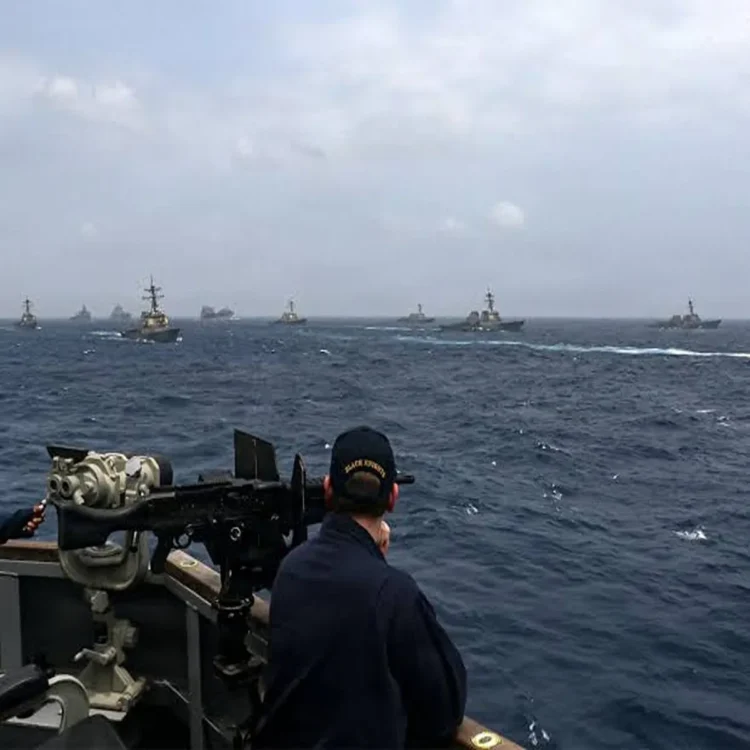
According to the US Central Command (CENTCOM), statements made by Tehran regarding the reported tanker incident are not supported by American assessments. In a message shared on X, CENTCOM described the allegation as false, directly responding to claims issued by Iran’s Islamic Revolutionary Guard Corps (IRGC).
Iran Reports Explosions Near Strategic Waterway
The Iranian military said that two commercial oil tankers caught fire after hitting mines south of the Strait of Hormuz, one of the world’s most important shipping routes for energy supplies. The IRGC claimed the vessels entered what it described as a mined area because of deceptive actions linked to American intelligence agencies.
Iran’s official news agency IRNA published the statement, which also asserted that security forces intercepted four additional vessels attempting to travel through the same maritime corridor. The Strait of Hormuz remains a critical global trade route, carrying roughly one-fifth of the world’s oil and gas shipments.
Military Operations Continue for Seventh Consecutive Night
The latest exchange comes as both countries continue military operations involving missiles and drones. US forces carried out strikes against Iranian targets for the seventh consecutive night, with CENTCOM stating that the objective of the operations is to further reduce Iran’s military capabilities.
The escalation follows earlier warnings from US President Donald Trump, who indicated that Iranian infrastructure could become a target. Although those remarks raised concerns about broader military action, Washington had not officially confirmed by Friday whether infrastructure-related strikes had been carried out.
Tehran Accuses Washington of Targeting Civilian Sites
Iran has accused the United States of attacking civilian infrastructure during the ongoing conflict. Officials in Tehran said an airport, a railway station and two bridges were among the locations affected by recent American operations.
In response, Iranian authorities announced a series of retaliatory military actions against US positions across the region. Both the Iranian Armed Forces and the IRGC released separate statements claiming responsibility for strikes aimed at American military facilities and naval assets.
Iranian state broadcaster IRIB reported that these operations were presented as retaliation for recent US attacks on Iranian territory and military personnel. Tehran further claimed that military action had expanded beyond its borders, with operations directed at US-linked locations in Qatar, Kuwait, Jordan, Oman and Syria.
Surveillance Facility Destroyed at Chabahar Port
In a separate announcement, CENTCOM confirmed that US forces had destroyed a surveillance tower at Shahid Kalantari Port in Chabahar on July 16. American officials said the installation formed part of a long-standing maritime surveillance network operated by the IRGC.
According to the US military, the surveillance system was used to monitor commercial shipping activity along Iran’s Gulf of Oman coastline, particularly vessels traveling through the Strait of Hormuz. CENTCOM stated that the tower had supported the IRGC’s ability to track commercial traffic moving through the strategically significant waterway.
Regional Tensions Remain High
The competing claims from Washington and Tehran highlight the growing instability across the Gulf region. While the United States continues to describe its operations as efforts to weaken Iranian military capabilities, Iran maintains that its actions are defensive responses to American attacks.
With both governments presenting sharply different accounts of recent events, concerns remain over the potential impact on regional security and international shipping through one of the world’s busiest energy transit routes.