
Security – India Condemns Deadly Airstrikes on Afghan Territory at UN
Security – India has strongly criticized recent air attacks carried out on Afghan territory, raising the issue at the United Nations Security Council and highlighting the severe human toll of the strikes. The Indian delegation said the operation violated international law and questioned the contradiction between claims of religious unity and the reality of civilian casualties during the holy month of Ramadan.
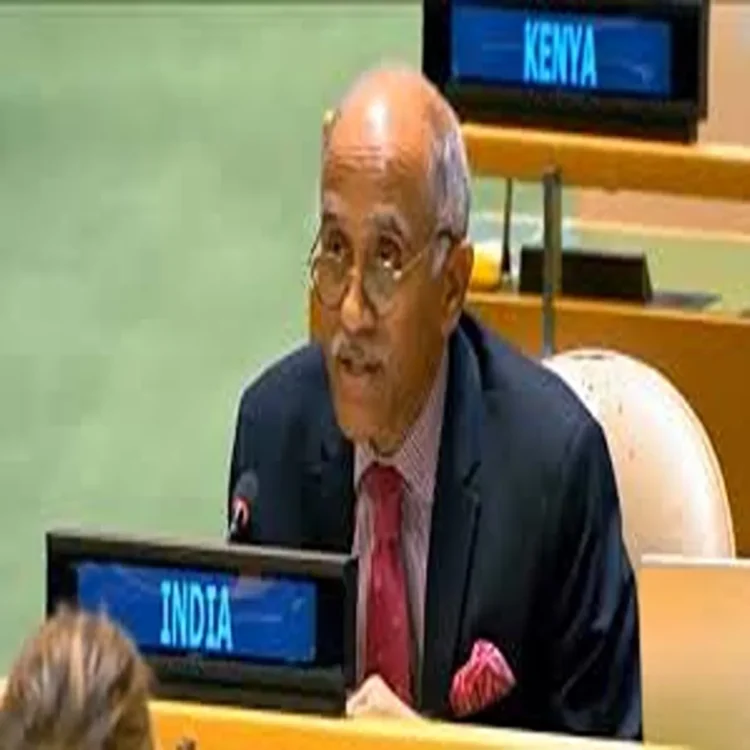
India Raises Civilian Casualty Concerns at UN
Speaking during a Security Council briefing on Afghanistan, India’s Permanent Representative to the United Nations, P. Harish, condemned the airstrikes that have reportedly caused heavy civilian losses. According to figures cited during the meeting, the attacks had killed around 185 civilians by March 6, 2026.
Harish noted that more than half of the victims were women and children, raising serious humanitarian concerns. He described the air attacks as a clear violation of international law, the United Nations Charter, and the principle of national sovereignty.
The Indian envoy also criticized the timing of the operation, pointing out that the strikes took place during Ramadan, a month traditionally associated with peace, reflection, and compassion in the Islamic world.
Allegations of Hypocrisy Over Islamic Solidarity
In his remarks, Harish questioned what he described as a contradiction between statements promoting Islamic solidarity and the reality of military operations that harmed civilians. He said it was difficult to reconcile calls for unity and adherence to international law with actions that resulted in the deaths of innocent people.
Although Harish did not directly mention Pakistan in his statement, the comments were widely interpreted as referring to Islamabad. Pakistan has previously acknowledged conducting military operations across the border, arguing that the strikes were aimed at terrorist groups operating from Afghan territory.
Debate Over Terrorism and Cross-Border Militancy
Pakistan has maintained that its actions were directed at militants using Afghanistan as a base to plan attacks. However, India countered this narrative during the UN discussion, arguing that Islamabad itself has long been accused of supporting armed groups used to destabilize neighboring countries.
Harish stressed that terrorism continues to pose a major threat worldwide and requires coordinated international action. He emphasized that organizations such as ISIS, Al Qaeda, and their affiliates remain active threats to global stability.
He also mentioned South Asia-focused militant groups including Lashkar-e-Taiba and Jaish-e-Mohammed, as well as affiliated networks like The Resistance Front, warning that these organizations and those who assist them must be prevented from carrying out cross-border attacks.
Reference to Recent Militant Violence
The Indian envoy referred to a recent attack carried out by The Resistance Front in the town of Pahalgam earlier this year. That incident, described as a religiously motivated terrorist assault, resulted in the deaths of 26 people and drew international condemnation.
India has repeatedly called for stronger global cooperation to dismantle terrorist infrastructure and prevent militant organizations from using safe havens in the region.
UN Officials Warn of Growing Regional Instability
During the same Security Council session, senior UN officials highlighted the broader impact of tensions between Afghanistan and Pakistan. Georgette Gagnon, Deputy Special Representative for Afghanistan under Secretary-General António Guterres, warned that the conflict has already imposed serious human and economic costs on Afghanistan.
She explained that the closure of Pakistan’s border has disrupted one of Afghanistan’s most important trade routes. As a result, the country has been forced to rely more heavily on trade through Iran, a pathway that has also been affected by ongoing regional conflict.
These disruptions have begun to push up the prices of essential goods across Afghanistan, placing additional strain on an economy that is already fragile.
Concerns Over Economic and Political Stability
Gagnon told the Security Council that instability along Afghanistan’s borders threatens the country’s broader recovery and long-term stability. With tensions affecting both major border regions, the risk of economic hardship and political uncertainty has grown significantly.
International officials warned that sustained regional conflict could further weaken Afghanistan’s economy and complicate efforts to maintain humanitarian support for its population.
The UN meeting concluded with renewed calls for restraint, diplomatic engagement, and greater international cooperation to reduce tensions and prevent further civilian casualties in the region.