
Trade Agreement – India and New Zealand Deepen Strategic Partnership Through Historic Economic Cooperation
Trade Agreement – Prime Minister Narendra Modi highlighted a new chapter in India-New Zealand relations on Saturday, describing the recently concluded free trade agreement as a significant step toward strengthening economic cooperation. Addressing a gathering of leading business executives and industry representatives in Auckland, Modi said the agreement would broaden market access, encourage investments, promote technology collaboration, and improve the movement of skilled professionals between the two countries.
Strategic Partnership Opens New Possibilities
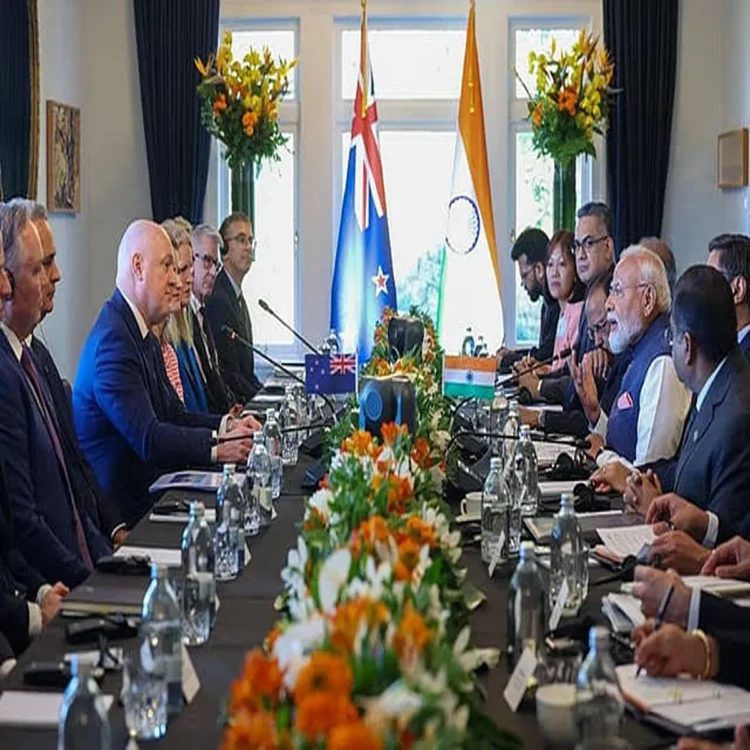
The prime minister’s remarks came shortly after his extensive discussions with New Zealand Prime Minister Christopher Luxon, during which both leaders announced 18 major outcomes, including the elevation of bilateral ties to the level of a strategic partnership. Modi said the upgraded relationship would provide a structured framework for expanding cooperation across multiple sectors with clearly defined goals and practical outcomes.
He noted that India and New Zealand share democratic traditions, cultural diversity, and a common commitment to sustainable development, creating a strong platform for building a long-term economic partnership.
Visit Marks a Historic Milestone
Modi arrived in Auckland on Friday as part of the final phase of his three-nation overseas tour, which has focused on strengthening economic and security cooperation. His visit is historically significant as it is the first by an Indian prime minister to New Zealand in four decades. The visit also follows the successful conclusion of the bilateral free trade agreement, which both governments consider a major achievement.
Speaking to business leaders, Modi said closer economic engagement would create fresh opportunities for entrepreneurs, innovators, and young professionals in both nations while encouraging stronger commercial ties.
India Highlights Expanding Investment Potential
The prime minister pointed to India’s sustained economic expansion, rapidly growing middle class, skilled workforce, digital transformation, and large-scale infrastructure development as key strengths attracting international investors. He said these factors, combined with ongoing policy reforms and political stability, have positioned India as one of the world’s important engines of economic growth.
Modi invited New Zealand companies to explore investment opportunities in infrastructure, logistics, civil aviation, renewable energy, urban transportation, water conservation, waste management, and the digital economy. He added that deeper business collaboration could generate long-term benefits for both countries.
Greater Collaboration in Innovation and Technology
Highlighting India’s thriving startup ecosystem, Modi encouraged stronger partnerships between private companies from both countries in areas such as financial technology, innovation, and emerging technologies. He said cooperation between businesses would help accelerate research, entrepreneurship, and the development of advanced digital solutions.
The prime minister also underlined the importance of combining New Zealand’s expertise in dairy science, horticulture, and forestry with India’s large consumer market, food processing capabilities, and agricultural technology talent. Such collaboration, he said, could contribute to developing globally competitive food value chains.
Trade Target Set for the End of the Decade
Calling on business leaders to expand commercial engagement, Modi urged both sides to work toward the shared objective of doubling bilateral trade to NZD 7 billion, approximately INR 35,000 crore, by the year 2030. He said stronger investment partnerships and increased business exchanges would play an essential role in achieving this target.
According to the prime minister, the growing economic relationship between India and New Zealand has the potential to become an international example of inclusive, sustainable, and innovation-driven trade. He expressed confidence that continued cooperation would create lasting prosperity for businesses and citizens in both countries while strengthening overall bilateral relations.