
Buddhism – Kakatiya-Era Inscription Reveals Amaravati’s Enduring Buddhist Legacy
Buddhism – A newly documented Telugu inscription from the 13th century has offered fresh evidence of Buddhist activity in the Krishna river basin and the wider Amaravati region during the Kakatiya period. The stone record, copied by the Archaeological Survey of India’s epigraphy wing during a survey in the Nallamala Tiger Reserve, indicates that Buddhist traditions continued in the area until at least the late 1200s.
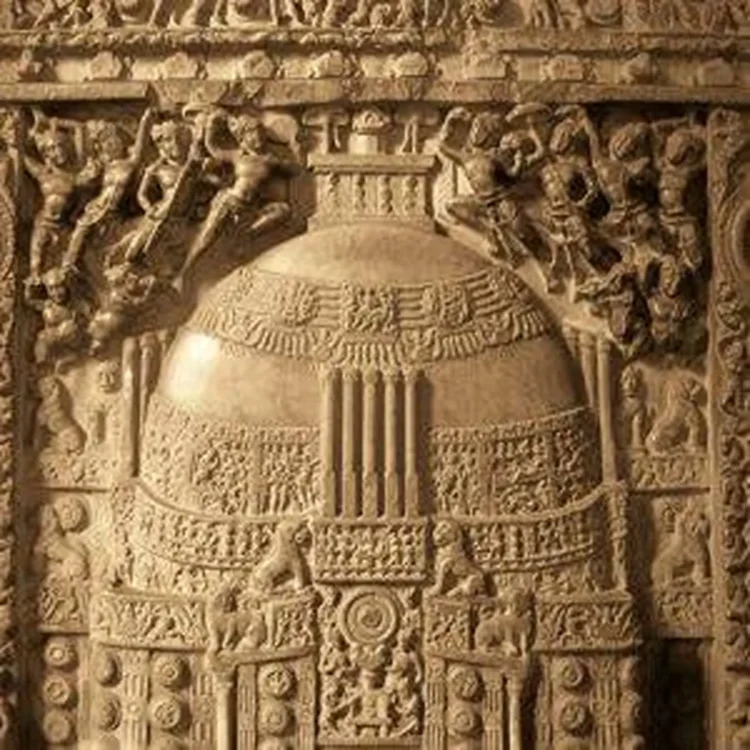
Inscription Found Near Ayyambholapalle
The damaged inscription was located near Ayyambholapalle village in Yerragondapalem mandal of Prakasam district. It is carved on a stone slab featuring images associated with Buddhism, including a stupa and figures of Muchalinda naga. Though parts of the text are no longer legible, the surviving portion has helped scholars identify its historical context.
Written in Telugu, the inscription has been dated to May 16, 1285 CE, corresponding to Saka year 1207. Its language, script and references place it in the reign of Kakatiya ruler Rudrama Devi, one of the most prominent monarchs of medieval Deccan history.
Record Mentions Village Gift for Buddhist Rituals
According to the inscription, Velmapalli village was granted to Buddhadeva of Sridhanyam, identified with the historic settlement of Dhanyakataka. The donation was made for the performance of rituals connected with the Krishna River.
The grant was issued by Bolayani Mallikarjuna Nayaka, who served as a commander under Rudrama Devi. The reference suggests that Buddhist religious practices continued to receive recognition and support in the region even during a period when Hindu religious institutions had become more dominant across much of South India.
Evidence Against Earlier Assumptions
For many years, historians generally believed that Buddhism had largely declined in the Amaravati region after the 7th century CE. The newly copied inscription, however, provides a dated record from the 13th century and points to the continued presence of Buddhist communities, rituals and patrons in the Krishna basin.
The finding is significant because Amaravati had long been one of the most important Buddhist centres in the Indian subcontinent. The region is known for its ancient stupa, sculptural traditions and monastic remains, which attracted followers and travellers for centuries.
Amaravati Stupa’s Long Religious History
ASI Director of Epigraphy Dr K. Muniratnam Reddy said the inscription reinforces the long-standing importance of the Amaravati stupa. He noted that the monument remained a celebrated religious and cultural site from around the 4th century BCE through the 13th century CE.
The discovery adds another layer to the history of Amaravati, showing that its Buddhist identity did not disappear as early as previously assumed. Instead, the inscription suggests that the site and surrounding region retained religious significance over a much longer period.
Survey Adds Value to Regional Archaeology
The inscription was documented during the ASI’s ongoing epigraphical survey in the Nallamala Tiger Reserve area. Such surveys are important for identifying inscriptions, sculptures and archaeological remains that may remain unnoticed in remote locations.
Researchers believe that further examination of the stone slab and nearby areas could provide additional details about Buddhist networks, local administration and religious patronage during the Kakatiya era. The record also underlines the need to preserve lesser-known archaeological sites in Prakasam district and other parts of Andhra Pradesh.