
Pedestrian Safety – Delhi Footpaths Remain Unsafe Despite Supreme Court Ruling
Pedestrian Safety – Urban mobility and pedestrian safety in Delhi face renewed scrutiny as footpaths across several parts of the capital remain blocked by parked vehicles, commercial spillover, debris and temporary structures. Although the Supreme Court has recently reaffirmed that walking on designated footpaths is a fundamental right, many residents continue to navigate traffic lanes because pavements are either inaccessible or missing.
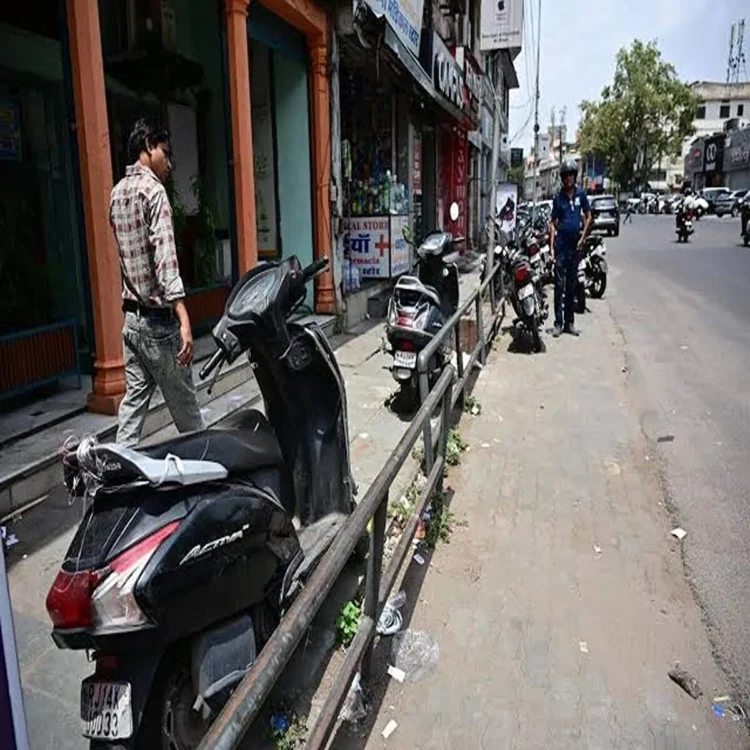
Delhi’s footpaths have increasingly been used for purposes other than walking. Cars and motorcycles are often parked on pavements, while shop displays, roadside stalls, garbage piles, construction material and barricades further reduce available space. For pedestrians, including senior citizens, children and people with disabilities, the result is a daily struggle to find a safe route.
Busy Markets Face Severe Pavement Encroachment
The problem is particularly visible in crowded commercial areas such as Karol Bagh, Laxmi Nagar, Chandni Chowk, Daryaganj and Kashmere Gate. In many locations, pavements have become informal parking zones or extensions of nearby shops, leaving pedestrians with little option but to walk alongside moving traffic.
In Daryaganj, stretches near bookshops and routes leading towards Jama Masjid are narrowed by tables, merchandise and temporary stalls. Chandni Chowk’s already congested lanes are further affected by vending activity, while footpaths in Karol Bagh and Laxmi Nagar are frequently occupied by cars and two-wheelers.
Residential neighbourhoods are not exempt. Residents in Mayur Vihar and IP Extension report that vehicles, rubble and uneven surfaces regularly obstruct pedestrian movement. Ramps intended to provide wheelchair access are also often blocked by scooters and motorcycles.
Residents Call for Stronger Civic Enforcement
Citizen groups say complaints to elected representatives and civic agencies have not led to sustained action. Saurabh Gandhi, general secretary of United Residents of Delhi, alleged that enforcement campaigns often fail because encroachers receive advance information and remove obstructions only temporarily.
He said anti-encroachment operations need stronger coordination between the Municipal Corporation of Delhi and local police. According to Gandhi, cleared pavements are often occupied again soon after officials leave, making periodic drives ineffective without regular monitoring and accountability.
Sunita Dahiya, an RWA president in Mayur Vihar Phase II, said public behaviour is also a major concern. She noted that even designated parking areas are frequently used by vehicles belonging to people outside the locality, adding pressure to already limited pedestrian space.
Road Crash Data Highlights Pedestrian Risk
The impact of unsafe walking infrastructure is reflected in Delhi’s road accident figures. Delhi Police data showed that 649 pedestrians were killed and 1,738 injured in road crashes during 2025. Private cars were linked to the highest number of pedestrian fatalities, followed by two-wheelers and heavy transport vehicles.
Research by the Transportation Research and Injury Prevention Centre at IIT Delhi, conducted with University College London, found that pedestrians accounted for 43 per cent of fatal road crashes recorded in Delhi in 2022. The study identified high-speed traffic, poor lighting, blocked crossings, parked vehicles and inadequate police presence as key risks, particularly after dark.
Uneven Infrastructure Across Delhi Neighbourhoods
The quality of footpaths varies sharply across the city. Areas such as Lodhi Colony, Khan Market, New Friends Colony and Greater Kailash generally have cleaner, more accessible pavements and stronger enforcement. In contrast, nearby or less affluent localities often lack continuous pedestrian infrastructure altogether.
Studies have repeatedly highlighted the gap. A 2024 road safety audit covering 1,400 kilometres of PWD-maintained arterial roads found that 84 per cent of footpaths did not meet Indian Road Congress standards, while only one in four was considered usable. Another IIT Delhi assessment reported that around 44 per cent of roads in the city did not have footpaths.
Policy Promises Await Effective Implementation
The Delhi government announced plans in July 2025 to repair and build 200 kilometres of footpaths along major roads. The project is expected to address drainage, illegal occupation and misuse by two-wheelers. However, earlier pedestrian-friendly proposals, including the DDA’s 2019 draft policy, have faced delays because of weak coordination among agencies.
The Supreme Court has stated that the right to walk on demarcated footpaths takes priority over motorised movement on those spaces. Its ruling places responsibility on urban development bodies, municipal authorities and local governments to create and protect safe pedestrian infrastructure.
For Delhi residents, the test will be whether court directions and government plans lead to lasting improvements on the ground.