
Heritage – Delhi Exhibition Connects Folk Art, Ecology and Everyday Memory
Heritage – A neighbourhood grocery shop, a handmade palm-leaf fan, decorated cow-dung structures from Haryana and protected forest patches in Rajasthan’s Thar Desert may seem unrelated. Yet these distinct images are brought together at De la Terre à l’Âme (From Soil to Soul), an exhibition at Alliance Française de Delhi. The show examines how everyday practices, local craftsmanship and community traditions continue to carry lessons about sustainability, identity and shared heritage.
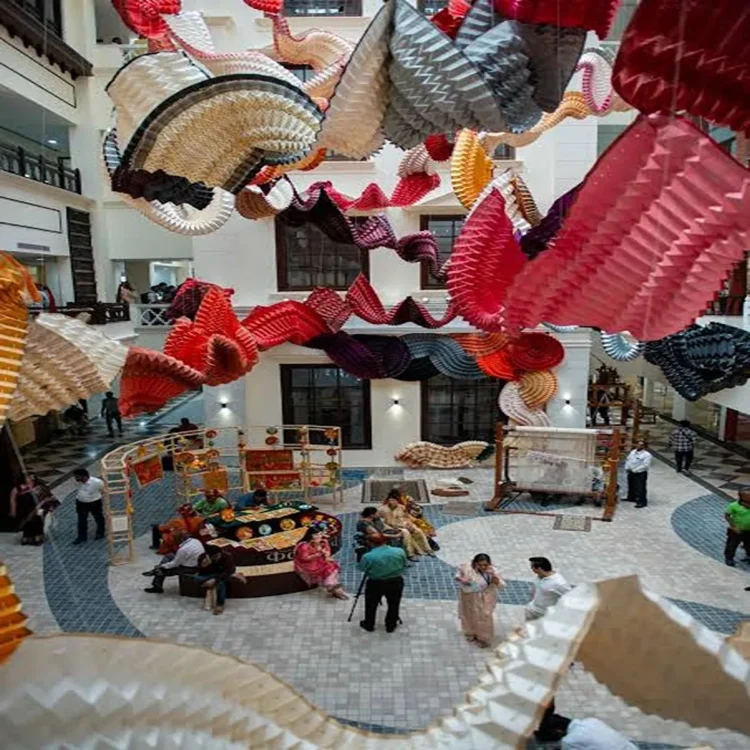
Exhibition marks Alliance Française de Delhi’s anniversary
The exhibition has been organised as part of Alliance Française de Delhi’s 70th anniversary programme and is curated by Shailja G Negi. Featuring installations and projects by artists, researchers and cultural organisations, the presentation looks at ecological knowledge and traditional practices that are gradually becoming less visible in modern life. The exhibition remains open to visitors until June 30.
Haryana’s bitoda structures inspire a study in rural geometry
Among the featured works is Bitoda Art – Living Geometry of Rural Haryana by artist Dr Asha Kumari. The project documents bitodas, hut-shaped stacks of cow-dung cakes commonly seen in villages. The structures are prepared by arranging dung cakes together and covering them with a mixture of cow dung and straw, creating a protective outer layer.
Before the surface dries, women often add patterns using their fingers or small sticks. Parallel lines, circles and other geometric forms are drawn with striking balance and precision. Cow-dung cakes have traditionally been used as biofuel in many rural homes, but the decorated structures also serve as expressions of local visual culture.
Kumari first noticed the designs while travelling through villages between Delhi and Nuh, where she works at Shaheed Hasan Khan Mewati Government Medical College. She was drawn to the careful placement of repeated motifs and the way the structures transformed ordinary village spaces into informal displays of art.
One artwork in the series features a six-pointed star inside a five-sided, house-like frame, with a gold-outlined circular pattern at its centre. Beyond their appearance, the bitodas also reflect social ties. Women often gather to help one another build them, turning the task into a shared activity filled with conversation and songs.
Changing fuel habits raise concerns over fading traditions
The growing use of LPG and other modern fuels has reduced dependence on cow-dung cakes in several rural areas. Kumari believes this shift could eventually affect both the bitoda structures and the decorative traditions associated with them. She sees the practice as an important record of rural heritage as well as a calming, hands-on creative activity.
Bengali hand fans recall disappearing household craft
Another installation, Remembering Hat Pakha by artist Abishi Sarkar, focuses on the traditional Bengali hand fan made from bamboo and palm leaves. The display includes 60 illustrated fans featuring sketches of electric fans, Goddess Durga and handwritten Bengali phrases.
Hat pakhas were once a familiar item in Bengali homes, particularly before electric fans and air-conditioners became widely available. Sarkar’s work highlights the labour involved in making each fan, from weaving and colouring to stitching and finishing. The installation also draws attention to the artisan communities whose livelihoods have been affected as handmade fans have become less common.
Childhood shop installation explores consumer aspirations
Bachpan Ki Dukaan recreates the look and feel of a small Indian neighbourhood store. Developed by Jaipur-based food and culture initiative The Kindness Meal with Alliance Française de Jaipur and Studio Nandan Ghiya, the installation uses audio stories, familiar packaged goods and childhood objects to explore how consumer desires are shaped early in life.
Food researcher Dipali Khandelwal developed the project after documenting changing food cultures among Bhil and Garasia communities in Rajasthan’s Mewar region. Many families traditionally relied on farming and foraging, purchasing only a few essentials such as salt. In recent years, low-cost packaged snacks and drinks have reached more remote villages, changing food habits and ideas of aspiration.
The installation includes snack packets, sweets, a toy truck, an old calendar, a film camera and familiar beverage and health-drink packaging. Through these objects, it reflects on how advertising and access to market products can influence childhood expectations.
Sacred groves highlight community-led conservation
The exhibition also presents Oran – Sacred Groves of the Thar Desert, developed by Kaner Retreat with collaborators including Ekayana Travels, artist Dr Madan Meena, photographer Himanshu Lakhwani, botanical artist Malini Saigal and the Jodhpur-based Sambhali Trust.
The project focuses on orans, community-protected groves where local residents have traditionally agreed not to cut trees. These spaces support biodiversity in the arid desert landscape and reflect long-standing practices of collective stewardship. Botanical illustrations, photographs, handcrafted birds and a fallen tree branch are used to contrast protected desert ecosystems with the continued loss of native trees in cities.
Together, the works encourage visitors to view familiar objects and fading customs with renewed attention, showing how they preserve knowledge, environmental awareness and memories across generations.