
Delimitation – Political Divide Deepens Over Lok Sabha Seat Expansion Plan
Delimitation – A growing political confrontation over the proposed redrawing of parliamentary constituencies has evolved into a wider debate on constitutional principles, representation, and the balance of power between different regions of the country. Leaders from both the ruling alliance and the opposition are presenting sharply contrasting views on how future Lok Sabha seats should be distributed as India prepares for a potential delimitation exercise after 2026.
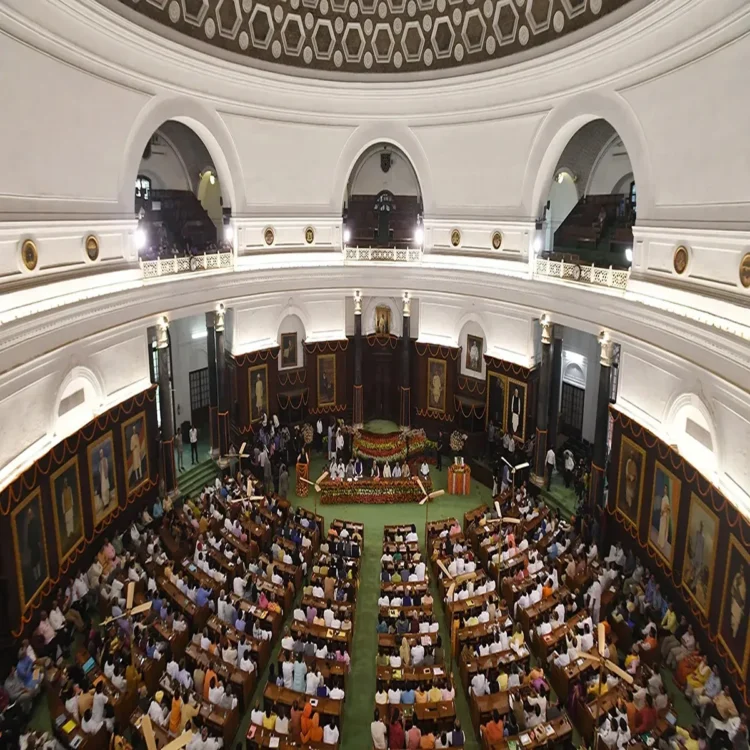
Debate Intensifies Over Proposed Seat Increase
The current discussion revolves around a proposal to increase the number of Lok Sabha seats by 50 percent. Supporters argue that a larger House is necessary to reflect India’s significant population growth over the past five decades, while critics warn that the move could alter the political influence of states that successfully controlled population growth.
The issue gained fresh attention after Congress MP Shashi Tharoor questioned the fairness of a uniform increase in seats. Drawing a comparison with salary hikes, he argued that equal percentage growth does not necessarily result in equal outcomes. According to his reasoning, identical increases can still widen existing gaps when the starting points are vastly different.
TDP Defends Population-Based Representation
Responding to Tharoor’s remarks, TDP national working president Nara Lokesh defended the proposal and cited the long-standing view of former President Pranab Mukherjee, who had supported a substantial expansion of the Lok Sabha to improve democratic representation.
Lokesh stressed that Article 81 of the Constitution links parliamentary representation to population figures. He noted that the freeze on seat allocation based on the 1971 Census was introduced as a temporary arrangement and is scheduled to end in 2026. According to him, a fresh delimitation process without safeguards could reduce the relative share of seats held by southern states.
He also questioned the Congress party’s position, arguing that opposition to the proposed framework could leave southern states vulnerable to future seat redistribution based purely on population data.
Growing Population Adds Pressure
Supporters of expansion point to India’s dramatic demographic growth since 1971. They argue that the number of citizens represented by each Member of Parliament has increased substantially, creating challenges in governance and public engagement.
Lokesh maintained that expanding the Lok Sabha is essential for strengthening representation rather than serving any political objective. He argued that every citizen’s vote should carry equal value and that a proportional increase in seats would help maintain fairness while accommodating population growth.
Rejecting concerns that some states would gain a political advantage, he stated that a uniform increase would preserve existing voting balances in Parliament because all states would receive additional seats under the same formula.
Ruling Alliance Seeks Alternatives From Critics
Leaders within the ruling alliance have continued to back the proposal. TDP national spokesperson Neelayapalem Vijay Kumar questioned why opponents have not presented a detailed alternative model for addressing representation challenges.
According to him, the suggested expansion is aimed at correcting structural imbalances created by rising populations and increasing constituency sizes. He argued that criticism alone is insufficient without offering a practical replacement plan.
Concerns Over Southern States’ Influence
Opposition leaders and regional representatives remain unconvinced. They contend that states that implemented population control measures could see their influence diluted under a future delimitation exercise.
Andhra Pradesh Congress Committee vice-president Kolanukonda Sivaji expressed concern that population-heavy states could gain a significantly larger share of parliamentary seats, increasing the gap between northern and southern regions. He warned that such a shift could weaken the South’s ability to influence national policy decisions.
Sivaji also argued that southern states make substantial economic contributions and should not face reduced political weight in national decision-making. Critics believe the issue extends beyond numbers and touches on the broader question of federal balance within the Indian Union.
Constitutional Question Remains Unresolved
As political parties continue to exchange arguments, the delimitation debate is increasingly becoming one of the most significant constitutional discussions ahead of the next phase of electoral reforms. While supporters view seat expansion as a democratic necessity, opponents are demanding safeguards to ensure that regional interests remain protected.
With the 2026 deadline approaching, the challenge for policymakers will be finding a solution that balances population-based representation with concerns about regional equity and federal fairness.