
Delhi-NCR: is covered in dense fog, and the average air quality is still “very poor.”
Delhi-NCR: On Tuesday, dense fog engulfed Delhi-NCR, drastically decreasing visibility and exacerbating the already bad air quality. Early in the morning, a dense layer of pollution and fog covered the city, seriously impeding commuters’ ability to go about their everyday lives.
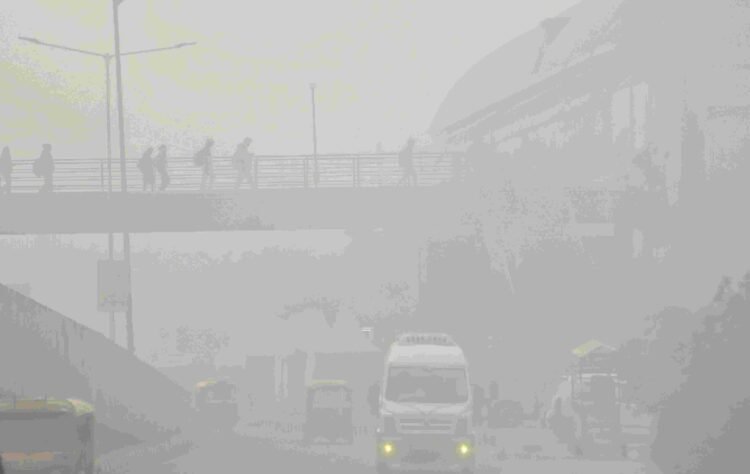
Due to the ongoing pollution and heavy fog over the nation’s capital, flight operations at the Indira Gandhi International Airport have been negatively impacted by low visibility. Over the previous several days, a number of flights have been delayed or canceled. Road traffic was also severely impacted, particularly in places like south Delhi’s Rajokri flyover where visibility fell to very low levels. Vehicles with their headlights and parking lights on were seen traveling slowly.
The NCR’s air quality remained oppressive even after the Commission for Air Quality Management (CAQM) implemented all of the actions outlined in Stage IV of the Graded Response Action Plan (GRAP). Delhi’s average Air Quality Index (AQI) at 7 a.m. on Tuesday was about 390, falling into the “very poor” category, according to the Central Pollution Control Board (CPCB).
Severe pollution was indicated by AQI scores exceeding 400 in a number of parts of the nation’s capital. The AQI was 438 in Srinivaspuri, 422 in Mundka, 396 in Okhla, 376 in RK Puram, 397 in Anand Vihar, and 403 in Noida Sector 1. The Akshardham region, where the AQI was reported at around 384, was similarly covered in a layer of haze.
Other NCR cities also continued to have bad air quality. Vasundhara in Ghaziabad registered an AQI of 374, while Sector 51 in Gurugram recorded 386. Drivers had challenges due to the very poor visibility in Bahadurgarh, which is close to Delhi. In Bahadurgarh, the lowest recorded temperature was 7 degrees Celsius, while the AQI hit 308. There were chilly winds blowing at around ten kilometers per hour.
Alarming visibility levels were also recorded by weather stations. At 8 a.m., west-southwesterly winds blowing at 5 kmph decreased visibility to barely 50 meters at Palam, whereas calm wind conditions in Safdarjung allowed for 100 meters of vision.
A chilly snap and extreme pollution were a double whammy for Noida. A number of sectors saw pollution levels that fell into the “extremely poor” category. Knowledge Park 3 in Greater Noida had an AQI of 339, Knowledge Park 5 at 407, Sector 62 at 396, Sector 116 at 426, and Sector 125 at 420.
As winter conditions deteriorate, the region’s PM2.5 and PM10 particle concentrations remained dangerously high, posing major health risks to locals.