
Women’s Quota – Rahul Gandhi Questions Delay in Implementing 2023 Law
Women’s Quota – Leader of Opposition in the Lok Sabha Rahul Gandhi has questioned the delay in implementing the 2023 law providing reservation for women in legislatures, saying the legislation had received unanimous approval and the support of the Congress party. His remarks came in response to Union Parliamentary Affairs Minister Kiren Rijiju, who urged Congress to support the measure without conditions.
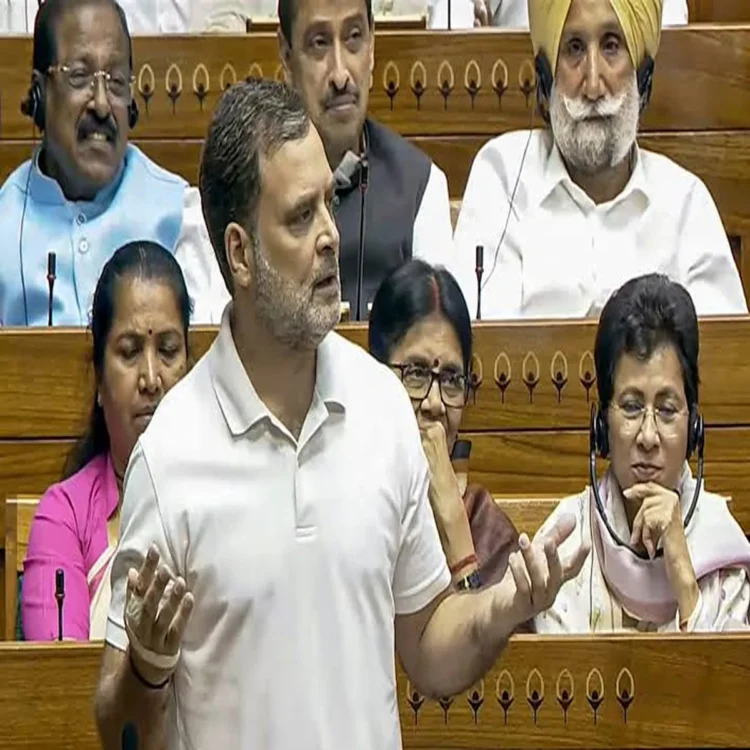
Rahul Gandhi Questions Delay in Implementation
Responding to Rijiju on X on Saturday, Gandhi pointed out that the Women’s Reservation Bill, passed in 2023, had received unanimous backing in Parliament, including support from Congress.
He questioned why the legislation had not yet been implemented despite several years having passed since its approval. Gandhi also objected to what he described as an unnecessary connection between the women’s quota and the delimitation process.
He called for the government to implement the 2023 legislation as it stands and without attaching additional conditions to it.
Rijiju Seeks Congress Support
Rijiju’s response followed comments made by Gandhi on women’s freedom and participation in public life. The Parliamentary Affairs Minister said Gandhi’s remarks appeared to indicate a change in the Congress party’s position on women’s political representation.
Rijiju expressed hope that Congress would extend unconditional support to the Women’s Reservation Bill in Parliament. His comments added another layer to the ongoing political discussion surrounding the timing and implementation of the legislation.
Gandhi Stresses Women’s Freedom
Gandhi had discussed the broader issue of women’s empowerment in an Instagram post on Friday, following an “Ask Me Anything” session held on Thursday.
In his remarks, he argued that India could not achieve its full potential unless women had the freedom and space to express themselves. He said women’s voices needed to have a stronger presence in public discussions and that society should allow women to pursue their ambitions freely.
According to Gandhi, the issue extends beyond representation in formal institutions such as politics and business. He said women’s empowerment should also be reflected in everyday life, including within families, communities and public spaces.
Focus on Participation Beyond Politics
Gandhi further stressed that women should be able to express views that differ from those around them. He also highlighted the importance of allowing women to question long-established expectations and practices within families and society.
He linked women’s ability to participate freely in social and public life with India’s wider development, arguing that restrictions on women’s expression can have consequences for the country’s overall progress.
What the Women’s Reservation Law Provides
The Women’s Reservation Bill was enacted as the Constitution (One Hundred and Sixth Amendment) Act, 2023, commonly known as the Nari Shakti Vandan Adhiniyam.
The law provides for reservation of 33 per cent of seats for women in the Lok Sabha, state legislative assemblies and the Delhi Legislative Assembly. Its implementation is linked to the delimitation process and the relevant census exercise under the legislation.
Fresh Debate Over Delimitation
The latest exchange comes amid a wider political debate over how quickly the reservation framework should take effect.
The Constitution (131st Amendment) Bill, 2026, introduced in April, sought to accelerate the implementation of the 33 per cent quota by using the 2011 Census as the basis for an earlier delimitation exercise. However, the proposal did not clear the Lok Sabha after failing to secure the required two-thirds majority.
The disagreement between Gandhi and Rijiju therefore reflects a continuing political dispute over the implementation of women’s reservation, the role of delimitation and the conditions under which the 2023 law should be brought into effect.