
Uranium – Congress Challenges BJP’s Claim Over India-Australia Nuclear Deal
Uranium – The Congress has disputed the BJP’s claim that Australia’s decision to supply uranium to India represents a diplomatic achievement secured solely during Prime Minister Narendra Modi’s tenure. The opposition party said Australia had begun moving towards uranium exports to India more than a decade ago, following developments linked to the India-US nuclear cooperation agreement.
Congress Cites Australia’s 2011 Policy Decision
Congress general secretary Jairam Ramesh said Australia’s Labour Party had approved a proposal in December 2011 to allow uranium sales to India. He said the decision was taken when Julia Gillard was Australia’s prime minister and followed the India-US Nuclear Agreement that was finalised in 2008.
Ramesh said the BJP was attempting to portray the latest civil nuclear energy arrangement as a fresh breakthrough without acknowledging earlier diplomatic developments. He shared reports from December 2011 which stated that Australia’s ruling Labour Party had backed a change in policy to permit uranium exports to India.
According to Ramesh, the current agreement should be viewed in the context of India’s longer diplomatic engagement with Australia and other international partners on civilian nuclear cooperation.
BJP Highlights Modi Government’s Strategic Engagement
The political exchange followed remarks by BJP IT department head Amit Malviya, who said Australia had refused to sell uranium to India in 2010 because New Delhi was not a signatory to the Nuclear Non-Proliferation Treaty.
Malviya said the situation had changed under the Modi government, with India and Australia now reaching an agreement on uranium exports. He described the development as a reflection of India’s stronger international position and growing recognition as a reliable strategic partner.
In a post on X, Malviya said the agreement was not limited to uranium supplies and represented a broader shift in how India is viewed by major global powers. He argued that India had moved from facing restrictions in the nuclear sector to building stronger partnerships in energy, security and technology.
Nuclear Agreement Becomes Political Flashpoint
Ramesh had earlier criticised the BJP over its position on the India-US nuclear deal, claiming that the party had opposed the agreement when it was being negotiated by the Congress-led government. He said the present India-Australia civil nuclear pact had become possible because of the India-US Nuclear Cooperation Agreement, which became law in October 2008.
The Congress leader said the earlier agreement created the diplomatic foundation for India to engage with countries that possess uranium reserves and nuclear technology. He also accused the BJP of taking credit for policy outcomes that had roots in decisions made during previous governments.
The BJP, however, has maintained that the current government’s foreign policy initiatives have strengthened India’s global relationships and expanded cooperation with strategic partners.
India and Australia Expand Wider Strategic Cooperation
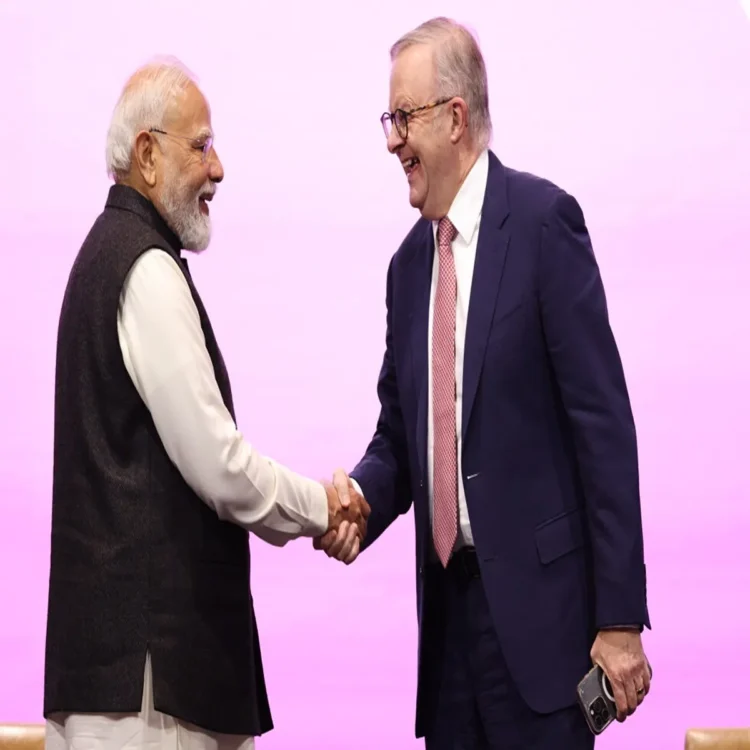
The latest agreement was signed during talks between Prime Minister Modi and Australian Prime Minister Anthony Albanese. Along with civil nuclear energy cooperation, the two leaders discussed maritime security, critical minerals, cyber technology, defence coordination and supply chain resilience.
India and Australia also released a joint declaration on defence and security, an energy cooperation statement and a roadmap for collaboration in cyber security, emerging technologies and critical supply chains.
Both countries highlighted the importance of their partnership in supporting peace, stability and economic security across the Indo-Pacific region. The discussions reflected growing cooperation between New Delhi and Canberra at a time when regional security and energy needs remain key policy priorities.
Uranium Supply May Support Nuclear Power Expansion
The civil nuclear energy pact is expected to enable commercial uranium supplies from Australia to India for use in nuclear power projects. India has been seeking to expand clean energy capacity while reducing dependence on conventional fossil fuels.
Australia is among the world’s major uranium-producing countries, and the agreement could support India’s long-term plans for nuclear energy generation. The arrangement also marks another step in the wider India-Australia partnership, which has expanded steadily across defence, trade, technology and energy sectors.