
Employment – MCD Mayor Urges Review of Regularisation for Long-Serving Contract Staff
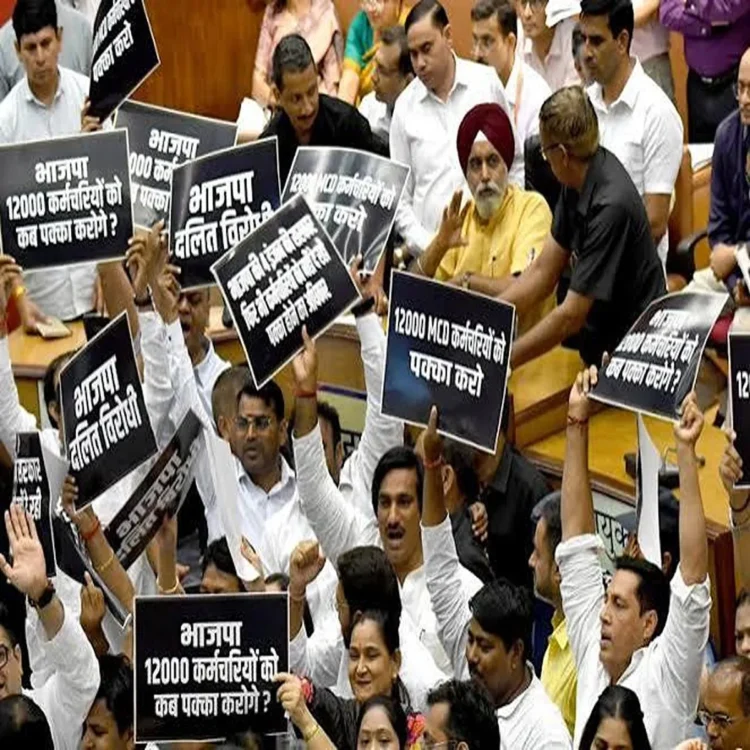
Employment –The Mayor of the Municipal Corporation of Delhi (MCD), Pravesh Wahi, has asked Commissioner Sanjeev Khirwar to take priority action to protect the interests of contractual employees who were directly recruited by the civic body and are currently serving against sanctioned vacant Group A, Group B and Group C posts. In a formal communication, the Mayor also called for a detailed review of the administrative and legal feasibility of granting regular status to eligible employees who have been serving the corporation for several years.
Long Years of Service Highlighted
According to the Mayor, a large number of contractual employees have remained in service without interruption for an extended period. Many of them perform responsibilities comparable to those assigned to permanent employees and meet the educational qualifications and eligibility conditions laid down under the applicable recruitment rules. Their sustained contribution has played an important role in the functioning of various departments of the civic body.
Wahi pointed out that several of these employees have spent a significant portion of their professional careers with the MCD. He also noted that many are either close to exceeding or have already reached the upper age limit required for applying to other government positions, reducing their opportunities for alternative public sector employment.
Proposal for Administrative and Legal Review
The Mayor said that the corporation has both an administrative and ethical responsibility to examine options that could provide long-term employment security to these workers. He recommended that officials carefully evaluate the legal framework and existing administrative provisions before taking any decision on regularisation.
As part of the exercise, Wahi suggested studying contractual employment policies followed by the Haryana government as well as the New Delhi Municipal Council (NDMC). He believes these models could offer useful references while preparing a suitable framework for the Municipal Corporation of Delhi.
Department-Wise Assessment Recommended
To move the proposal forward, the Mayor advised conducting a department-wise identification and verification process to determine which contractual employees fulfil the prescribed eligibility requirements. This review would help the corporation prepare an accurate assessment of employees who may qualify under any future policy for one-time regularisation.
He further proposed that, where corresponding permanent vacancies are unavailable, the civic body should explore the possibility of creating supernumerary posts as a one-time arrangement. However, he clarified that such a step should only be considered after obtaining the necessary legal clearances and financial approvals.
One-Time Regularisation Framework Suggested
The proposal also outlines the possibility of introducing a one-time regularisation framework for eligible contractual employees. The suggested approach is aimed at recognising the experience, continuity of service and contribution of employees who have worked with the corporation over many years while ensuring that any decision remains consistent with applicable legal provisions.
The recommendation is expected to undergo administrative examination before any policy decision is taken by the civic authorities.
Focus on Employee Welfare Measures
In addition to the regularisation proposal, Wahi has recommended extending leave benefits, employee welfare schemes and other service-related benefits that are legally permissible for eligible contractual employees. He said such measures would improve workplace security and acknowledge the contribution of workers who have remained associated with the corporation for a long period.
The Mayor also emphasised that future recruitment to permanent posts currently occupied by contractual employees should be planned carefully. He urged the administration to ensure that experienced workers who have served the corporation for years are not suddenly left without employment because of recruitment exercises, while maintaining compliance with existing legal and administrative requirements.