
TempleDispute – Bhojshala Sees Historic Prayer Gathering After High Court Decision
TempleDispute – The historic Bhojshala complex in Dhar witnessed large gatherings of Hindu devotees on Tuesday as people arrived to participate in regular prayers following a recent judgment by the Indore Bench of the Madhya Pradesh High Court. The day also carried emotional significance for many groups associated with the long-running campaign linked to the site, with several organisations arranging tribute events in memory of individuals who were part of the movement over the years.
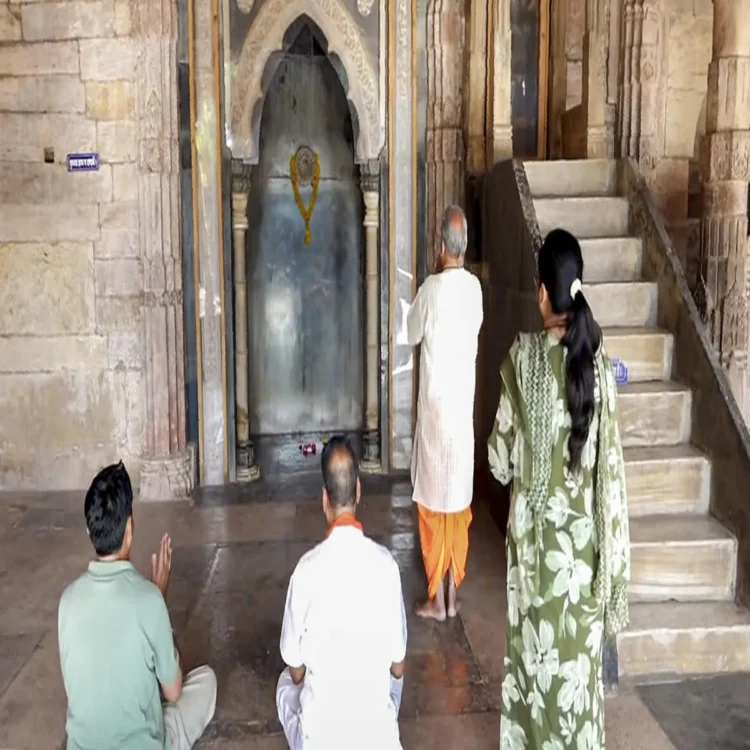
Tribute Event Held Outside Bhojshala Complex
A commemorative programme was organised near the monument premises under the banner of the Bhojshala Mukti Yajna. Organisers placed photographs of people associated with the decades-old campaign and invited devotees to pay floral tributes. The event marked the first Tuesday after the implementation of the revised worship arrangement directed by the court.
Gopal Sharma, associated with the organising committee, said the gathering was intended to honour those who had dedicated themselves to the movement concerning the Bhojshala site. According to him, participants from different regions visited the venue to offer prayers and remember those connected to the campaign.
Daily Worship Begins Under New Arrangement
The recent High Court ruling has brought a major change to the management of religious activities at the protected monument. Under the latest Archaeological Survey of India guidelines framed after the judgment, Hindu devotees are now allowed to perform prayers at the site every day from sunrise to sunset.
Previously, a 2003 arrangement regulated access to the complex by permitting Hindu worship only on Tuesdays for limited hours, while members of the Muslim community were allowed to offer namaz on Fridays. The revised structure has now replaced that earlier system.
From early morning on Tuesday, a significant number of devotees gathered at the Bhojshala premises. Authorities and volunteers managed the movement of visitors as people entered the complex for prayers and religious observances.
Religious Programmes Draw Devotees
Special devotional activities were also organised as part of the long-running “Tuesday Satyagraha” associated with the Bhoj Utsav Samiti. Participants recited Saraswati Vandana and Hanuman Chalisa during the morning programme.
Many visitors described the moment as historically important, saying the development represented the outcome of years of legal and social efforts surrounding the disputed site. Religious chants and prayer ceremonies continued throughout the morning in a peaceful atmosphere.
High Court Observations on Religious Character
In its recent judgment, the Indore Bench of the Madhya Pradesh High Court stated that the religious character of the disputed structure was that of Bhojshala, identified with a temple dedicated to Goddess Saraswati.
The court also set aside parts of the 2003 arrangement that restricted Hindu worship within the complex and permitted Muslim prayers at the location. Additionally, the judgment directed that the Union Government and the Archaeological Survey of India would oversee decisions regarding administration and management of the site.
At the same time, the court clarified that the ASI would continue to supervise preservation, conservation, and regulation of religious practices under the provisions of the ASI Act, 1958, since the monument remains a protected archaeological structure.
Matter May Reach Supreme Court
Soon after the High Court verdict, legal developments continued as caveat petitions were submitted before the Supreme Court. The petitions were filed in anticipation of a possible challenge to the ruling by parties representing the Muslim side.
One of the caveats was moved by Hindu litigant Jitendra Singh Vishen, who requested that no order be passed by the apex court without hearing his side. Another caveat petition was later filed through Advocate Vishnu Shankar Jain on behalf of a principal petitioner associated with the Hindu side in the dispute.
The Bhojshala site in Dhar has remained at the centre of legal and religious disagreement for many years, with Hindus identifying it as a temple and Muslims regarding it as a mosque. Until the recent verdict, authorities had maintained a shared arrangement for religious practices while the ASI retained supervision over the monument.