
Politics – Vijay’s TVK Shakes Tamil Nadu with Historic Electoral Breakthrough
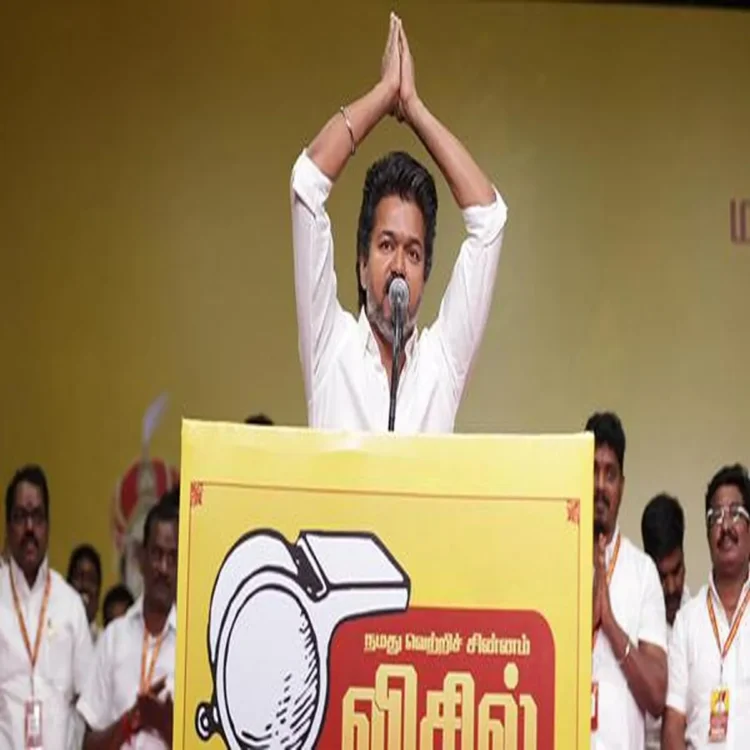
Politics – In a dramatic turn of events, Tamil Nadu’s political landscape has witnessed a major transformation as actor-turned-politician C. Joseph Vijay leads his party, Tamilaga Vettri Kazhagam (TVK), to a remarkable debut performance in the 2026 Assembly elections.
A New Force Ends Decades of Political Tradition
For nearly sixty years, Tamil Nadu politics has largely been shaped by Dravidian parties. This long-standing dominance has now been challenged as TVK emerges as a formidable contender. Despite being a newcomer, the party has secured significant public support, marking a clear shift in voter sentiment across the state.
TVK’s strong showing in its first electoral outing signals growing acceptance of alternative leadership. The party’s performance has not only surprised political observers but also redefined the competitive landscape of the state’s politics.
Short of Majority Despite Strong Performance
While the results highlight TVK’s impressive rise, the party has not yet crossed the threshold required to independently form a government. In the 234-member Assembly, a minimum of 118 seats is necessary to secure a majority. Current trends indicate that TVK is ahead in 108 constituencies, placing it just below the required mark.
Complicating matters further, Vijay has secured victories from two constituencies—Perambur and Tiruchy East. As per election rules, he must vacate one seat, reducing the party’s effective strength by one member.
Additionally, one of the elected legislators will need to assume the role of Speaker. Since the Speaker typically does not participate in voting during confidence motions unless there is a tie, this reduces the party’s active voting count once again.
Dependence on External Support Becomes Key
Taking these factors into account, TVK will need the support of at least a dozen additional legislators to comfortably demonstrate a majority in the Assembly. This makes post-election alliances and negotiations crucial for government formation.
Several smaller parties and alliances are expected to play a decisive role in this phase. The fragmented mandate has ensured that no single bloc holds overwhelming power, opening the door for strategic partnerships.
Other Parties Hold the Balance
The alliance led by the Dravida Munnetra Kazhagam (DMK) has secured a mixed outcome. Within this grouping, the Congress has won six seats, while the Communist Party of India (CPI) and Communist Party of India (Marxist) have secured two seats each. Other regional players, including the Indian Union Muslim League and Viduthalai Chiruthaigal Katchi, have also managed to gain representation.
On the opposing side, the AIADMK-led alliance has returned with relatively smaller numbers. Parties such as the Pattali Makkal Katchi and the Bharatiya Janata Party have won a limited number of seats. Even partial support from these groups could help TVK cross the majority mark without requiring a full coalition.
Governor’s Role in Government Formation
Attention now turns to Tamil Nadu Governor Rajendra Arelekar, who is expected to begin the formal process of government formation. He may invite Vijay to present his claim and prove majority support on the Assembly floor. Alternatively, Vijay could be asked to provide written assurances of backing from supporting legislators.
If TVK is unable to demonstrate sufficient numbers, the Governor may extend an invitation to the second-largest party, likely the DMK, to explore forming the government. In the event that no party succeeds in establishing a stable majority, the state could face President’s Rule, followed by fresh elections within six months.
A Defining Moment for Tamil Nadu Politics
The 2026 election outcome marks a turning point in Tamil Nadu’s political history. While the final shape of the government remains uncertain, the emergence of TVK has clearly disrupted traditional power structures and introduced a new phase of political competition in the state.