
Politics – Rajya Sabha Sees Major Shift After AAP MPs Join BJP
Politics – A significant political development has altered the balance of power in the Rajya Sabha, after seven Members of Parliament from the Aam Aadmi Party (AAP) formally aligned with the Bharatiya Janata Party (BJP). The decision was approved by Rajya Sabha Chairman CP Radhakrishnan on Monday, reducing AAP’s presence in the Upper House from ten members to just three, while strengthening the BJP’s numbers considerably.
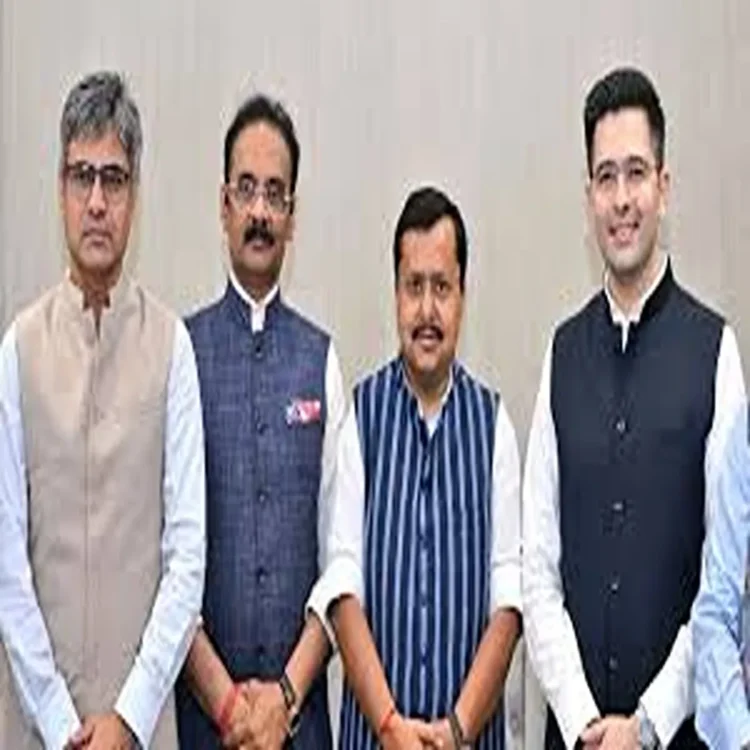
Senior Leaders Lead the Transition
The shift was led by prominent figures including Raghav Chadha, Sandeep Pathak, and Ashok Mittal. The leaders met BJP President Nitin Nabin to complete the process of joining the party. Other MPs who moved include Harbhajan Singh, Swati Maliwal, Vikramjit Singh Sahney, and Rajinder Gupta.
Those who switched sides pointed to growing dissatisfaction within their former party. They described an internal environment that, in their view, no longer reflected the original values of transparency and anti-corruption on which AAP was built. According to their statements, this disconnect played a central role in their decision to leave.
Legal Grounds Behind the Move
The group of seven MPs has relied on provisions within the Tenth Schedule of the Constitution to justify their action. By reaching the required two-thirds threshold, they argue that their shift qualifies as a legitimate merger, which protects them from disqualification under the Anti-Defection Law.
This legal framework allows a faction of legislators to merge with another party if a sufficient number agree to the move. In this case, the MPs maintain that they have complied with all necessary conditions to make the transition valid under parliamentary rules.
AAP Challenges the Legitimacy
The Aam Aadmi Party has strongly opposed the development and has taken formal steps to contest it. The party has submitted a petition to the Rajya Sabha Chairman, calling for the immediate disqualification of the seven MPs.
Senior AAP leader Sanjay Singh criticized the move, describing it as a violation of constitutional principles and a breach of public trust. He also alleged that external pressure may have influenced the decision, though no independent confirmation of such claims has been presented.
AAP has further argued that a merger cannot be considered valid without the approval of the party’s organizational structure, not just its legislative members. The party believes that the current situation does not meet that requirement and has indicated it may approach the Supreme Court for further legal review.
Impact on Rajya Sabha Numbers
The development has significantly changed the numerical dynamics in the 245-member Rajya Sabha. With the BJP’s tally rising to 113 seats, the party is now in a much stronger position. When combined with its allies in the National Democratic Alliance (NDA), the bloc’s strength reaches 141, bringing it closer to a working majority.
This shift is expected to influence legislative proceedings, potentially making it easier for the government to pass key bills without substantial opposition resistance.
AAP Faces Organizational Setback
For the Aam Aadmi Party, the loss represents a major setback at the national level. Several of the departing MPs were considered influential figures within the party and played important roles in its expansion beyond Delhi, particularly in Punjab.
With only three members remaining in the Rajya Sabha—Sanjay Singh, ND Gupta, and Balbir Singh Seechewal—the party’s ability to assert itself in the Upper House has been significantly reduced. The situation marks one of the most challenging phases for AAP since its formation, raising questions about its internal cohesion and future strategy.
The political and legal implications of this development are likely to unfold in the coming weeks, especially if the matter reaches the judiciary. For now, the episode has reshaped parliamentary equations and intensified the ongoing contest between major political forces in the country.