
Politics – Rahul Gandhi Criticises Ram Madhav Over US Remarks Controversy
Politics – Congress leader Rahul Gandhi on Saturday strongly criticised senior Rashtriya Swayamsevak Sangh (RSS) figure Ram Madhav following his remarks at a policy discussion in the United States. Gandhi described the comments as revealing the organisation’s underlying mindset and questioned its stance on nationalism.
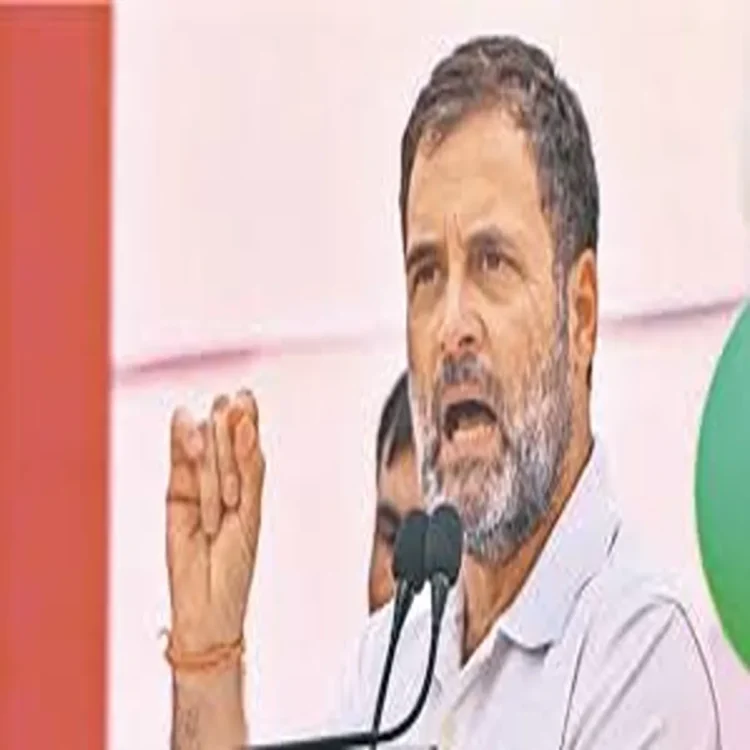
Gandhi Responds Sharply to Remarks Abroad
Taking to social media, Gandhi accused the RSS of projecting what he termed as inconsistent positions in India and overseas. He used sharp language to allege that the organisation presents one narrative domestically while adopting a different tone internationally. His criticism came shortly after Madhav participated in a high-level panel discussion in Washington, D.C.
Gandhi’s comments quickly gained attention online, adding a political dimension to what began as a policy discussion on international relations.
Panel Discussion Sparks Debate
The controversy stems from a session held at the Hudson Institute’s New India Conference, where Ram Madhav shared the मंच with policy experts, including Kurt Campbell and Elizabeth Threlkeld. The discussion focused on evolving ties between India and the United States and explored areas of cooperation such as trade and energy.
During the exchange, Madhav suggested that India had taken several steps aligning with US expectations, including decisions related to oil imports and trade tariffs. He raised a question about what more India could do to strengthen ties with Washington, pointing to these examples as evidence of cooperation.
Statement Draws Criticism and Clarification
Soon after the event, Madhav’s remarks faced criticism, particularly regarding his claims about India’s oil imports from Russia and Iran, as well as tariff-related issues. Observers and political leaders questioned the accuracy of these statements.
In response, Madhav issued a public clarification acknowledging errors in his earlier comments. He stated that India had not agreed to stop importing oil from Russia and had, in fact, opposed the imposition of a 50 percent tariff. He explained that his remarks were intended as a limited counterpoint during the discussion but admitted they were factually incorrect. He also offered an apology for the confusion caused.
Government Position on Energy Security
Amid the debate, government sources reiterated that India remains in a stable position regarding its energy requirements. Officials indicated that the country maintains adequate reserves of crude oil, petroleum products, and liquefied petroleum gas.
They also noted that India has diversified its supply sources over time to reduce dependency on any single region. In the event of disruptions, alternative supply routes and partners are available to ensure continuity.
Oil Imports and Strategic Routes
Data shared by sources highlights a significant shift in India’s oil import patterns in recent years. Since 2022, imports from Russia have increased substantially. While Russia accounted for a very small share of India’s total crude imports earlier, recent figures show a notable rise, with a significant portion of imports now coming from Russian suppliers.
Additionally, a large share of India’s crude oil passes through the Strait of Hormuz, making it a critical route for energy supplies. The remaining imports are sourced from various other regions, reflecting a strategy aimed at maintaining supply stability through diversification.
Political Reactions Continue
The exchange between Gandhi and Madhav underscores how international discussions can quickly become part of domestic political discourse. While Madhav has clarified his remarks, the issue continues to draw reactions from political leaders and analysts, particularly regarding how India’s global positioning is presented on international platforms.
As debates around foreign policy and economic decisions intensify, such incidents highlight the sensitivity surrounding India’s strategic choices and the importance of accurate representation in global forums.