
Politics – Owaisi Questions Congress Role in Partition, Targets Rivals
Politics – AIMIM president Asaduddin Owaisi on Sunday stirred political debate by questioning the long-standing narrative around India’s Partition, arguing that Muslims alone should not be blamed for the events of 1947. Speaking at a public gathering in Gujarat’s Limbayat area, he pointed to historical accounts to suggest that the responsibility was more complex and involved multiple political actors, including the Congress party.
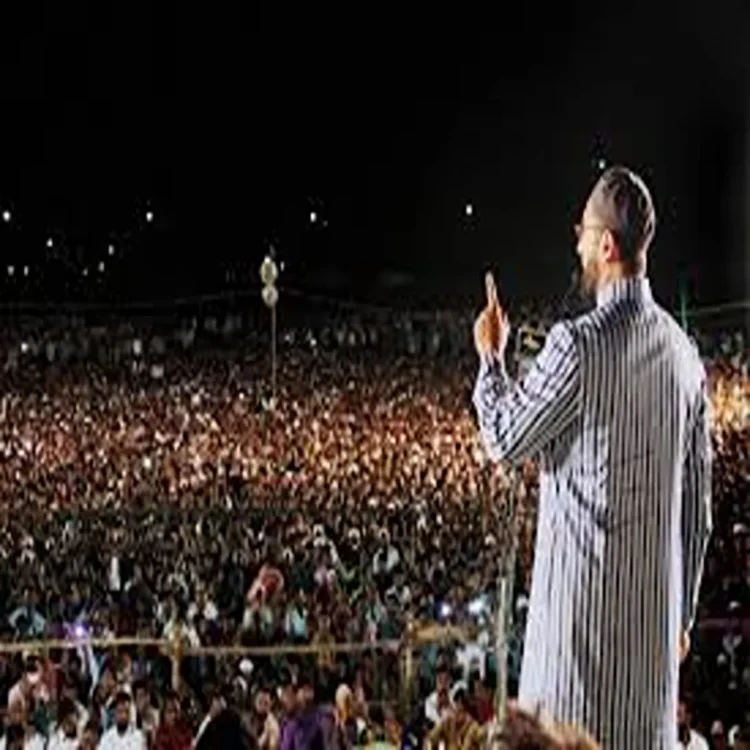
Remarks on Partition and Historical Responsibility
During his address, Owaisi cited the writings of Maulana Abul Kalam Azad, India’s first Education Minister, to support his position. Referring to Azad’s book, he said that efforts were made to prevent the division of the country and that key leaders of the time were approached with appeals against Partition. According to Owaisi, such historical records indicate that it is inaccurate to assign blame solely to one community.
He emphasized that discussions around Partition should be grounded in documented history rather than political narratives that single out specific groups. His remarks appeared aimed at reshaping public understanding of the period while also addressing contemporary political discourse.
Response to Allegations in West Bengal
Owaisi also responded sharply to criticism from rival parties, particularly in West Bengal, where his party plans to contest a limited number of seats. Both the Congress and the Trinamool Congress have previously accused AIMIM of indirectly benefiting the Bharatiya Janata Party by dividing votes.
Rejecting these claims, Owaisi questioned why his party’s participation in elections should be seen as problematic when larger parties contest across the state. He argued that democratic participation should not be restricted and called on critics to focus on their own electoral performance instead of targeting smaller parties.
Assertion of Independent Political Space
Highlighting AIMIM’s political stance, Owaisi presented his party as an independent force that seeks to operate strictly within constitutional boundaries. He stated that his party aims to challenge policies it disagrees with while advocating for the rights of marginalized communities through legal and democratic means.
He urged supporters to take an active role in shaping leadership within their communities, suggesting that political representation should evolve naturally rather than being influenced by external narratives. His speech reflected an effort to position AIMIM as a serious contender rather than a peripheral player in national politics.
Criticism of TMC Leadership in Bengal
Earlier, while addressing a rally in Asansol, Owaisi directed criticism at the Trinamool Congress and West Bengal Chief Minister Mamata Banerjee. He alleged that the growing strength of the BJP in the state could be attributed to governance failures and political decisions made by the ruling party.
Owaisi argued that the impact of policies affecting constitutional values and minority communities was not limited to one political party. He suggested that regional leadership must also be held accountable for conditions on the ground.
Concerns Over Development in Minority Areas
In his speech, Owaisi raised concerns about the state of infrastructure and public services in areas with significant minority populations in West Bengal. He claimed that several such regions lack adequate access to basic facilities, including education and healthcare.
He pointed to issues such as insufficient hospital resources, lack of clean drinking water, and limited agricultural support for farmers. He also highlighted the challenges faced by women in these areas, describing them as among the most affected by gaps in development.
Broader Political Implications
Owaisi’s remarks come at a time when political competition is intensifying across several states. His statements reflect ongoing efforts by smaller parties to carve out space in a landscape dominated by larger national and regional players.
By revisiting historical debates and addressing current governance issues, Owaisi appears to be positioning his party as both a voice of dissent and an advocate for underrepresented communities. Whether this approach will translate into electoral gains remains to be seen, but it has certainly added a new dimension to the political conversation.