
Archaeology – Ancient Telugu Inscription Unearthed in Nallamala Reveals Temple Land Grant
Archaeology – An important archaeological discovery has brought to light an 11th-century Telugu inscription found deep inside the Nallamala Reserve Forest, offering fresh evidence of medieval temple administration and land donations in present-day Andhra Pradesh.
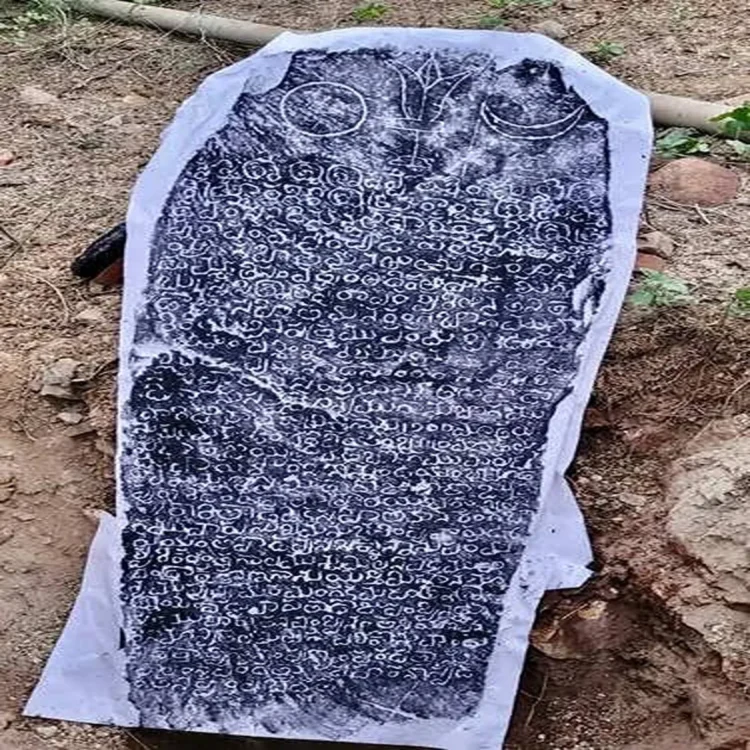
An inscription believed to be around 900 years old has been identified near Sathakodu village in the Yerragondapalem region during a field survey carried out by the Epigraphy Branch of the Archaeological Survey of India (ASI). The stone record, engraved in early Telugu script, provides valuable historical details about religious practices and land grants made during the rule of the Chalukyas of Kalyani.
Survey Leads to Significant Historical Discovery
The inscription was documented during a recent epigraphical exploration undertaken by the ASI’s Mysuru Epigraphy Branch. After examining the stone record, ASI Director (Epigraphy) K. Munirathnam Reddy successfully deciphered its contents and linked it to the Chalukyas of Kalyani, a prominent medieval dynasty that ruled large parts of southern India.
According to the findings, the inscription belongs to Chalukya Vikrama Year 42, which corresponds to Saka 1043, or 1121 CE. Experts say the record offers valuable insight into local governance, temple management, and agricultural land distribution during that period.
Details of the Recorded Land Donation
The inscription states that an individual identified as Bhimisetty donated agricultural land to support regular worship at the temple of Sathakodu Devara. The grant included four mattars of irrigated farmland along with ten matlu of land located under the irrigation tank of Pullalacheruvu.
Researchers believe such donations played an important role in maintaining temple activities and ensuring the continuous performance of religious rituals. The inscription serves as direct historical evidence of how land resources were allocated for religious institutions during medieval times.
ASI Explains the Historical Importance
Speaking about the discovery, ASI Director K. Munirathnam Reddy said the inscription clearly records the donation made by Bhimisetty for conducting worship at the Sathakodu Devara temple. He noted that the details mentioned in the inscription provide valuable information about historical land administration and religious endowments.
Officials also pointed out that inscriptions like these help historians reconstruct regional history with greater accuracy, especially in areas where written records from the period remain limited.
Appeal to Protect Ancient Heritage
The Archaeological Survey of India has urged local residents and visitors to remain alert whenever they encounter old stone inscriptions, sculptures, or other historical objects. According to the department, such artefacts are an irreplaceable part of India’s cultural heritage and deserve proper preservation.
K. Munirathnam Reddy appealed to the public not to damage or remove historical remains. Instead, he encouraged people to immediately inform the ASI whenever they come across inscriptions or other antiquities. He assured that the department, as the authorised agency responsible for heritage conservation, would take necessary steps to document, protect, and preserve these historically significant discoveries.
Officials believe greater public awareness and cooperation are essential for safeguarding archaeological evidence that helps preserve the country’s rich historical legacy for future generations.