
USChinaRelations – Trump and Xi Hold Key Talks During Beijing Summit
USChinaRelations – US President Donald Trump and Chinese President Xi Jinping held formal bilateral discussions in Beijing on Thursday during Trump’s two-day official visit to China, with both sides focusing on major issues shaping relations between the world’s two largest economies.
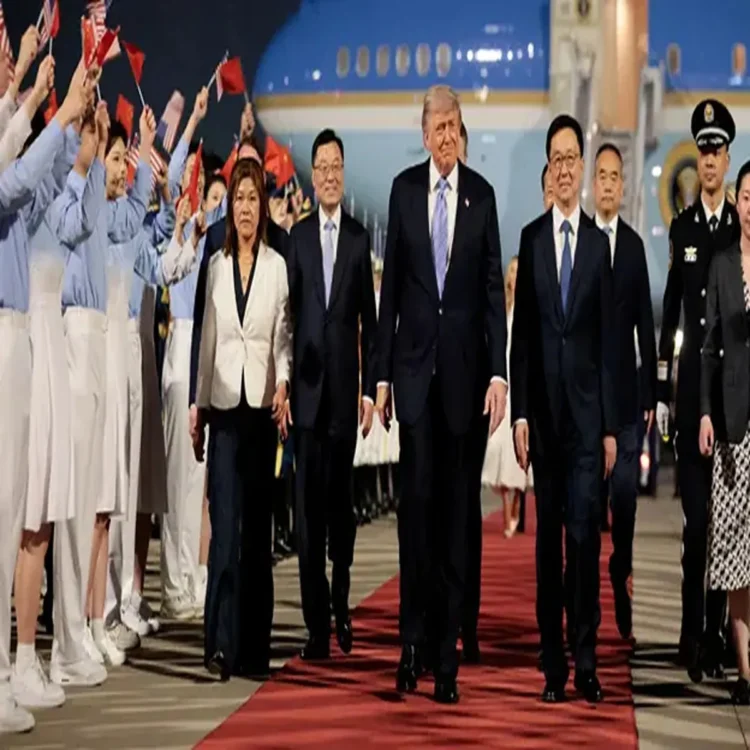
The meeting began after an official reception ceremony at Beijing’s Great Hall of the People, where Xi welcomed Trump with full state honours. The visit has drawn international attention as Washington and Beijing continue to navigate disagreements over trade policies, technology competition, and regional security concerns.
Formal Welcome Marks Beginning of High-Level Engagement
The two leaders greeted each other with a handshake before entering closed-door discussions alongside senior officials from both governments. Trump later met members of the Chinese leadership team, while also introducing his own delegation to Xi.
Among the American officials accompanying Trump were US Secretary of State Marco Rubio and Secretary of War Pete Hegseth. The visit included a ceremonial guard of honour presented by the People’s Liberation Army Honour Guard Battalion, reflecting the diplomatic significance attached to the summit by Chinese authorities.
Officials from both countries described the talks as an important opportunity to maintain communication channels between Washington and Beijing at a time when several sensitive issues continue to test bilateral ties.
Focus on Trade, Technology and Regional Stability
Although detailed outcomes of the discussions were not immediately released, the meeting is expected to address long-standing disputes involving trade regulations, access to advanced technologies, and security developments across the Asia-Pacific region.
Relations between the United States and China have remained under close scrutiny in recent years due to disagreements involving tariffs, semiconductor restrictions, military activity in the South China Sea, and broader geopolitical competition.
Analysts have noted that continued dialogue between the two leaders may help reduce tensions and maintain stability in international markets, particularly as both economies play a major role in global trade and investment flows.
Trump’s First China State Visit Since 2017
Trump arrived in China on Wednesday and was welcomed by Chinese Vice President Han Zheng at the airport. US Ambassador to China David Perdue was also present during the arrival ceremony.
The trip marks Trump’s first state visit to China since his previous visit in 2017. It is also one of the most closely watched diplomatic engagements between the two countries since Trump and Xi last met in person during a summit in Busan, South Korea, in October last year.
A formal state banquet in honour of the US President was scheduled to take place later on Thursday evening as part of the official visit programme.
China Reiterates Position on Sensitive Issues
Ahead of Trump’s arrival, China’s Embassy in the United States publicly restated Beijing’s stance on several core issues linked to China-US relations. In a statement shared on social media platform X, the embassy said there are “four red lines” that should not be challenged during the visit.
According to the statement, those issues include Taiwan, democracy and human rights matters, political systems and governance models, and China’s right to development.
The message highlighted the continuing differences between the two countries on matters that Beijing considers central to its national interests and sovereignty.
International Attention on Future Relations
The Beijing summit is being closely monitored by governments, investors, and international observers looking for signals about the future direction of US-China relations. Any progress in diplomatic engagement could influence economic cooperation, regional security discussions, and broader global political dynamics.
While major policy differences remain unresolved, both sides have continued to emphasise the importance of maintaining direct communication between their leadership teams in order to manage competition and avoid further escalation in tensions.