
Geopolitics – Xi’s Pyongyang Visit Signals Shifting Northeast Asian Alliances
Geopolitics – China’s recent diplomatic engagement with North Korea has highlighted significant changes in the political landscape of Northeast Asia. Chinese President Xi Jinping’s visit to Pyongyang on June 8–9 underscored the growing importance of ties among China, North Korea, and Russia, while also suggesting a notable shift in Beijing’s approach toward North Korea’s nuclear status.
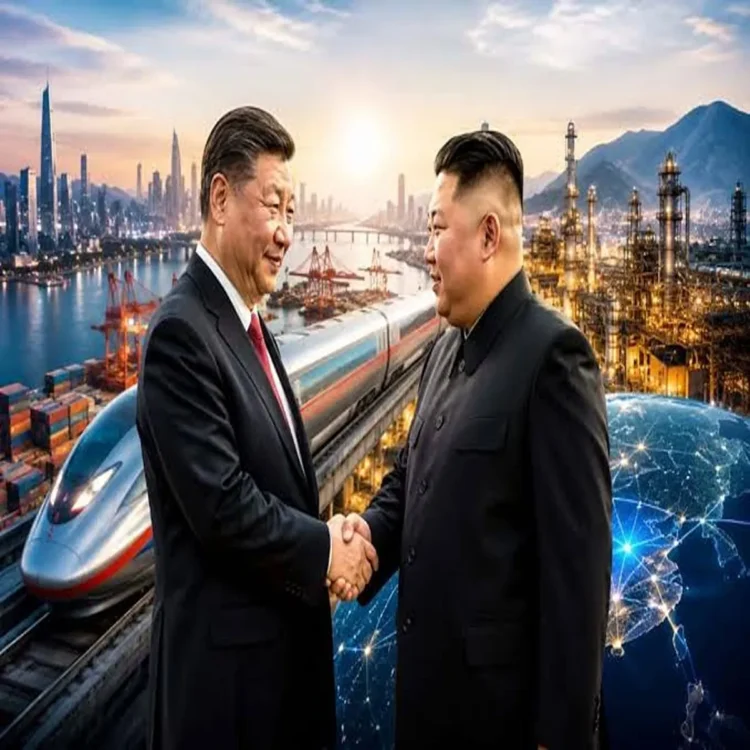
The visit marked Xi’s first trip to North Korea in seven years. North Korean leader Kim Jong-un welcomed the Chinese president with exceptional ceremony, reflecting the continued importance of bilateral relations. State media in both countries emphasized the longstanding friendship between Beijing and Pyongyang, often describing their partnership as one built on deep historical and strategic foundations.
Growing Cooperation Among Regional Powers
Recent months have witnessed a series of high-profile exchanges involving China, Russia, and North Korea. Kim’s attendance at a major military parade in China in 2025 brought him together publicly with both Xi Jinping and Russian President Vladimir Putin. Shortly afterward, North Korea hosted senior officials from China and Russia during a military display in Pyongyang that featured advanced missile systems.
These developments have fueled discussion among analysts about whether denuclearisation remains a central objective in China’s policy toward North Korea. Unlike previous years, Beijing has largely avoided public calls for North Korea to abandon its nuclear program.
China Seeks to Preserve Influence
Although North Korea continues to depend heavily on China for economic support, Russia’s influence in Pyongyang has expanded in recent years. North Korea’s military cooperation with Moscow, particularly in relation to the conflict in Ukraine, has strengthened ties between the two countries.
Against this backdrop, Xi’s visit appeared aimed at reinforcing China’s role as North Korea’s most important strategic partner. During meetings, both leaders stressed their shared interests and highlighted the importance of maintaining close coordination amid growing uncertainty in global affairs.
The Chinese delegation included several of Beijing’s most senior officials, demonstrating the significance attached to the visit. For Kim, hosting the leader of the world’s second-largest economy provided an opportunity to showcase North Korea’s diplomatic relevance despite ongoing international sanctions.
Historical Ties Remain Central
Relations between China and North Korea date back to 1949 and were further strengthened during the Korean War. During Xi’s visit, both leaders paid tribute to Chinese soldiers who fought in the conflict by visiting a memorial site dedicated to their sacrifices.
The relationship, however, has not always been smooth. China’s decision to establish diplomatic relations with South Korea in 1992 created tensions with Pyongyang. Later, Beijing supported United Nations sanctions following North Korea’s first nuclear test in 2006, leading to additional strains.
Despite these disagreements, diplomatic engagement resumed in the late 2010s through a series of meetings between Xi and Kim. Although the COVID-19 pandemic temporarily disrupted trade and cross-border exchanges, cooperation has since recovered.
A New Approach to North Korea’s Nuclear Program
Many experts now believe China has adjusted its position regarding North Korea’s nuclear capabilities. Analysts note that recent Chinese statements have avoided references to denuclearisation, a contrast to Beijing’s previous diplomatic language.
According to several observers, North Korea has increasingly embedded its nuclear strategy into state policy and long-term national planning. This has led some experts to conclude that Beijing is adapting to the reality of a nuclear-armed North Korea rather than attempting to reverse it.
The closer alignment among China, Russia, and North Korea has also contributed to broader changes in regional security dynamics. Russia’s growing military cooperation with Pyongyang, combined with China’s diplomatic support, has strengthened North Korea’s international position.
Strategic Interests Drive Beijing’s Policy
One of China’s primary concerns remains stability on the Korean Peninsula. Chinese policymakers have long viewed North Korea as an important buffer separating China from US military forces stationed in South Korea.
Beijing remains cautious about any scenario that could lead to instability or the collapse of the North Korean government. Chinese leaders are particularly wary of a unified Korean Peninsula closely aligned with Washington.
At the same time, China continues to compete with Russia for influence in Pyongyang. This rivalry has reduced the likelihood of either country exerting significant pressure on Kim Jong-un’s government.
Regional Balance Continues to Evolve
Xi Jinping’s visit highlighted how Northeast Asia’s strategic landscape is evolving. As China, Russia, and North Korea deepen cooperation, longstanding assumptions about regional security are being reassessed.
While differences among the three countries remain, their expanding collaboration reflects a broader realignment of political and security interests. The visit demonstrated that North Korea is no longer viewed solely through the lens of denuclearisation but increasingly as a key participant in an emerging regional partnership