
Stocks – South Korea’s Market Rally Pushes Trading Activity to Historic Levels
Stocks – South Korea’s benchmark stock market witnessed unprecedented trading activity in May as investor demand for technology and artificial intelligence-linked companies continued to fuel a powerful rally across the country’s financial markets.
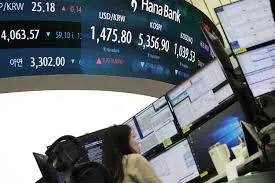
South Korea’s main stock index, the Korea Composite Stock Price Index (KOSPI), recorded average daily transactions of 48.05 trillion won during the first 22 trading days of May, according to figures released by the Korea Exchange on Monday. The amount represents the highest monthly trading average ever recorded for the index.
The latest figure comfortably exceeded the previous monthly record of 32.23 trillion won set earlier this year in February, highlighting the strong momentum that has swept through the market in recent weeks.
Technology Shares Lead Market Surge
The remarkable jump in trading activity came alongside a sharp rise in the KOSPI itself, which has continued to post record performances throughout May. Investor enthusiasm surrounding artificial intelligence and semiconductor-related industries has remained one of the key forces behind the market’s advance.
Earlier this month, the KOSPI crossed the 7,000-point level for the first time on May 6. The benchmark index later climbed above the 8,000 mark during intraday trading on May 15 before pulling back slightly amid market volatility.
Despite fluctuations, the index still closed at 7,847.71 on Friday, marking a gain of nearly 19 percent compared with the end of April. Analysts said the rally reflects strong investor confidence in companies tied to future technology growth.
Samsung Electronics and SK hynix Dominate Trading
Major semiconductor companies played a central role in driving turnover higher. Trading involving Samsung Electronics Co. and SK hynix Inc. accounted for a significant portion of overall market activity during the month.
Combined daily transaction values for the two technology giants averaged 20.57 trillion won over the period, making up roughly 43 percent of the KOSPI’s total average daily trading volume.
Market observers noted that investors continue to favor companies expected to benefit from expanding global demand for AI infrastructure, memory chips, and advanced computing technologies.
Kang Dae-seung, an analyst at SK Securities, said capital has increasingly flowed into industries linked to artificial intelligence despite lingering concerns over slower economic growth worldwide.
According to Kang, investor concentration in AI-focused sectors has intensified steadily since 2023, when enthusiasm surrounding artificial intelligence investments began accelerating across global financial markets.
Manufacturing Confidence Returns to Positive Territory
Separately, South Korea’s manufacturing sector showed signs of improving sentiment after several months of weaker business confidence.
Data released Monday by the Korea Institute for Industrial Economics & Trade showed that the Professional Survey Index (PSI) for manufacturing business outlooks rose to 107 for June, compared with 95 recorded for May.
A reading above 100 indicates that optimistic responses outnumber negative expectations, while figures below that level signal a more pessimistic outlook among businesses.
The latest rebound marks the first time in three months that the manufacturing confidence index has returned to positive territory. The PSI had stayed below the 100-point threshold during both April and May.
Economic Risks Still Remain
Although confidence among manufacturers has improved, analysts said uncertainty surrounding the global economy has not completely disappeared. Ongoing geopolitical tensions in the Middle East, along with concerns over slowing international demand, continue to present risks for exporters and industrial producers.
Even so, the recovery in business sentiment suggests many South Korean manufacturers expect conditions to improve in the coming months, particularly as demand for advanced technology products remains strong worldwide.
Financial experts believe market performance in the near term will likely depend on whether investor enthusiasm for AI-related industries can continue offsetting broader economic concerns.