
KOSPI – South Korean Stocks Slide as Middle East Tensions Shake Investor Confidence
KOSPI – South Korean shares recorded a steep decline on Monday as investors reacted cautiously to escalating tensions in the Middle East, leading to broad-based selling across the country’s stock market despite positive momentum seen on Wall Street at the end of last week.
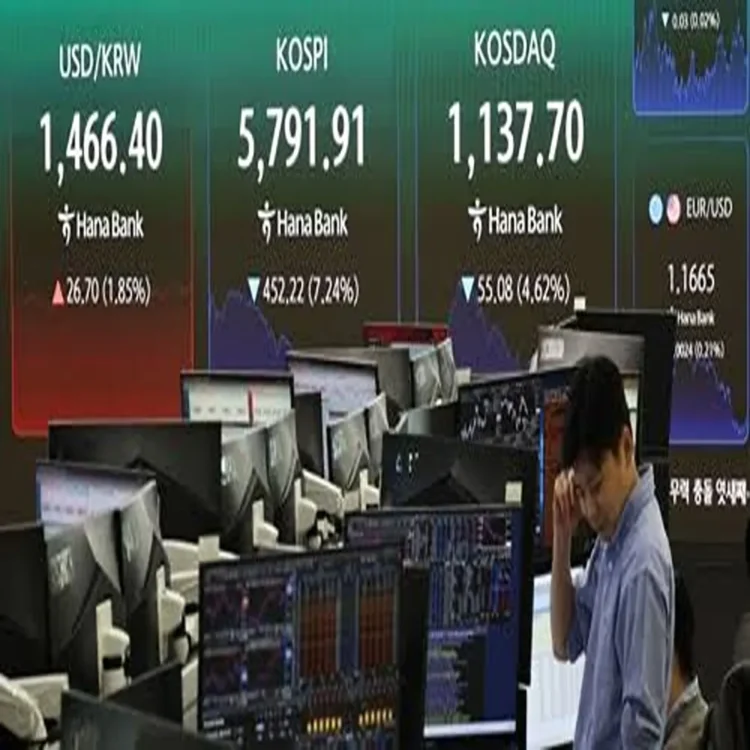
The benchmark Korea Composite Stock Price Index (KOSPI) extended its losses during late morning trading after opening sharply lower. By 11:20 a.m. local time, the index had dropped 392.53 points, or 5.25 percent, to 7,083.41. The market came under heavy pressure as investors moved away from large-cap stocks following renewed geopolitical concerns involving the United States and Iran.
Escalating Middle East Conflict Weighs on Global Markets
Investor sentiment weakened after fresh military developments in the Middle East raised concerns about regional stability. The latest tensions followed new exchanges between the United States and Iran linked to the strategic Strait of Hormuz. According to reports, the U.S. military carried out strikes against Iran on Sunday after Iran launched drone attacks targeting American allies in the region. The developments increased uncertainty across international financial markets, prompting investors to adopt a more cautious approach.
Technology Shares Lead the Market Decline
Technology companies suffered the sharpest losses on the Seoul stock exchange. Samsung Electronics, one of the market’s largest companies, declined by 5.09 percent during the session. Chipmaker SK hynix experienced an even steeper fall, with its shares dropping 9.08 percent as investors reduced exposure to semiconductor stocks amid heightened market volatility.
Other major companies also traded lower. Korean Air lost 2.24 percent, while aerospace and defense company Hanwha Aerospace slipped 1.65 percent. The broad sell-off reflected growing investor concerns over the impact of global geopolitical risks on economic and corporate performance.
Select Stocks Defy the Downward Trend
Although the overall market remained under pressure, a few companies managed to post gains. Hyundai Motor edged up 0.22 percent, while Hyundai Steel outperformed the broader market with a 4.09 percent rise. These advances, however, were not enough to offset the widespread losses across key sectors.
Foreign and Institutional Investors Increase Selling
Trading data showed strong selling activity from institutional and overseas investors. Foreign investors sold shares worth approximately 906.28 billion won, while institutional investors recorded net sales of around 501.77 billion won. In contrast, retail investors stepped in as buyers, purchasing a net 1.38 trillion won worth of stocks in an effort to absorb part of the market’s decline.
The Korean won also weakened against the U.S. dollar during the session. By late morning, the local currency was trading at 1,505.35 won per dollar, marking a decline of 6.85 won compared with the previous trading day.
Wall Street Strength Fails to Support Seoul Market
The weakness in Seoul came despite a positive finish on Wall Street last Friday. U.S. equities had advanced after investor optimism surrounding SK hynix’s multibillion-dollar American share offering. Both the Dow Jones Industrial Average and the Nasdaq Composite gained 0.29 percent, while SK hynix’s American depositary receipts closed at 168 U.S. dollars, significantly above the offering price of 149 dollars.
Market Safety Mechanism Activated
As selling intensified, South Korea’s stock exchange operator activated a sell-side sidecar for the KOSPI. The temporary market mechanism is designed to slow rapid declines by briefly restricting certain trading activities during periods of exceptional volatility. The move highlighted the intensity of selling pressure as investors responded to heightened geopolitical uncertainty and reduced exposure to major market heavyweights