
South China Sea – Chinese Coast Guard Actions Raise Fresh Maritime Tensions Near Disputed Waters
South China Sea – China and the Philippines were involved in another tense maritime confrontation near Bajo de Masinloc after Philippine authorities reported that Chinese Coast Guard vessels used water cannons and carried out risky navigation maneuvers against Philippine government ships during a routine mission on Friday.
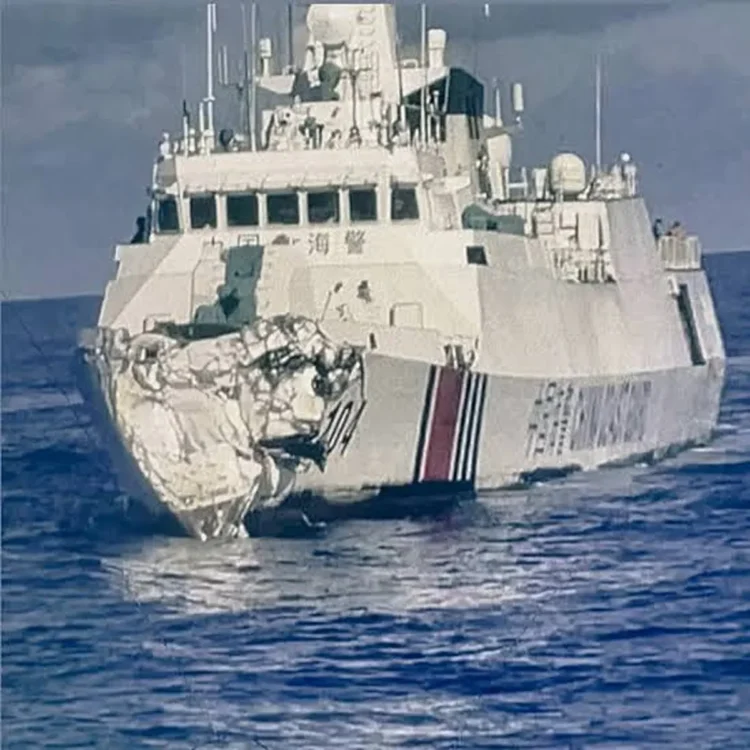
Philippine Maritime Mission Faces Multiple Incidents
According to the Philippine Coast Guard (PCG), the operation was conducted together with the Bureau of Fisheries and Aquatic Resources (BFAR) as part of the government’s Kadiwa ng Bagong Bayaning Mangingisda (KBBM) program. The initiative aims to provide fuel assistance, essential supplies, and operational support to Filipino fishermen while helping them continue fishing safely in their traditional fishing grounds.
Officials said the first incident took place at approximately 6:26 a.m. local time when a China Coast Guard vessel reportedly sprayed water at the BRP Cape San Agustin from a distance of nearly 400 meters. At the time, the Philippine vessel was carrying out a maritime patrol around 15 nautical miles northeast of Bajo de Masinloc. Philippine authorities also stated that the vessel was being followed by several Chinese Coast Guard and maritime militia ships throughout the operation.
Water Cannon Attacks Continue During Patrol
The situation reportedly became more serious around 7:35 a.m. when another Chinese Coast Guard vessel directed water cannon fire toward the BFAR ship BRP Datu Paduhinog during a routine surveillance mission. The Philippine Coast Guard said the Chinese vessel approached to within about seven meters of the Philippine ship, creating what it described as a significant danger of collision.
Authorities further alleged that the Chinese vessel had turned off its Automatic Identification System (AIS), making it difficult to identify and track while operating in the area. The Philippine Coast Guard said BRP Datu Paduhinog was directly struck by additional water cannon blasts at approximately 7:53 a.m. and again shortly after 8:00 a.m.
Following the incidents, the vessel temporarily lost satellite internet connectivity before communications were successfully restored at around 8:36 a.m.
Additional Navigation Concerns Reported
The Philippine Coast Guard also reported another incident at approximately 8:09 a.m., claiming that a Chinese maritime militia vessel dragged a rope estimated to be around 100 meters long behind the BRP Datu Sumakwel. Officials said the action created a potential hazard for safe navigation in the area.
Later, at around 8:55 a.m., another Chinese Coast Guard vessel allegedly discharged a water cannon toward the BRP Datu Cabaylo from roughly 300 meters behind the Philippine ship.
Despite the repeated encounters, Philippine authorities said all crew members remained unharmed and the mission continued as planned to support local fishermen operating in waters that Manila considers part of its lawful maritime jurisdiction.
Philippine Coast Guard Reaffirms Maritime Position
By 9:30 a.m., the Philippine Coast Guard reported observing a total of 26 vessels near Bajo de Masinloc. These included three Philippine Coast Guard ships, seven BFAR vessels, 12 China Coast Guard vessels, and three Chinese maritime militia ships.
The Philippine Coast Guard strongly criticized the reported actions, describing them as dangerous and lacking professionalism. It reiterated that Bajo de Masinloc forms part of Philippine territory and that the surrounding waters fall within the country’s territorial sea and exclusive economic zone. Officials also referred to the 2016 arbitral ruling, which recognized the area as a traditional fishing ground for Filipino fishermen.
The agency stated that it would continue carrying out maritime operations while protecting the country’s sovereign rights under international law, including the United Nations Convention on the Law of the Sea (UNCLOS), while seeking to avoid unnecessary escalation.
Quad Meeting Highlights Regional Security Focus
The latest maritime confrontation occurred only two days after the Quad Foreign Ministers’ Meeting held in Manila alongside ASEAN-related ministerial events. The meeting brought together India’s External Affairs Minister S. Jaishankar, Australia’s Foreign Minister Penny Wong, Japan’s Foreign Minister Toshimitsu Motegi, and U.S. Secretary of State Marco Rubio.
In their joint statement, the four ministers reaffirmed their commitment to promoting a free, open, and rules-based Indo-Pacific while expressing continued support for ASEAN unity and centrality. They also emphasized stronger cooperation in maritime security, regional stability, economic resilience, emerging technologies, humanitarian assistance, disaster response, and other shared priorities under the ASEAN Outlook on the Indo-Pacific.