
India-EU Trade Deal – Strategic Partnership Drives Landmark Free Trade Agreement
India-EU Trade Deal – The European Union has rejected claims that recent changes in United States trade policy were the main reason behind the progress in its proposed free trade agreement with India. EU officials said the deal was shaped by long-term political planning, commercial interests and a shared interest in strengthening cooperation between two major democratic economies.
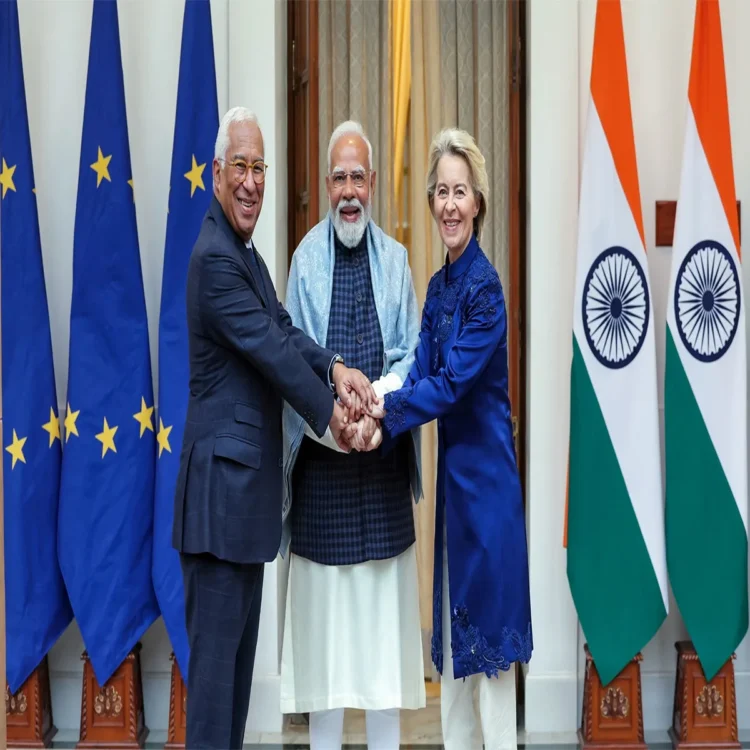
EU negotiator cites long-term economic and strategic priorities
Christophe Kiener, the European Union’s chief negotiator for the agreement, said the negotiations were not concluded because of a single development in global trade policy. Speaking at an event organised by the Peterson Institute for International Economics, he said the agreement was based on a genuine strategic and economic need for India and the EU to work more closely.
Kiener acknowledged that the global trade environment has become more uncertain in recent years. However, he said the groundwork for the India-EU trade deal had been established well before the latest tensions involving tariffs, protectionism and changing trade policies.
According to him, the agreement is part of a wider partnership covering trade, security, defence, mobility and technology. He described the proposed free trade pact as a key element of that relationship, with the potential to create meaningful commercial opportunities for businesses and exporters on both sides.
Earlier negotiations were suspended before talks resumed
India and the EU first began discussing a free trade agreement more than a decade ago. Those talks were suspended in 2013 after differences emerged over the scope and priorities of the proposed deal.
Kiener said the earlier negotiating positions of the two sides did not fully align at the time. When discussions restarted in 2022, India and the EU chose to begin with a new approach rather than relying on the old draft framework.
The renewed talks took place against a changing global backdrop. Kiener pointed to the limited progress in wider trade liberalisation through the World Trade Organization, supply-chain disruptions during the Covid-19 pandemic and the economic impact of Russia’s war in Ukraine.
These developments, he said, highlighted the importance of reliable trading partners, diversified supply chains and predictable rules for international commerce.
India says commitment existed before recent US policy changes
Darpan Jain, India’s chief negotiator for the agreement, also said the proposed pact should not be viewed mainly as a reaction to changes in US trade policy.
He noted that the European Commission leadership visited New Delhi in January 2025, when India and the EU agreed to work towards completing negotiations by the end of that year. At that point, Jain said, the new US administration had only recently assumed office and its trade policy direction had not yet taken shape.
Jain said the decision to move forward came from the growing India-EU relationship and India’s broader effort to improve market access through trade agreements.
India has completed nine free trade agreements during the past five years, according to Jain. He said the government has maintained strong political support for expanding trade links, improving conditions for Indian exporters and encouraging greater international economic engagement.
Agreement seen as a signal for rules-based trade
The proposed India-EU free trade agreement is also being viewed as important beyond its commercial value. Cecilia Malmstrom, who moderated the discussion, said the pact sends a wider geopolitical message at a time when tariffs and protectionist measures are becoming more common.
She said the agreement demonstrates that India and the European Union remain committed to transparent, open and rules-based trade. Supporters believe the deal could strengthen economic resilience while giving companies access to larger markets and more dependable supply networks.
The agreement is not yet ready to take effect. It must first undergo legal scrutiny and receive formal approval from both sides. EU officials have said they aim to sign the agreement later this year and begin implementation next year.
Indian officials have indicated that the approval process in New Delhi is expected to involve Cabinet clearance followed by presidential ratification.