
Economy – Trump Outlines Tax Cuts, Tariffs and Border Claims
Economy – President Donald Trump used his State of the Union speech to present an upbeat assessment of the country’s direction, declaring that the United States was regaining strength on multiple fronts. Addressing lawmakers on Capitol Hill, he pointed to tax reforms, trade measures, immigration enforcement and a new approach to energy costs tied to artificial intelligence as signs of progress.
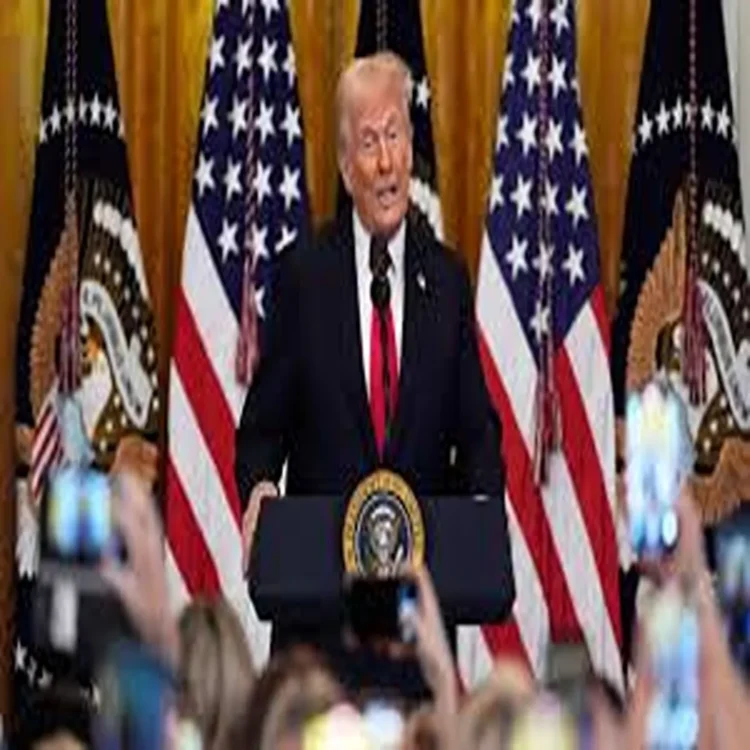
“Members of Congress, the state of our union is strong,” Trump said, framing his remarks around economic growth and national security.
Tax Relief and Economic Performance
A significant portion of the address focused on domestic economic policy. Trump described recent tax measures as the most extensive reductions in the nation’s history. He highlighted proposals to eliminate federal taxes on tips and overtime wages, as well as on Social Security benefits for senior citizens.
The president argued that these steps had strengthened household finances and supported business activity. He also cited stock market performance since the election, noting dozens of record highs, and said inflationary pressures had eased while private investment commitments had increased.
Defending his trade strategy, Trump credited tariffs as a driving force behind what he called a sharp economic turnaround. According to him, the duties imposed on foreign goods would remain in place as part of a broader plan to protect domestic industries. He further suggested that tariff revenues, paid by overseas exporters, could eventually reduce reliance on income taxes.
Border Security and Immigration Policy
Immigration featured prominently in the address, with Trump taking a firm stance on border enforcement. He asserted that the United States now has the most secure border in its history and claimed that no undocumented migrants had been admitted over the past nine months.
The president urged Congress to take action against so-called sanctuary cities, which limit cooperation with federal immigration authorities. He also called for passage of the “Save America Act,” legislation he said would prevent non-citizens and other unauthorized individuals from voting in federal elections.
Trump emphasized the need for stricter voter verification standards, arguing that identification and proof of citizenship should be mandatory requirements at polling stations nationwide.
Artificial Intelligence and Energy Costs
Turning to technology and infrastructure, Trump addressed concerns about rising electricity demand from artificial intelligence data centers. With AI systems requiring large-scale computing power, he acknowledged that some Americans worry about potential increases in household utility bills.
To address this, the president announced what he described as a newly negotiated “Rate Payer Protection Pledge.” Under the plan, technology companies operating energy-intensive facilities would be required to secure and finance their own power supply, ensuring that residential customers are shielded from higher costs.
Trump characterized the proposal as an unprecedented approach aimed at balancing innovation with consumer protection. The measure comes as AI development accelerates across industries, increasing demand for reliable and affordable electricity.
Anti-Fraud Initiative
In addition to economic and border issues, Trump introduced a nationwide campaign targeting government waste and fraud. He said Vice President J.D. Vance would oversee the effort, with the goal of identifying inefficiencies and improper spending.
According to the president, recovering misused funds could help restore fiscal balance. He suggested that substantial savings might make it possible to achieve a balanced federal budget more quickly than anticipated.
Implications for International Partners
Trump’s comments on tariffs are being closely followed abroad, particularly in countries with significant trade ties to the United States. India, for example, has previously faced trade tensions with Washington over steel, aluminium and market access. Any expansion of tariff policies could have consequences for exporters and bilateral trade discussions.
The emphasis on artificial intelligence and energy infrastructure also carries global relevance. Nations such as India are rapidly expanding their data center capacity and investing in AI technologies while managing rising power demand. Policies that reshape energy costs and digital infrastructure in the United States could influence broader trends in global technology markets.