
SubmarineMissiles – Navy Begins Search for Long-Range Strike Weapon
SubmarineMissiles – The Indian Navy has set in motion plans to equip its conventional submarines with submarine-launched land attack cruise missiles capable of precision strikes against targets on shore.-
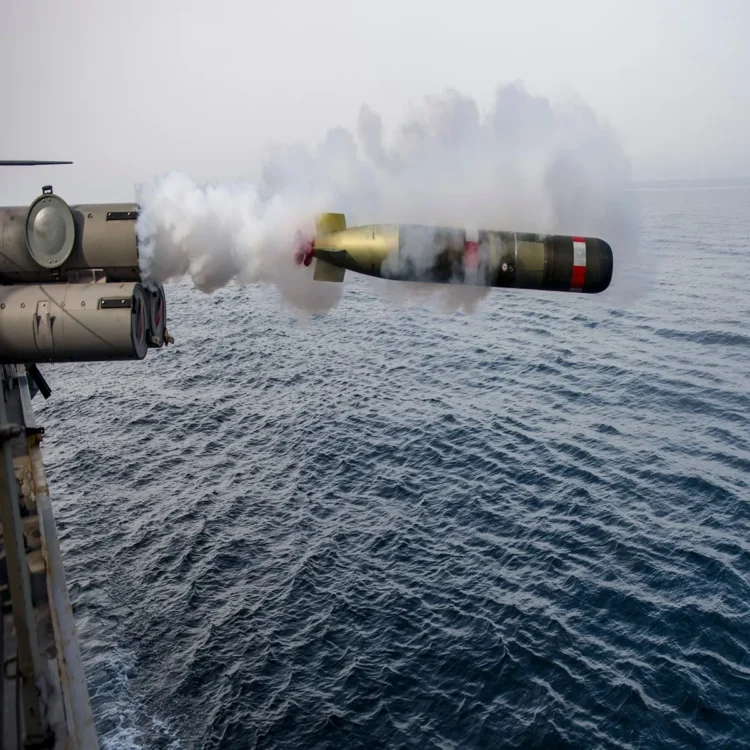
The move follows a recent Request for Information (RFI) issued by the Ministry of Defence, inviting responses from industry for missiles designed to hit land-based targets at distances starting from 50 kilometres and extending beyond 500 kilometres. According to the document, the proposed missile must deliver high accuracy and remain effective in challenging operational environments.
Technical Specifications and Operational Needs
The Navy has specified that the missile should be compatible with the standard 533 mm torpedo tubes installed on its existing conventional submarines. The overall weight, including the launch capsule, must remain under 1,500 kilograms. Officials have indicated that compatibility with current platforms is essential to avoid extensive modifications to the fleet.
The RFI outlines the need for a system capable of operating in contested conditions, including scenarios where GPS signals may be disrupted. It calls for advanced features such as terrain-following capability, waypoint navigation, and anti-jamming technology to ensure survivability and precision during flight.
This initial request marks the early stage of the acquisition cycle. If the proposal advances, it will proceed to Acceptance of Necessity and later move into a formal tendering process before any contract is finalized.
Addressing a Capability Gap
At present, India’s conventional submarines are equipped with anti-ship cruise missiles such as the Russian-origin Klub system and the SM39 Exocet, both primarily intended for maritime strike missions. While these weapons provide significant sea-denial capabilities, they do not offer a dedicated land-attack option.
The planned acquisition is intended to bridge that gap by enabling submarines to conduct long-range strikes against strategic land targets. Defence analysts note that such a capability enhances deterrence and expands operational flexibility without exposing surface assets.
Regional developments have also underscored the importance of this capability. Pakistan has previously tested the Babur-3 submarine-launched cruise missile, reportedly with a range of around 450 kilometres. Meanwhile, China deploys submarine-launched cruise missiles such as the YJ-18, largely configured for anti-ship roles, across its expanding submarine fleet. The Indian Navy’s initiative reflects broader efforts to maintain credible deterrence in the region.
Indigenous Programme Progresses in Parallel
Alongside the external procurement process, the Defence Research and Development Organisation is advancing work on a homegrown submarine-launched cruise missile programme derived from the Nirbhay platform.
The indigenous missile, designed in both land-attack and anti-ship variants, underwent a developmental trial from an underwater platform in February 2023. During the test, it covered a distance of approximately 402 kilometres. The trial focused on validating key underwater launch mechanisms, including wing deployment after breaching the surface and engine ignition during flight.
Officials familiar with the programme say the system is being tailored for compatibility with the Navy’s Sindhughosh (Kilo)-class and Kalvari-class submarines. Future platforms, including those planned under Project-75I and the proposed nuclear-powered attack submarine initiative under Project 76, are also being considered during development. The objective is to maintain a common launch architecture across multiple submarine classes rather than creating separate configurations.
Design and Timeline Expectations
Sources indicate that the indigenous missile is expected to be lighter than the original Nirbhay system. It is projected to cruise at subsonic speeds and carry a payload of roughly 250 kilograms, with options including penetration-cum-blast and airburst warheads.
The navigation system is likely to combine inertial and satellite guidance during the mid-course phase, followed by terminal guidance through an RF seeker. The design uses a two-stage configuration, beginning with a solid rocket booster for launch and transitioning to a turbofan engine for sustained cruise flight.
Development timelines suggest that the missile could be ready for induction around 2028 or 2029, subject to successful trials and certification. Officials have also indicated that integration with future submarines will depend on platform-specific validation once development milestones are met.
Together, the Navy’s acquisition initiative and the parallel indigenous effort signal a sustained push to strengthen long-range strike capabilities beneath the sea, reinforcing India’s evolving maritime strategy.