
Budget – Owaisi Questions Minority Education Provisions in Parliament
Budget – All India Majlis-e-Ittehad-ul-Muslimeen chief and Hyderabad MP Asaduddin Owaisi on Wednesday voiced strong reservations over the Union Budget while speaking in the Lok Sabha, arguing that it does not adequately address the educational and welfare needs of minority communities.
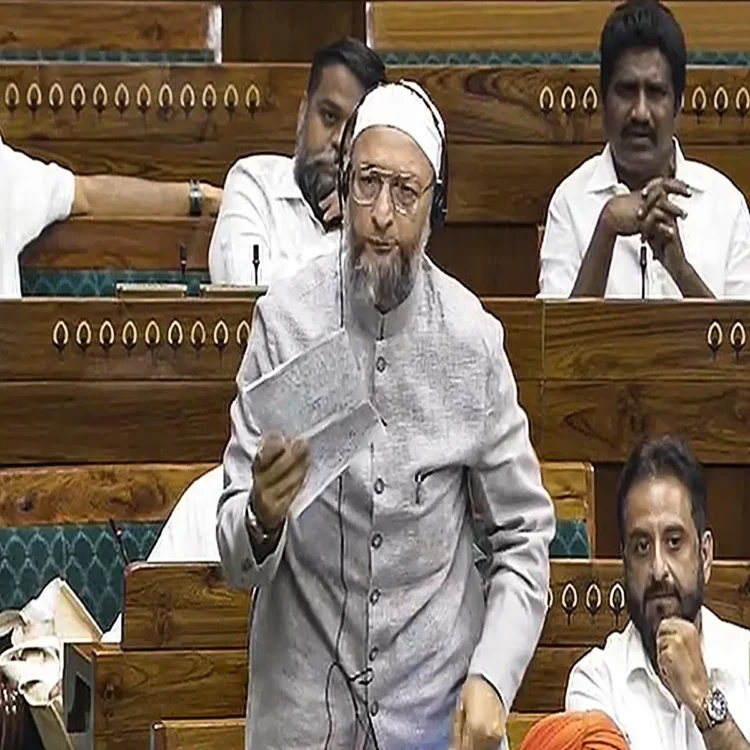
In his address to the House, Owaisi cited official data to support his concerns about declining enrollment among Muslim students as they progress through the education system.
Enrollment Figures Highlight Downward Trend
Referring to data from the Unified District Information System for Education (UDISE) for 2021-22, Owaisi said Muslim student enrollment stands at 15 percent at the primary level. However, the share drops to 14 percent in upper primary, 12 percent in secondary, and 10 percent at the higher secondary stage.
He pointed out that this steady fall reflects a five-percentage-point decline from primary to higher secondary levels. According to him, the figures indicate structural challenges that require targeted intervention.
Owaisi also quoted statistics from the All India Survey on Higher Education (AISHE). He noted that Muslim participation in higher education was 4.87 percent in 2016-17, rose to 5.45 percent in 2019-20, and then declined to 4.64 percent in 2020-21. The dip, he said, translates into a reduction of nearly 1.79 lakh students compared with the previous year.
Allegations of Policy Neglect
During the debate, the AIMIM leader alleged that government policies have not adequately addressed dropout rates among Muslim students. He argued that educational setbacks are linked to insufficient institutional support and delayed decisions on scholarship programs.
Owaisi claimed that three scholarship schemes have not received approval from the Cabinet Committee on Economic Affairs for the past five years. According to him, the lack of clearance has adversely affected students who depend on such assistance to continue their studies.
He further stated that inclusive development requires the empowerment of all communities, particularly in education and employment. “A developed India cannot be achieved without ensuring equal opportunities,” he told the House.
Call to Reinstate Fellowship Scheme
Owaisi urged the government to reinstate the Maulana Azad National Fellowship, which previously supported students from minority communities pursuing higher studies. He questioned the current structure of the pre-matric scholarship scheme, noting that assistance now begins at Classes 9 and 10.
Pointing to state-level data, he said dropout rates among Muslim students are 23 percent in West Bengal and 30 percent in Assam. He argued that early-stage financial and academic support is critical to preventing students from leaving school prematurely.
Trade Policy Also Draws Criticism
Apart from domestic policy matters, Owaisi also addressed international trade concerns. He criticised a recent executive order signed by US President Donald Trump that proposes a 25 percent tariff on Indian imports if India purchases Russian oil, directly or indirectly.
Calling the move an affront to India’s sovereignty, Owaisi questioned why the government had not issued a stronger response. He maintained that decisions on energy imports should remain a matter of national interest and independent policy.
The Hyderabad MP further expressed apprehension about ongoing trade discussions with the European Union. He warned that certain trade terms could expose domestic industries to competitive pressures that may lead to de-industrialisation if adequate safeguards are not in place.
Broader Debate on Inclusive Growth
Owaisi’s remarks formed part of a broader parliamentary debate on the Union Budget, where several members from different parties raised sector-specific concerns. His intervention focused primarily on education equity, scholarship funding, and economic sovereignty.
The government has not yet issued a detailed response to the specific claims made during the debate. However, the discussion underscores continuing political disagreement over how budgetary allocations should address social inclusion and economic resilience.
Sabha debate, Minority education, UDISE data, AISHE report, Scholarships, Maulana Azad National Fellowship, US trade policy,