
Basant Panchami: Peaceful and Friday Namaz Observed at Dhar’s Disputed Complex
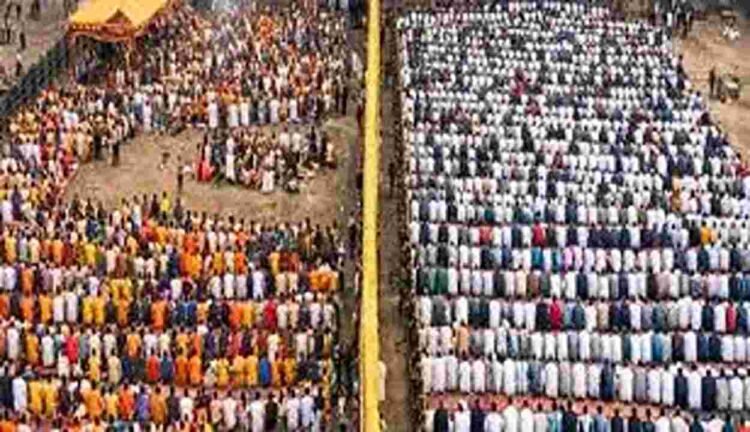
Basant Panchami: The historically sensitive Bhojshala–Kamal Maula complex in Dhar, Madhya Pradesh, witnessed a calm and orderly observance of Basant Panchami prayers by Hindus and Friday namaz by Muslims, following clear directions from the Supreme Court. Despite the rare coincidence of Basant Panchami falling on a Friday, an event that has previously triggered unrest, the day passed without any major incident, reflecting strict administrative planning and heightened security arrangements.
Supreme Court Directions and Administrative Planning
The peaceful conduct of religious activities was the direct result of a Supreme Court order issued earlier in the week. The apex court allowed both communities to perform their respective prayers at separate and exclusive locations within the Archaeological Survey of India protected monument. Hindu devotees were permitted to offer prayers from sunrise to sunset, while Muslims were allowed to perform Friday namaz between 1 pm and 3 pm. Separate entry and exit routes were also mandated to avoid any overlap or confrontation.
Local authorities in Dhar implemented these directions meticulously. Multiple access points were created to manage the movement of thousands of Hindu devotees, while a separate, secured passage was arranged for a limited number of Muslim worshippers. Heavy police deployment and surveillance ensured that the proceedings remained peaceful throughout the day.
Large Hindu Participation on Basant Panchami
Basant Panchami holds deep religious significance for Hindus, particularly those who believe the complex to be an 11th century temple dedicated to Goddess Saraswati, built during the reign of Raja Bhoja. From early morning, large processions moved through Dhar town, culminating in prayers offered at the designated area inside the complex. Devotees remained present from sunrise to sunset, chanting prayers and participating in rituals under close administrative supervision.
Senior leaders associated with the long-running Bhojshala temple movement expressed satisfaction over the uninterrupted prayers. They publicly thanked the district administration and the state government for ensuring compliance with the court order and maintaining law and order in a highly sensitive environment.
Friday Namaz and Official Response
In line with the court’s instructions, a small group of Muslim men was escorted to the complex in protected vehicles to offer Friday namaz at the allotted location. According to senior police officials present on the ground, the prayers were conducted peacefully and without interruption during the stipulated time window.
However, controversy arose after a video circulated in which a group of local Muslim residents alleged that they were prevented from entering the premises and claimed that a symbolic or dummy namaz was arranged using people brought from outside the town. The district administration rejected these allegations, stating that the prayers were conducted with community consent and strictly as per judicial directions. The district collector declined to comment on the claims beyond reaffirming compliance with the Supreme Court order.
Political and Administrative Reactions
The Chief Minister of Madhya Pradesh praised the Dhar administration for successfully managing the situation. He highlighted that both Basant Panchami prayers and Friday namaz were conducted simultaneously yet peacefully, setting an example of administrative efficiency and adherence to constitutional principles.
Senior officials emphasized that the situation was monitored minute by minute, given the town’s history of communal tension during similar coincidences in the past. Authorities remained on high alert throughout the day, ensuring rapid response readiness.
Historical Context and Significance
The coincidence of Basant Panchami and Friday namaz after a gap of nearly ten years made this event particularly sensitive. In earlier instances, especially in 2013 and 2016, clashes had erupted despite restrictions imposed by heritage authorities. This time, with no separate directive from the Archaeological Survey of India, the Supreme Court’s order became the sole guiding framework.
The dispute over the complex remains unresolved, with Hindus viewing it as a historic temple and ancient learning center, while Muslims consider it a mosque. Friday’s peaceful observance, however, demonstrated that judicial clarity and firm administration can help maintain harmony even in long-standing disputes.