
Lalu: How the land-for-jobs case against a family with ties to 20-year-old railroad transactions, developed
Lalu: In the well-known “land-for-jobs” case, a Delhi court on Friday filed charges against Lalu Prasad, his wife Rabri Devi, and their son Tejashwi Yadav, accusing them of being members of a “criminal syndicate.”
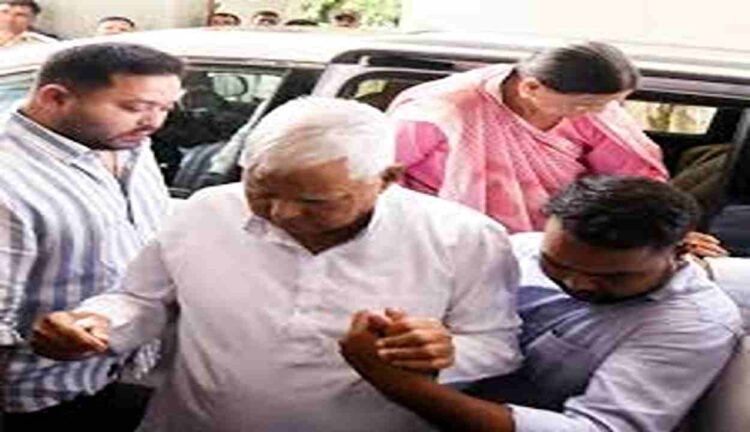
The Central Bureau of Investigation (CBI) is looking into the issue, which claims that when Lalu was Railway Minister, land tracts were given to his family in return for employment.
The alleged offense occurred between 2004 and 2009, at which time Lalu Prasad served as Union Railway Minister in Manmohan Singh’s first United Progressive Alliance government.
According to the agency’s investigation into the practice, people looking for work in the railway industry allegedly gave land to Lalu’s relatives and allies at inflated rates.
As an aside, both Lalu and Rabri served as Bihar’s chief ministers for an extensive tenure that lasted more than 10 years with sporadic pauses.
In 1997, Rabri Devi, a housewife with no political experience, was appointed Bihar’s first female chief minister when Lalu was forced to resign due to corruption allegations involving the “fodder scam.”
The three Rashtriya Janata Dal (RJD) leaders and others were charged by the CBI in the present case, alleging that Lalu “misused the Railway Ministry as a personal fiefdom to run a criminal enterprise.”
According to Rouse Avenue Court Special Judge Vishal Gogne, Lalu and his family “acted as a criminal syndicate” and used their official jobs as leverage.
With accusations of corruption, cheating, and criminal conspiracy under the Prevention of Corruption Act and IPC provisions, the court discovered prima facie evidence of a “overarching conspiracy” including Lalu and his family.
Lalu Prasad and his family members and colleagues are accused of benefiting from land parcels exchanged at nominal rates by a number of people against positions in his department between 2004 and 2009 when he served as the Union Railway Minister.
Later on, these transactions were dubbed the “land-for-jobs scam.”
The central agency filed a lawsuit against Lalu and the others and began looking into the purported swindle between 2018 and 2019.
The agency said that the positions were closely related to property deals and were awarded without due procedure.
The investigation was stepped further in 2019 when the CBI carried out searches at many sites, including homes connected to Lalu’s family.
Three years later, the CBI submitted its charge sheet against Tejashwi Yadav, Lalu Prasad, Rabri Devi, and other family members, describing how land plots were given to the Yadav family at exorbitant rates.
They were charged with criminal conspiracy, corruption, and cheating under the Prevention of Corruption Act and the then-IPC.
The next year, a Delhi court called Lalu, Rabri, Tejashwi, and others to appear before it after taking notice of the charge sheet.
The family called the lawsuit politically motivated and denied any misconduct.
The three family members were released on bond last year after their attorneys said that the lawsuit was founded on a political grudge and little evidence. However, the prosecution argued that there was unmistakable evidence of a quid pro quo between property transactions and employment.
The Yadav family’s legal responsibility as well as the political destiny of Tejashwi, the head of Bihar’s Opposition Mahagathbandhan alliance, will be decided by the result of the case, which is now scheduled for trial after formal charges were brought against them.